
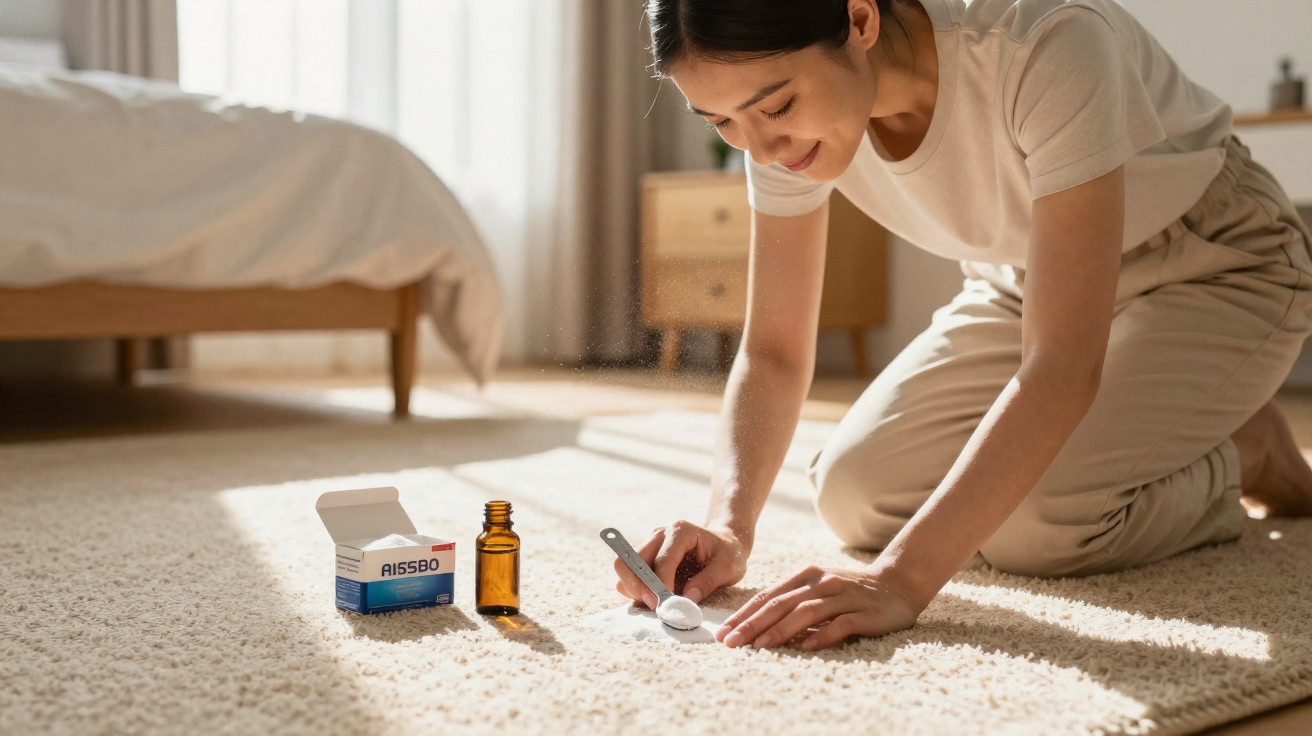
Carpets collect traces of everyday life: a wet dog, dropped wine and last winter’s boots. Professional cleaning can be expensive, while hired machines often leave the fibres damp and unhappy. A cleaning professional insists there is a milder alternative that works while you sleep, using a kitchen-cupboard staple and a few scented drops. No equipment. No foam. Just time and a vacuum the following morning.
When the house had finally fallen silent, a ceiling fan gently moved the warm air and the hallway carpet carried a faint reminder of last week’s curry. Alexis Hart, a cleaning professional with a mover’s forearms, sat cross-legged beside a glass jar and wire sieve. There was no need to hurry. She tapped the jar, sending up a fine cloud of powder, and the room seemed to breathe out as if it anticipated the relief.
Everyone knows the feeling: the floor appears to grip yesterday’s living a little too firmly. Alexis did not make a speech about it. She scattered the mixture, brushed it in and then left the room undisturbed. The lights were switched off, the door closed with a click, and the carpet simply rested. The real work takes place overnight.
Why this overnight baking soda trick works so well
Alexis says the powder is the main ingredient. Baking soda does the heavy lifting. Its fine, chalk-like grains settle into the carpet fibres and capture odour molecules from cooking, pets and footwear. Essential oils provide the supporting notes rather than doing the main job. Lavender, lemon or tea tree add a clean-smelling layer while the baking soda quietly absorbs odours.
She first used the blend during an end-of-tenancy clean. It was a narrow third-floor flat with no lift, and the carpets smelled of spicy takeaway food and damp towels. The client wanted it to smell “fresh”, rather than like a “fake hotel”. Alexis mixed baking soda with lemongrass and a small amount of tea tree, sprinkled it over the carpet and shut the door. The next morning, the landlord stepped inside, took a breath and laughed. “It smells like a new lease,” he said. It was a small success with a huge sense of relief.
The science behind it is straightforward: chemistry combined with patience. Sodium bicarbonate is amphoteric, meaning it can help move both acidic and alkaline odours towards neutral. Many smells around the home are volatile compounds seeking a surface on which to settle. The powder gives them somewhere to land. The oils add volatile top notes, including linalool from lavender and limonene from citrus, which slowly evaporate through the night. It can feel like a modest household miracle.
The cleaning pro’s overnight carpet refresh method
First, vacuum slowly to remove grit and open up the pile. Put 1 cup of baking soda and 8–12 drops of essential oil into a jar, shake it with the lid secured, then leave it for five minutes to allow the oil to distribute. Scatter the mixture lightly through a sieve or shaker, as though dusting flour rather than icing a cake. Brush it gently into the carpet in both directions. Shut the door and leave it for 6–12 hours. Go to bed and let the powder do its work.
There are a few pitfalls to avoid. Use oils sparingly: too much can leave residue or trigger a headache. Do not saturate busy walkways; a light, even coating is better than lumps. Test an inconspicuous spot first if the carpet is wool, silk, dark in colour or susceptible to marking. Keep pets out of the room overnight, as tea tree and certain other oils may irritate cats and dogs. If the weather is humid, use a fan to keep the powder dry. Realistically, this is not something anyone does every day.
When people ask whether this counts as “real cleaning”, Alexis gives a shrug. Her answer is that it is a reset, not surgery.
“Baking soda resets the room so your nose stops chasing old stories. The oils don’t fix the carpet-they fix your mood while the soda does its job.” - Alexis Hart, cleaning pro
- Ratios that work: 1 cup soda + 10 drops oil for a bedroom; 2 cups + 20 drops for a living room.
- Gentle blends: lavender + cedarwood for sleep; lemon + eucalyptus for daylight; peppermint only in small doses.
- Morning move: vacuum slowly-two passes each lane for a real lift.
- Skip for these: sisal, jute, antique rugs, or anything marked “dry clean only.”
What to expect the following morning
Open the door and smell the room before you even begin vacuuming. It should seem clearer, as though an unseen window has been opened. That flat, musty haze in the hallway is usually gone. Vacuum at an unhurried pace with overlapping strokes, and listen for the powder moving through the hose. You are removing more than fragrance: you are also lifting the dust that the baking soda has brought up. Vacuum slowly-twice.
This is not about perfume; it is about atmosphere. You may notice a faint trace of lavender or lemon as you breathe in, then nothing more. That is the intention: clean-feeling carpet without an overwhelming chemical scent. If a persistent smell remains around the dog bed or beside the sofa, repeat the process in that area the following night. Small routines work better than grand interventions. Should you find a stain while doing this, deal with it separately using the appropriate stain-removal method rather than oils.
It works so quietly because the carpet gets time without interruption. There is no foot traffic, no sudden rise in humidity from baths or cooking, and no fresh smells settling into the fibres. Give the floor a night to itself and it can seem like a different floor. The greatest benefit is not the fragrance, but the sense of calm your mind takes from the reset.
Some habits linger because they are complicated. This one lasts because it removes a household task from your list while you sleep. You may start choosing oils as you would a playlist: lavender on Sunday, lemon before visitors, cedarwood when the weather changes. Pass it on to the neighbour who has just adopted a puppy, or the friend subletting a studio with an unexplained smell. The best secrets make mornings feel easier and rooms seem as though they have breathed out. Try it once, then see whether your carpet has a different story by morning.
| Key point | Detail | Benefit for the reader |
|---|---|---|
| Dry overnight dwell | 6–12 hours with doors closed and light airflow | Maximum odour capture without effort or machines |
| Low oil, high soda | 1 cup baking soda + 8–12 drops essential oil | Fresh scent, minimal residue, wallet-friendly |
| Morning vacuum ritual | Slow, overlapping passes, two directions | Removes powder and lifts the pile for a “new” feel |
FAQ
- Will this remove stains or just odours? Primarily odours. Baking soda can neutralise smells trapped in carpet fibres. For stains, blot them first and then use a method designed for that particular stain. Oils will not remove spills, so address marks before applying the overnight powder.
- Is it safe for wool, jute or antique rugs? Wool may be suitable for a light dusting if you carry out a patch test. Jute, sisal and antique rugs are more delicate, so avoid oils and heavy applications of powder. If unsure, test a concealed area and consider calling a professional.
- Which oils work best-and which should I avoid with pets? Gentle choices include lavender, cedarwood and sweet orange. Tea tree, peppermint and eucalyptus can irritate pets. Keep animals out of the treated room until after vacuuming, and use only a minimal number of drops or leave the mixture unscented.
- How often should I do the overnight refresh? Every 2–4 weeks in living spaces, weekly in an area used by pets and before visitors arrive. Heavy use or rainy periods may justify a quick midweek refresh in one area.
- Will baking soda clog my vacuum? A reliable vacuum should cope if you work slowly. If it uses bags, replace the bag sooner than normal. With bagless machines, empty the container and tap the filters outside afterwards to maintain strong airflow.

Comments
No comments yet. Be the first to comment!
Leave a Comment