
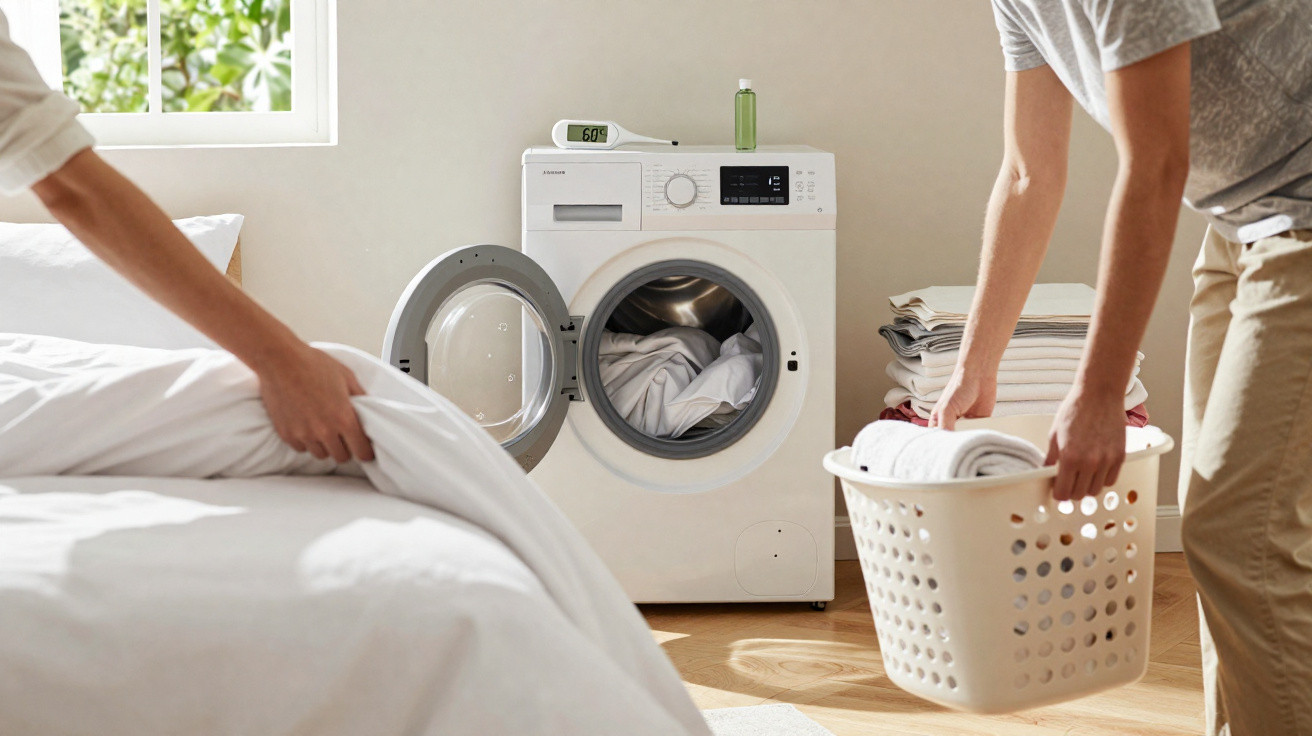
Many households rely on the “Eco 40°C” programme, expecting bedding that is clean, hygienic and energy-efficient at the same time. Bacteriologists and allergists take a far more sceptical view: their analyses indicate that, while this temperature produces a fresh smell, it does little to tackle mites and their allergens. Anyone aiming for a genuinely healthy sleeping environment needs to reconsider a few habits.
Why washing bedding at 40 degrees is so popular
Most washing machines now come with standard 30°C or 40°C cycles, often carrying an “Eco” label. They promise lower electricity use, gentle fabric care and adequate hygiene. This frequently works well enough for everyday clothes, but bedding is a different matter.
During the night, the body can lose up to one litre of fluid. Sweat, sebum, dead skin cells, pollen and dust particles all end up in the sheet fibres. Combined with body heat, they create something of a buffet for mites and certain bacteria.
“A 40-degree wash mainly delivers visual and olfactory cleanliness – not a genuinely hygienic bed.”
The issue is that 40°C is roughly body temperature with a little extra heat. For many microorganisms, this is not fatal; it is merely mildly disruptive. They are put under stress, but are far from being reliably destroyed.
What studies really show about 40 degrees
Laboratory testing with modern enzyme-based detergents shows that, in a healthy household, a 40°C programme removes a large proportion of bacteria from clean, only lightly soiled sheets – often more than 90 per cent. On paper, that sounds impressive.
However, mites behave very differently from many bacteria. According to specialists, a standard wash below 60°C removes only around 6 to 10 per cent of mites. Their droppings, which are the real allergy triggers, remain within the fibres. For people prone to allergies, this is nowhere near sufficient.
Bacteriologists stress that temperature is the only non-chemical factor capable of thoroughly cleaning textiles. Even detergents marketed with “hygiene” claims can close this gap only to a limited extent.
“40 degrees creates an illusion of hygiene: laundry smells fresh and feels soft – yet enough remains alive in the fibres to encourage allergies and irritation.”
When 60 degrees become essential
Data from various groups of experts draw a clear line: only from around 60°C, maintained for at least one hour, are mites and a large share of common household bacteria almost completely eliminated.
Medical professionals therefore describe 60°C as a type of “restoration programme” for bedding. It is not necessary for every wash, but it is clearly called for in particular circumstances.
When you should genuinely wash your bedding at 60 degrees
- When a contagious illness has recently been present in the household, such as a stomach bug, flu or a pus-forming skin infection.
- Where there is a confirmed house dust mite allergy or severe hay fever.
- If sheets have been soiled with blood, urine, faeces or vomit.
- For the bedding of young children or people needing care who have weakened immune systems.
In these situations, specialists recommend a conventional cotton or “bedding” programme at 60°C, rather than a quick-wash cycle. The drum should be filled to no more than three quarters of its capacity, allowing water and detergent to reach every area.
How often should sheets really be washed?
Everyday habits and medical guidance vary widely on this point. Many people change their bedding around once a month. Allergists consider that too infrequent.
| Situation | Recommended changing frequency | Recommended temperature |
|---|---|---|
| Healthy adults, household without allergy sufferers | Every 7–10 days | Usually 40°C, 60°C 1× per month |
| Mite allergy or asthma | Every 7 days | 60°C regularly |
| Acute infectious illness in the household | Once symptoms have passed, and more often if required | Consistently 60°C |
| Heavy sweating during the night | Every 3–7 days | Alternate between 40°C and 60°C |
Anyone who sleeps without pyjamas in summer, or sleeps in a particularly warm bedroom, should generally shorten these intervals. Pets in the bed also increase the organic load considerably.
How to sensibly combine hygiene and energy saving
Higher temperatures make many people worry about their electricity bill. Rather than rigidly defaulting to “always 40 degrees”, the answer is to use a graduated approach.
“The best routine is to wash sheets regularly, raise the temperature to 60 degrees when needed, and make deliberate use of drying and material choice.”
Practical tips for everyday life
- Do not select 60°C for every load; use it deliberately, such as once a month or in higher-risk situations.
- Use enzyme-based detergents that perform well at 40°C, and do not overdose detergent for a 60°C wash.
- Add half a cup of white household vinegar to the fabric-softener compartment; this may reduce odours and loosen residues.
- Dry sheets completely, ideally in a tumble dryer on a medium setting or outdoors in direct sunlight.
- Air the mattress regularly and turn back the bedding briefly during the day so moisture can escape.
Drying is particularly important: damp bedding in poorly ventilated rooms creates ideal conditions for mould. Anyone without a tumble dryer should dry items near an open window, on a balcony or in a courtyard where possible, rather than in small, cold rooms.
Which fabrics make sense for hygienic sheets
Not all bedding performs in the same way. Cotton is regarded as the gold standard because it can be washed at 60°C without difficulty and absorbs moisture effectively. Pure linen dries quickly and can also tolerate hot washing; it creases, but lasts a long time.
Delicate materials are more problematic, including viscose blends, silk and certain microfibre types that, according to their care labels, may be washed only at 30°C or 40°C. Those with a strong tendency towards allergies are better served by straightforward fabrics that can withstand boiling temperatures.
It is worth checking the care label before buying: choosing bedding that tolerates 60°C or more gives you greater long-term flexibility for hygienic washing routines.
What microbes in the bed can actually cause
At first, many people notice nothing. Nevertheless, the body can react. House dust mites produce microscopic pellets of droppings which, once dry, become airborne. In sensitive people, these particles can trigger sneezing fits, itchy eyes, coughing and, in extreme cases, asthma attacks.
There are also bacteria that thrive in warm, damp conditions. They usually have no consequences on healthy skin, but can worsen irritation around small wounds or eczema. Anyone who repeatedly wakes with a blocked nose or scratchy throat should consider not only pollen, but also their own bed.
What a realistic washing routine can look like
Consider a typical four-person household: two adults, two school-age children and no chronic illnesses. In this case, washing bedding every 10 days at 40°C with a good heavy-duty detergent is usually enough. Once a month, all sheets go through a 60°C cycle, ideally on a sunny day with good drying conditions.
If a stomach bug occurs, the bedding used by the affected person should go into a separate 60°C wash immediately after the illness. Towels and pyjamas should be included as well. This helps households limit infection risk without permanently washing at high temperatures.
What the “illusion of hygiene” means in everyday life
A “sea breeze” or “spring meadow” fragrance can quickly create the impression of cleanliness. Fabric softener coats the fibres like a film, masking odours and making the material drape pleasantly. For bacteria and mites, however, this plays only a minor role.
To judge whether a bed is genuinely hygienic, it is better to rely less on smell and appearance and more on facts such as temperature, wash duration, drying and the changing routine. Microorganisms respond to physical conditions, not to marketing promises on a bottle.
Why small changes to washing can have noticeable effects
Just three adjustments can make a difference: changing sheets a little more often, using a 60°C programme from time to time and drying them consistently. For most healthy people, this combination is enough to substantially reduce the risk of irritation, allergy symptoms and infections arising from the bed.
Anyone who frequently wakes feeling tired, congested and “under the weather” can try a stricter routine for four weeks: change bedding weekly, wash every second load at 60°C, avoid sleeping in bed wearing outdoor clothes, and air the bedroom thoroughly at least once a day. Changes during this period often offer a clear indication of how strongly the sleeping environment affects wellbeing.



Comments
No comments yet. Be the first to comment!
Leave a Comment