
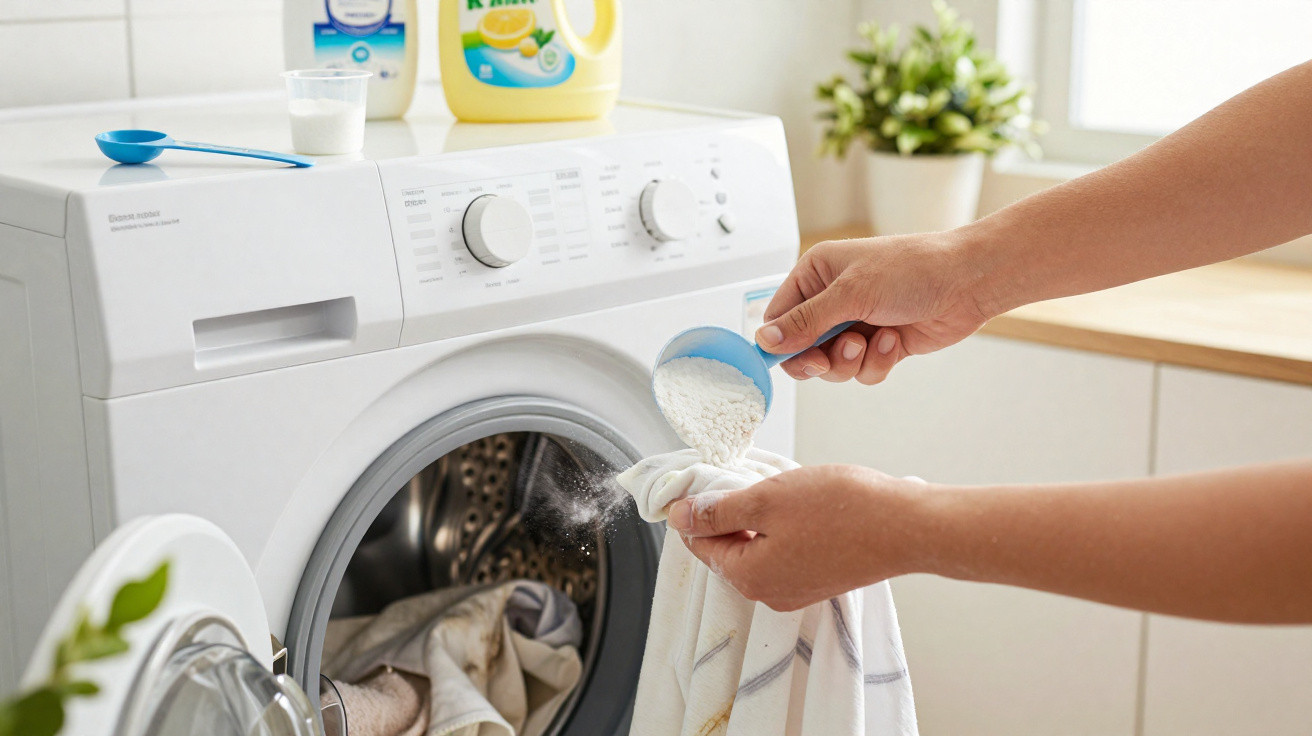
The laundry basket is overflowing, the machine beeps impatiently, and you pour in liquid detergent “by eye” without giving it much thought.
The reasoning feels obvious: more detergent means cleaner clothes, right? Then the sheets come out smelling fresh but feeling rough. Your favourite black T-shirt shows up with pale speckles. The towel, instead of plush, turns stiff-almost scratching your skin. And we blame the washer, the detergent brand, or the city’s hard water. It rarely occurs to anyone that the real culprit might be the overdoing it.
With life moving at full speed, who actually reads the detergent label before pressing “start”? Almost nobody. And that is where a quiet kind of wear-and-tear begins-damage that doesn’t show up overnight, but builds with every wash cycle, like a bill that arrives without warning.
The myth of “the more detergent, the better”
There’s a familiar scene in many homes: someone tips the bottle of liquid detergent and lets a generous stream run out, almost as if dressing a salad. Foam blooms inside the drum, the fragrance drifts through the utility area, and there’s that comforting feeling of a job well done. The problem is, this story doesn’t always end well. What looks like care can be exactly what’s slowly breaking down the fabric.
Anyone who has used a professional laundry service knows the approach is completely different. There, everything is measured in millilitres, with almost annoyingly strict accuracy. It’s not just about saving money-it’s about getting the best outcome. A laundry in São Paulo that works with hotels shared an interesting pattern: when customers wash at home, they often use double the amount listed on the label. The outcome? Towels that go hard within weeks and white items that gradually turn grey, despite being washed “with care” at home.
When you use too much detergent, it often can’t be rinsed out fully-especially in older machines or when the drum is packed too tightly. Some of it stays lodged in the fibres, creating a thin film. That layer traps grime, sweat, and even skin residue, leaving clothes looking tired even when they’ve just been washed. Over time, fibres weaken, colours fade, and fabrics feel harsher. And then the unwanted bundle deal arrives: more allergies, more stubborn odours, and more spending on products that claim to “rescue” textiles that are already compromised.
Getting the detergent amount right (without obsessing)
There’s a simple way to tell if you’re going overboard. Check the machine’s detergent area after the first agitation. If it looks like an oversized cappuccino of foam, you’ve likely used too much. Manufacturers’ guidance is fairly straightforward: for an 8 to 10 kg machine, the usual amount is around one shallow measuring cap. Not a cap filled right to the brim-the generous way many of us instinctively pour.
Another clue is how the laundry feels and smells. If a garment comes out with a strong detergent scent that seems to cling to your nose, there’s probably product left behind. Properly rinsed clothes may have only a light fragrance-or almost none at all-and still be clean. Let’s be realistic: most people aren’t weighing laundry at home every day. But you can build a practical habit, like separating “half load” and “full load” and tying each to fixed amounts written on a note stuck near the washer. That tends to work far better than relying on guesswork.
“What ruins clothes the most these days isn’t dirt-it’s too much chemical product,” said a domestic laundry worker in Belo Horizonte, used to seeing the before-and-after on all sorts of garments.
- Use the measuring cap that comes with the detergent, even if it looks insufficient at first.
- Choose an extra rinse cycle for heavy items such as towels and bedding.
- Avoid piling in powder detergent, liquid detergent, and fabric conditioner in the same wash.
- Don’t cram the drum to the limit; tightly packed laundry can’t tumble properly or rinse well.
- Try one wash with less detergent and pay attention to how the fabric feels once it’s dry.
When the “clean smell” becomes a trap
There’s an unspoken pressure for the whole home to smell fragranced all the time. Clothes, towels, sheets-everything is expected to give off that advert-style scent. But this chase for a “clean smell” has a harsh downside. Many people pour in detergent and fabric conditioner as though they’re spraying perfume into a room, rather than handling chemicals that sit directly against skin. Children’s clothes, for instance, often get even more product-almost as a protective gesture.
The result can be irritated skin, unexplained itching, and allergies that seem to come from nowhere. Then there are sports clothes, which hold sweat and bacteria. When they’re saturated with detergent, they don’t “breathe”; the fabric loses performance and the bad smell returns at first wear, as if they were never washed at all. Excess foam creates a false sense of efficiency, but in practice it gets in the way of cleaning. Some of the dirt gets trapped in the suds and ends up back on the fabric during rinsing.
There’s also the hidden cost of overdoing it. More detergent often means more rinsing, more water, more time with the machine running, and more energy. Clothing that’s attacked by too much product wears out sooner, fades faster, and loses its shape. In other words: you spend more on detergent today and more on clothes tomorrow. Somewhere in that loop, people wonder why garments “aren’t made like they used to be” or why a beloved T-shirt lasted only one season. Very often, the answer is on the laundry shelf-not in the shop.
Where your clothes go from here
Perhaps the most surprising part of all this is realising how a daily, almost automatic habit can quietly sabotage your wardrobe. Nobody wakes up thinking, “Today I’ll ruin my clothes with too much detergent.” The intention is to be careful-to be thorough-to keep everything clean, fresh, and presentable. But the rules of household chemistry don’t respond to good intentions. They work the same way every day, without making a sound.
The next wash you run can be a small experiment: less detergent, a proper rinse, and a quick check of the fabric’s feel once it’s dry. You might find the towel is softer than expected, the black T-shirt holds its colour for longer, and the sheet stops irritating your skin. You might also notice that a faint, almost discreet scent feels more like genuinely clean laundry than a heavy fragrance that fills the hallway.
These tweaks can seem tiny-almost not worth thinking about in the rush of daily life. Yet the way we care for clothes says something about how we deal with what isn’t immediately visible: wear that accumulates, and excess disguised as diligence. Half the battle is seeing the detergent bottle not as “more is better”, but as a precise tool that works best when used in measured amounts. The rest is observation, trial, and the kind of back-and-forth chat about what works in each home-something you can keep revisiting over many washes.
| Key point | Detail | Value for the reader |
|---|---|---|
| Too much detergent damages fibres | Residue forms a film, stiffens fabrics, and speeds up wear | Helps extend the lifespan of favourite clothes |
| Less foam doesn’t mean less cleaning | Effective washing depends on complete rinsing, not lots of suds | Avoids allergies, recurring odours, and disappointment with results |
| Correct dosing saves money | Cuts product use, water, and energy while maintaining the same level of cleaning | Lowers monthly costs and reduces the need to buy new clothes |
FAQ:
Question 1: How can I tell, in practice, if I’m using too much detergent in the machine?
Answer 1: Watch the foam during the wash and the smell after drying. If the washer fills with suds and the items keep a strong detergent scent, you’re using too much. Another sign is touch: fabric that feels stiff or overly perfumed often still has detergent residue.Question 2: Don’t very dirty clothes need more detergent?
Answer 2: Not always. Heavily soiled items often need a pre-wash, soaking, or targeted scrubbing, rather than extra detergent in the main cycle. Overloading detergent in these cases makes rinsing harder and can keep dirt trapped in the foam.Question 3: Is liquid detergent better than powder detergent for avoiding damage to clothes?
Answer 3: Liquid detergent usually dissolves more easily, which lowers the risk of white specks and visible residue. Even so, if you use too much, it can still leave a film on fabrics. The issue isn’t only the type-it’s the amount and whether you rinse properly.Question 4: Can I compensate by using more fabric conditioner and less detergent?
Answer 4: It’s not a good trade. Too much fabric conditioner can also stiffen towels, reduce absorbency, and trigger allergies. The best approach is to adjust both products, stick to label dosing, and prioritise a thorough rinse. Fabric conditioner doesn’t replace what detergent is meant to do.Question 5: How do I “detox” clothes that are already loaded with detergent?
Answer 5: One option is to run a wash with hot (if the fabric allows) or warm water only-no detergent or conditioner-repeating the rinse if there’s still foam. In some cases, a brief soak in water with a little white vinegar can help loosen built-up residue.






Comments
No comments yet. Be the first to comment!
Leave a Comment