
In plenty of kitchens, squeezing lemon or pouring vinegar over raw meat can feel reassuring, even though hardly anyone stops to check what the science says.
From long-held family habits to viral cooking clips, washing meat with lemon juice or vinegar has turned into a pre-cooking routine for many people. The idea is comforting: less of a “bloody” taste, meat that looks cleaner, and the feeling you have disinfected dinner using natural ingredients. Food safety authorities, however, describe a very different reality.
Why people wash meat with lemon or vinegar
Ask most home cooks and the explanations tend to repeat themselves. Some want to get rid of a metallic, bloody flavour. Others think they are removing grime from the abattoir. Many also assume the acidity in citrus or vinegar will kill harmful germs.
You see this most often with poultry and offal, though it also happens with beef and lamb. Social media pushes the habit even further: quick videos of shiny chicken pieces rubbed with lime and vinegar attract millions of views, almost never alongside any mention of food safety advice.
What feels “clean” to the eye and nose does not always match what is safest for your kitchen.
That gap between sensory reassurance and microbiological reality is what drives the disagreement.
The hidden problem: water acts like a bacteria sprinkler
Across Europe and the United States, food safety agencies are unusually consistent on one point: do not rinse raw meat under the tap, whether you add lemon or vinegar or not.
From a microbiology standpoint, the core issue is not the acid. It is the water. When running water hits meat, it ricochets and becomes a mist of tiny droplets. Those droplets can travel much further from the sink than most people assume.
How cross-contamination actually happens
- Water strikes the raw meat and splashes microscopic droplets outwards.
- Those droplets may contain bacteria such as Salmonella or Campylobacter.
- They land on nearby items: chopping boards, draining racks, utensils, washed salad leaves, even your phone.
- Later, you touch these items and move the bacteria onto ready-to-eat foods.
This sequence is called cross-contamination. You may not spot it at all. The kitchen can look spotless, smell of lemon, and still become an ideal setting for foodborne infection.
Public health authorities warn that splashes from rinsed meat can contaminate surfaces within roughly a one-metre radius of the sink.
Mixing lemon or vinegar into the rinse does not change how splashing works. Droplets still spread, and any surviving microbes can spread with them.
Does acid from lemon or vinegar really kill germs on meat?
Acid can affect bacteria, but the reality is much more complicated than many viral “tips” suggest.
Lemon juice contains citric acid, and vinegar contains acetic acid. Both reduce pH at the meat’s surface. In laboratory conditions and for some organisms, that can lower bacterial counts. In everyday home cooking, those conditions are rarely met.
| Factor | What cooks usually do | What bacteria actually need to be inactivated |
|---|---|---|
| Contact time | Quick rinse, a few seconds | Minutes to hours of exposure |
| Acid strength | Highly diluted by tap water | Precisely controlled, often stronger solutions |
| Coverage | Uneven, especially in folds and crevices | Complete and uniform surface coverage |
Pathogens including Salmonella, Campylobacter and certain strains of Escherichia coli can cope surprisingly well with brief exposure to acid. A rapid lemon rinse is unlikely to make a meaningful dent. The meat might smell fresher, but the infection risk is largely unchanged.
What actually makes meat safe: temperature, not rinsing
Food safety guidance is based on heat, not on washing rituals. Proper cooking temperatures are what inactivate dangerous microbes.
Key temperature benchmarks you can rely on
- Whole cuts of beef, pork or veal: about 63°C at the centre.
- Minced or ground meat (burgers, meatballs): at least 71°C.
- Poultry (chicken, turkey, duck): around 74–75°C at the thickest point.
When reached and held appropriately, these temperatures sharply reduce pathogens. A small digital probe thermometer-now cheap and easy to find-removes the guesswork. Judging by colour alone (such as “no pink left”) is not always a reliable safety check, particularly with minced meat.
Kitchen thermometers do far more to prevent food poisoning than any rinse, no matter how natural or traditional.
Where lemon and vinegar truly shine: marinades, not rinses
Lemon and vinegar still earn their place in meat prep-just not as a wash. Used in a marinade, they add flavour, gentle tenderising and a limited reduction in surface microbes.
Using acidic marinades safely
To keep the benefits without a false sense of security, it helps to stick to a few basics:
- Marinate meat in the fridge, not on the worktop.
- Choose a non-reactive container such as glass or food-grade plastic.
- Throw away any marinade that has been in contact with raw meat, or boil it before using it as a sauce.
- Do not treat marinade as a way to make meat safe if it will be eaten raw, such as tartare or carpaccio.
Acid softens the outer meat fibres and helps carry flavour from herbs and spices. It may reduce bacterial numbers slightly on the surface, but it does not sterilise. Cooking still has to do the final work.
How to prep meat safely without rinsing
If you are used to rinsing, stopping can feel odd at first. A straightforward routine can keep that feeling of control while avoiding splash-related risks.
A safer step-by-step routine
- Keep meat chilled until close to cooking time.
- Open the packaging over the sink or bin to minimise drips.
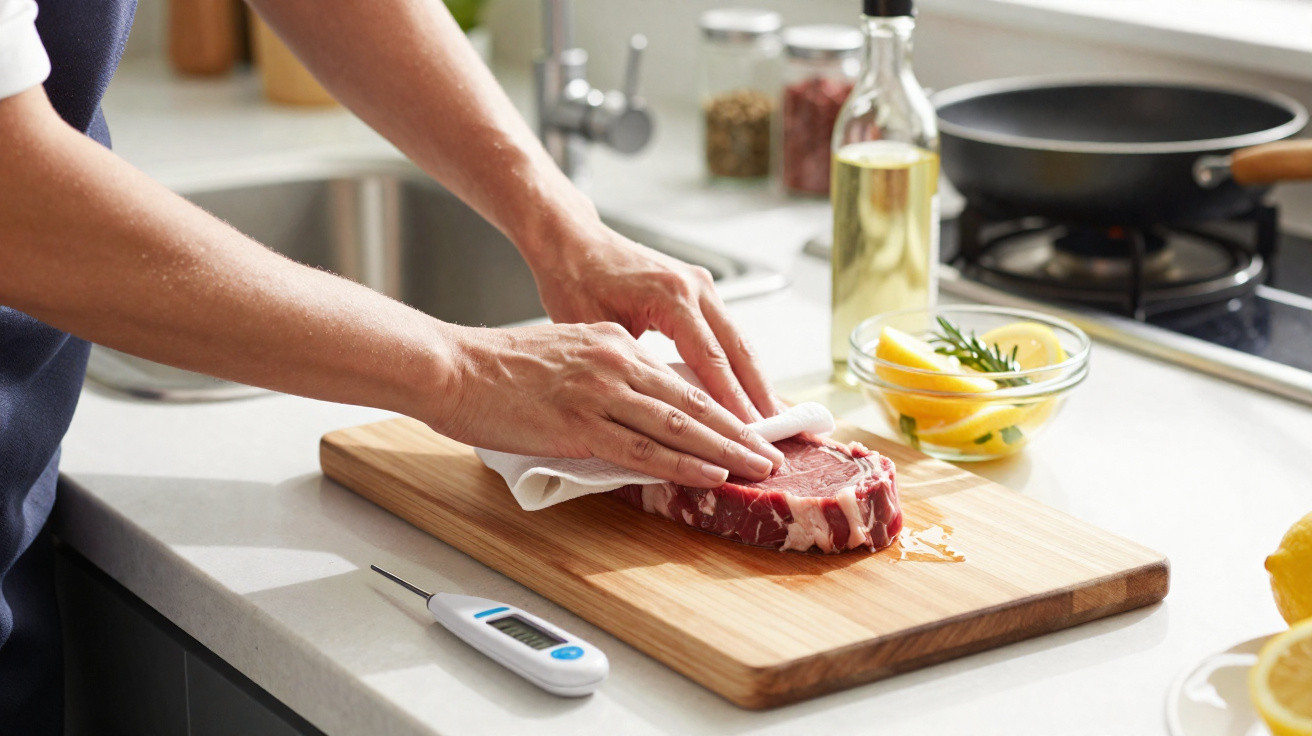
- Pat the meat dry with disposable paper towels, then bin them straight away.
- Wash hands with soap and warm water for at least 20 seconds after handling raw meat.
- Use separate boards and knives for raw meat and ready-to-eat foods such as salad or bread.
- Clean and disinfect the worktop, handles and sink area once you have finished prepping.
Drying the surface helps in another way too: it improves browning. When meat is wet, moisture has to evaporate before browning can begin, so a dried steak or chicken thigh develops a deeper, tastier crust.
A dry surface gives you both a better sear and less splashing than a wet, rinsed piece of meat.
The Maillard reaction: why a dry steak tastes better
That appealing brown crust on grilled or roasted meat comes from the Maillard reaction-a chain of chemical reactions between amino acids and natural sugars when heated. It only properly kicks in once surface moisture has gone and the temperature rises enough.
If you rinse meat and put it straight into the pan, you slow that process down. The pan’s early heat is spent turning water into steam rather than creating flavour. Patting the meat dry avoids the delay and promotes fast, even browning, boosting both texture and aroma.
Everyday scenarios where rinsing backfires
Imagine a typical Sunday roast. You wash the chicken in the sink with lemon and vinegar, feeling conscientious. Meanwhile, a bowl of salad leaves sits on the nearby worktop waiting to be dressed. Invisible droplets from the rinse settle on the leaves. The chicken is later cooked thoroughly; the salad is not. Any bacteria carried by those droplets now have a direct route to your plate.
Or consider a midweek burger night. You rinse minced beef to “clean” it before seasoning. Droplets reach the salt grinder handle, the drawer pull and the board where you later slice cheese. If the mince happens to be contaminated, that single step can spread it across much of the kitchen.
Understanding the terms: contamination and food poisoning
Two ideas are often muddled in everyday conversation: contamination and illness. Contamination simply means microbes are present on a surface or in food. Illness occurs only if enough survive and multiply, then reach your body in sufficient numbers.
Rinsing with lemon or vinegar does not remove the risk of contamination. In some cases, it can raise the risk by dispersing bacteria more widely. Thorough cooking reduces or removes living microbes; good hygiene prevents them reaching other foods in the first place.
Practical tips for families and shared kitchens
Homes with young children, pregnant people, older relatives, or anyone with a weakened immune system need extra caution. For them, a foodborne infection that might be a miserable day for a healthy adult can lead to dehydration, hospitalisation or worse.
In shared flats or student kitchens-where boards and utensils are constantly swapped-a small set of clear rules can make a big difference: do not rinse meat, keep separate boards for raw and ready-to-eat foods, and always wash hands after touching raw meat. Simple boundaries can cut down on both arguments and illness.
Food safety is less about complicated tricks and more about a handful of simple rules applied every day.
Lemon wedges and vinegar bottles still belong by the hob-just as flavour builders rather than improvised disinfectants. Thinking about them this way keeps cooking enjoyable while quietly reducing the chances that dinner sends someone to bed with more than a full stomach.




Comments
No comments yet. Be the first to comment!
Leave a Comment