
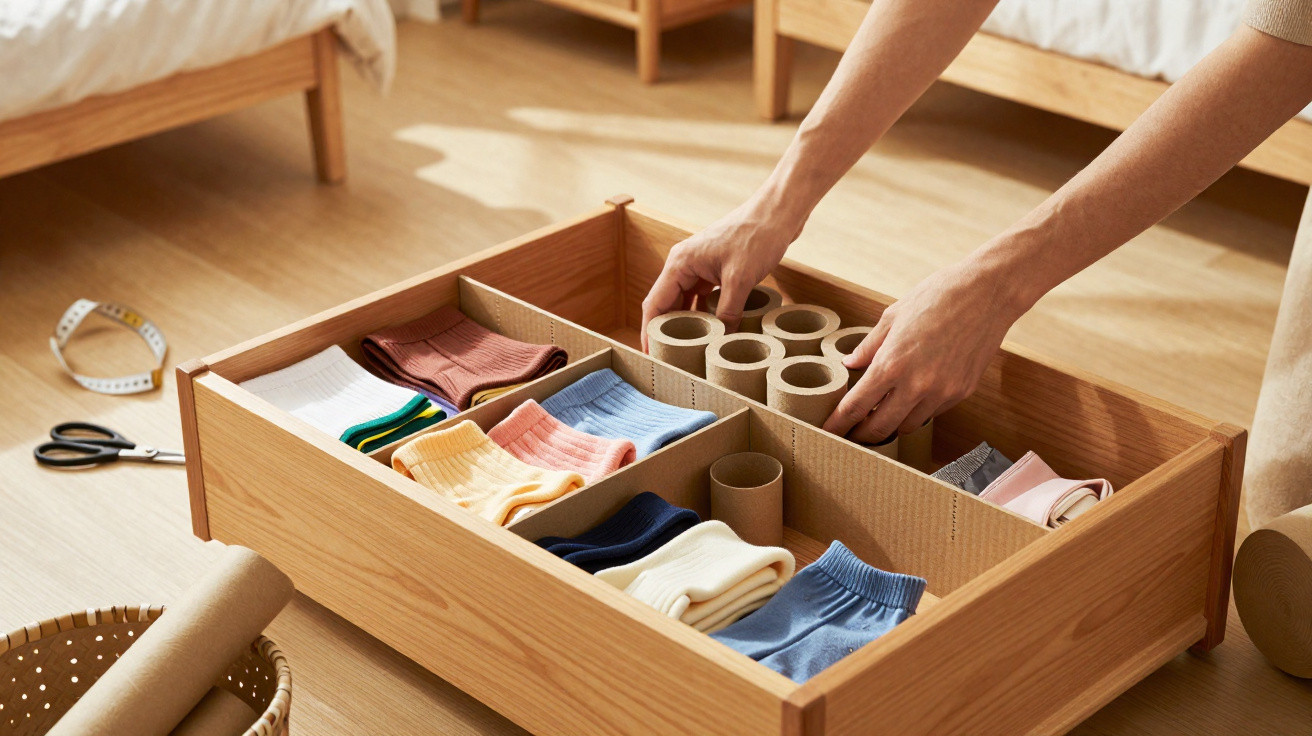
Reusing paper towel rolls as drawer dividers has become a straightforward, budget-friendly way to create more order without spending money. Drawing on Japanese organisation principles, this approach focuses on practicality, a clean look and everyday ease of upkeep. It also lets you build custom-sized compartments for all sorts of items, from underwear to office supplies.
How does Japanese organisation inspire using paper towel rolls in drawers?
Japanese-style organisation centres on giving every item a defined place and avoiding unnecessary build-up. By repurposing paper towel rolls inside drawers, you can create individual spaces for smaller belongings, stopping them from sliding together and making daily routines harder.
The method is easy to do, requires no crafting experience and can be adapted to the size of the drawer and whatever you plan to store. It is also a sustainable way to reuse materials, reflecting the Japanese habit of making the most of what you already have at home.
How do you create row dividers for socks and small items?
The first option is to turn rolls into ring-shaped sections that work as dividers arranged in rows-ideal for socks, underwear and accessories. The idea is similar to the modular organisers found in many Japanese homes, but made here with simple, reused materials.
Before you start, it helps to measure the drawer and decide how many compartments you will genuinely use, so you do not end up with too many spaces that sit empty or are awkward to fill.
- Measure the internal height of the drawer and mark the rolls, leaving them 0.5 cm shorter.
- Cut the rolls into rings of the same height using scissors or a sharp craft knife.
- Strengthen the edges with strips of kraft paper or thin cardboard to make them sturdier.
- If you want a neutral, understated finish, cover the rings with plain paper.
- Fit the rings side by side in the drawer, filling any gaps with small pieces of cardboard.
How can you make adjustable compartments with reused rolls?
The second idea uses the roll as the starting point for adjustable compartments, which are particularly handy for cables, chargers, pens or office stationery. The inspiration comes from the Japanese preference for modules that can be shifted and rearranged whenever needed.
To do this, the roll is opened up and gently flattened, creating a wider surface that better matches the size of the objects. These compartments can be lightly secured with a small amount of glue or left loose, so you can reconfigure them whenever the drawer’s contents change.
How do you build a modular grid for maximum drawer organisation?
The third approach turns the rolls into strips that slot into one another to form a modular grid with multiple sections. This structure works well for cosmetics, stationery, small tools and other items that tend to get jumbled together.
The strips are reinforced with thin cardboard and given carefully placed cuts so they can cross over and create a mesh. The grid can be made to measure for each drawer and taken apart when required, keeping the Japanese-organisation spirit of flexibility and smart use of space-without extra cost and with simple day-to-day maintenance.

Comments
No comments yet. Be the first to comment!
Leave a Comment