
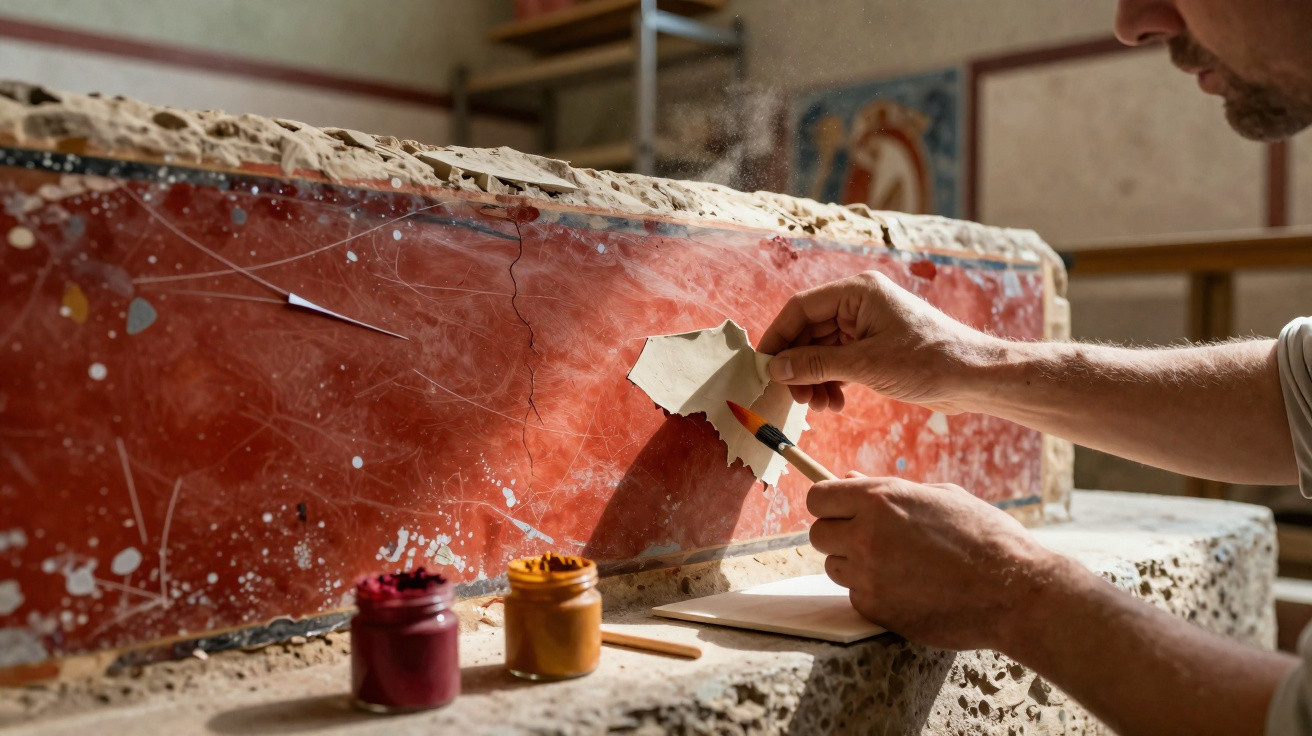
A fresh study reports that Roman painters working in a Roman house in what is now Cartagena developed an unrecorded method of layering to make expensive red pigments go further while maintaining their impact.
Rather than reading the striking murals simply as a show of money, the research suggests they reflect careful control of materials and planning.
Preservation of painting strategy
In one well-preserved room of a Roman house in today’s Cartagena, in south-eastern Spain, the red wall panels still owe their lasting appearance to the way the paint was built up in layers.
By analysing those strata, Daniel Cosano Hidalgo, a chemist at the University of Cordoba (UCO), detected a yellow foundation layer beneath the red, effectively documenting how the pigment was assembled.
The evidence indicates the red was not brushed straight onto the plaster; instead, it was produced through a managed sequence designed to deliver strong colour while keeping consumption of valuable materials in check.
This construction suggests an intentional answer to both expense and longevity, and it raises further questions about how the red finish was technically achieved.
Roman balance of wealth and efficiency
Under the room’s most sumptuous red sections lay a calculated compromise: red iron oxide combined with cinnabar, a scarce mineral that yields an intense red long valued as “red gold.”
Applied in this blended way, painters could retain cinnabar’s visual punch while reducing how much of the costly mineral they needed-an approach already known from Roman workshop practice.
Since patrons were responsible for providing cinnabar, the completed surface could still broadcast affluence even if the painters discreetly economised.
Yet price is not the whole story behind the scheme, and the layer beneath points to the craftsmen taking a longer view.
The unseen layer beneath vivid red walls
Under the brilliant red, the team identified a yellow earth pigment laid down first as a warm priming coat. That yellow layer probably acted as a buffer between the upper paint and the lime-rich wall, limiting the chemical conditions that can cause cinnabar to darken.
“Cinnabar tends to blacken when exposed to light, moisture, and caustic environments,” wrote Hidalgo and his co-authors.
With this priming step, the craftsmen were doing more than stretching supplies; they were also trying to preserve the red’s brightness over time.
Color as architectural storytelling
In other parts of the room, the palette included white lime, black charcoal, yellow ochre, green pigment, and small traces of Egyptian blue-the earliest synthetic blue pigment made by humans.
The painters mixed that blue into green passages, a tactic that could lift a muted mineral green and shift it towards a turquoise tone.
Figures representing the seasons and faux-marble panels helped the dining room-about 4.9 by 7.9 metres-read as lavish without requiring every area to be coated in premium pigments.
This wider colour programme matters because the red recipe was one element within an overall design intended to signal refinement and social standing.
Local materials to luxury surfaces
Beneath the painted finish, the wall fabric offered further evidence: four plaster coats made using stone and sand sourced nearby.
Mineral signatures in the mortar aligned with local materials around Cartagena in south-eastern Spain, indicating the painters relied largely on resources close at hand.
In the lower layers, crushed ceramic probably improved resistance to damp, while inclusions of marble fragments point to meticulous preparation rather than crude building.
The result implies the room’s elegance depended on ordinary regional materials treated with exceptional care, rather than on imported substances at every stage.
Binding color into wet plaster
The colours were also fixed using fresco technique, in which paint is applied onto wet lime plaster and becomes durable as the surface sets.
Because pigments were worked into damp plaster, many tones effectively became part of the wall, instead of sitting as a fragile layer on top.
Both paint layers still show lime, supporting the idea that the painters had planned the order of application before the plaster had time to dry.
That workflow required pace and precision, helping to explain why the approach looks like established workshop know-how rather than on-the-spot improvisation.
The blackening of cinnabar
Time also revealed the risk inherent in using bright red mineral pigments, as exposure to light and moisture can shift the colour towards darker tones.
Experimental studies of cinnabar change demonstrate that illumination, humidity, and salts can disrupt its surface chemistry and alter its appearance.
Dark speckling on some fragments from Cartagena suggests that vulnerability, although structural collapse, burial conditions, and later exposure could each have contributed.
In that context, the yellow undercoat appears less decorative and more like a protective measure against a pigment notorious for turning against painters.
Evidence of shared artistic practices
Within Roman Spain, this precise sequence for producing red seems to have been extremely uncommon, with only one close counterpart reported from Ephesus, an ancient site in western Turkey.
Interpreted in that light, the similarity to Ephesus suggests recipes may have travelled via itinerant workshops, copied instructions, or craft traditions maintained over long periods.
The Cartagena evidence also pushes local use of cinnabar later than archaeologists had previously recorded, even though the city shows signs of economic decline.
Wealth remained part of the message, but the walls now also indicate knowledge circulating across the empire.
Ancient workshop knowledge
In the same room, chemical analysis could finally be combined with excavation documentation, allowing the team to interpret decoration, supply, and technical decision-making together.
Microscopic work established the sequence of coats, while site records linked individual fragments back to panels, borders, and painted figures.
By collaborating with archaeologists from the University of Murcia, the UCO chemists were able to examine whether visual splendour reflected spending alone.
Together, the partnership turns a damaged interior into persuasive evidence for how Roman workshops organised labour, chose materials, and engineered visual results.
The engineering of visual strategy
After centuries underground, this room demonstrates that Roman painting could unite frugality, chemistry, and status into a single, carefully managed surface.
Further discoveries in Cartagena and elsewhere may clarify whether the method was a local innovation or part of a broader tradition of craft practice.



Comments
No comments yet. Be the first to comment!
Leave a Comment