
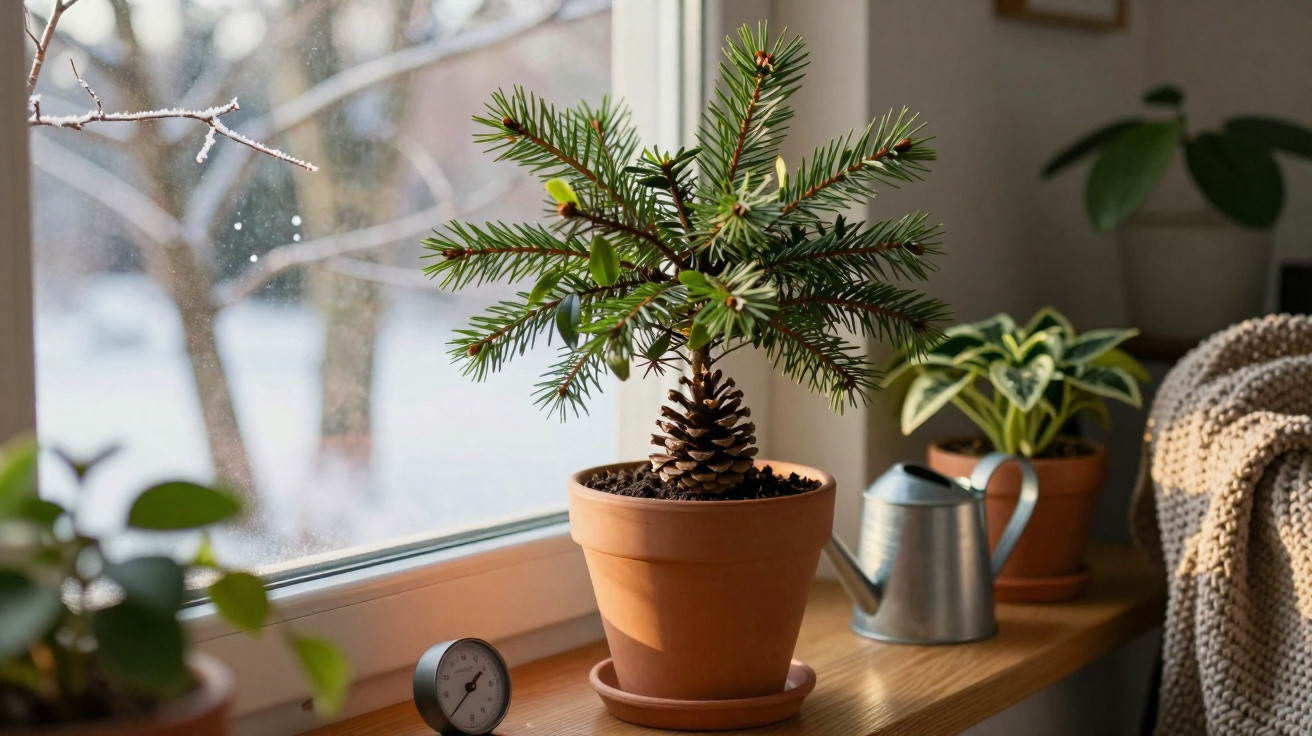
Many keen home gardeners assume that, in January, their plants are suffering from too little light or not enough water. In reality, the issue is often something else entirely: the roots are quietly being starved of oxygen in waterlogged potting compost. That is why an old gardening rule suggests placing a simple pine cone on the surface of the soil. It sounds like decoration, but it has a surprisingly practical purpose.
Why houseplants struggle so often in winter
Indoors in winter, the conditions are a long way from anything “natural”. Central heating runs, the air becomes dry, and at the same time people tend to ventilate less. For plants, that combination can be a trap.
- Heated air dries the compost surface very quickly.
- Gardeners assume from this: the plant needs water.
- Yet the compost in the middle of the pot stays damp to wet.
- Roots receive too little oxygen and start to rot.
The result is familiar: leaves turn yellow, droop, and look “limp”. Many people then instinctively add even more water, which only makes things worse. Waterlogging in the centre of the pot increases, while the surface dries again quickly and continues to give the impression that everything is too dry.
At the same time, windows tend to stay shut in winter. The air above the compost sits still. Without air movement, moisture lingers on the surface for longer-ideal conditions for mould fungi. At first you may see very little from the outside, but down in the root zone the process of root rot is already beginning.
"The real winter problem for houseplants is often not too little water, but persistently too much moisture around the roots."
The surprising role of a pine cone in a plant pot
This is exactly where the pine-cone trick comes in-something many older gardeners used to do as a matter of course. A dry pine cone is made from hard, porous wood. That material can absorb moisture from its surroundings; in other words, it has a hygroscopic effect.
When the cone sits directly on the compost, two things happen at once:
- It draws excess moisture out of the top layer of compost.
- It acts like a kind of “protective cap”, breaking up the surface and slowing down direct over-watering in that exact spot.
In practice, it works like a small, natural surface drainage aid. Mould has a harder time spreading across the compost. The white, fluffy layer that many people notice on pots in winter appears far less often. Chemical fungicides become unnecessary.
"A dry pine cone on the compost works like a free mini moisture regulator-and completely without chemicals."
The cone as a living moisture gauge
Even more interesting is another feature: the cone’s scales respond visibly to humidity. Depending on moisture levels, the cone “moves”.
Open scales: a sign of dry, well-aerated compost
If the scales are spread wide and look loose, that is a positive sign. The air above the compost is relatively dry, and the surface is as well. The plant can breathe and the risk of mould is low. In this state, the cone is effectively saying: “Everything’s fine here-no rush to water.”
Gardeners can treat an open cone as a green light-not meaning you should water immediately, but that there is currently no looming excess-moisture problem.
Closed cone: a warning of too much moisture
If, on the other hand, the pine cone closes up almost completely and looks compact and smooth, humidity is high right above the compost. That points to a very wet potting mix.
"A closed pine cone in the pot means: put the watering can away and only pick it up again once it opens."
That makes the cone more useful than any “finger in the soil” test. Instead of watering on instinct, you get a clear, always-visible signal.
How to choose and place the right cone
Suitable pine cones can be found in parks, woodland, or your own garden. A few basics are worth keeping in mind:
- Collect only dry cones that are already open.
- Avoid cones with resin residue or visible insect infestation.
- At home, give them a quick brush and leave them to dry for a few more days somewhere warm.
Once the cone is ready, place it on the compost-ideally close to the plant’s stem, but not touching it and not pressing against it. This position lets it indicate moisture at the crucial point: the transition from stem to root zone.
For large containers or long balcony troughs, it can help to use a small “cone battery”:
- 1 cone for small pots up to around 15 centimetres in diameter
- 2–3 cones for medium-sized tubs
- 4 or more cones for long planters
This makes it easier to spot different moisture zones-for example, when one side is nearer a radiator than the other.
Which plants benefit most
Plants that dislike sitting in water gain the most stability from using pine cones. This includes, for instance:
- rubber plants and other Ficus varieties
- succulents and cacti
- Monstera and other fashionable big-leaf plants
- Mediterranean container plants kept in a cool winter space
Succulents, in particular, can look dry on top while their roots are still standing in wet compost. A closed cone slows you down before you reach for the watering can.
Common winter watering mistakes-and how the cone prevents them
Three errors crop up especially often in winter:
| Mistake | Result | How the cone helps |
|---|---|---|
| Watering by the calendar | Too much water on dull, cool days | A closed cone shows: take a break |
| Watching only the dry surface | Root rot despite seemingly dry compost | The cone responds to overall moisture, not just the top layer |
| No checks after watering | Moisture builds up over several days | Changes in the cone make the trend visible |
Keeping an eye on the cone naturally encourages more mindful watering. Instead of “once a week because that’s what you do”, the actual condition of the potting compost becomes the focus.
Sustainable plant care without chemicals
This approach fits perfectly with a more environmentally conscious way of looking after houseplants. Rather than using sprays against fungal growth, you reduce the trigger-compost that stays too wet at the surface. Fungi that thrive on constantly damp potting mix lose their foundation.
At the same time, plants get through winter with less stress. Protecting roots from long-term wetness supports stronger new growth in spring. The plant does not have to spend energy repairing damaged roots and can instead put it straight into growth and bud formation.
More helpful tips for healthy houseplants in winter
A pine cone is not a substitute for good basic care-it is an addition to it. A few extra steps make the effect noticeably stronger:
- Feed far less in winter, or pause fertiliser altogether.
- Avoid placing plants directly above radiators.
- Air the room regularly with short, wide-open ventilation to shift stagnant, humid air.
- Empty saucers after watering so water cannot pool.
If you are unsure, you can also use a simple wooden stick: push it deep into the compost and pull it out again after a few minutes. If compost clings to it, the centre of the pot is still damp. In parallel, the cone shows what is happening at the surface-together they give a very clear picture.
This “natural technology” can also be used elsewhere. Pine cones have long served as a kind of sensor in cellars or larders: when they absorb moisture and close, humidity is rising. In plant care, the same principle works on a smaller scale, directly in the pot.


Comments
No comments yet. Be the first to comment!
Leave a Comment