
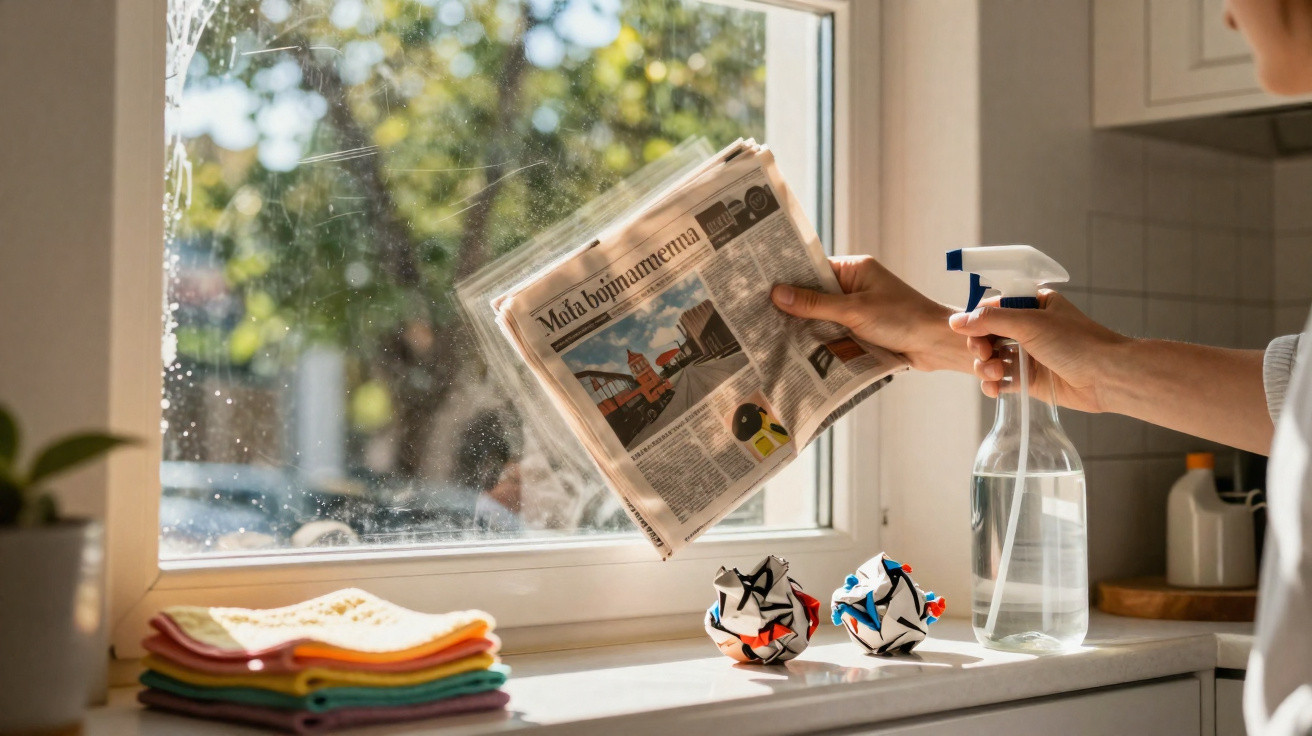
On the first bright Saturday of spring, I finally lost patience with the dull, greyish veil on my living-room windows. You know the one: it doesn’t scream “filthy”, but it wipes out any chance of a decent view. I’d even treated myself to the “good” microfibre cloths-the sort that promise hotel-lobby sparkle and a little hit of smugness. I laid them out beside a posh eco glass spray and, for a brief moment, felt like a person who had everything under control.
Fifteen minutes later I was peering at streaks I couldn’t stop noticing, tipping my head from side to side like a baffled pigeon. So I did the thing my nan would’ve cackled at me for forgetting: I dug an old newspaper out of the recycling and tried the method everyone quietly knows is best. That’s when the battle with the windows turned genuinely interesting.
The old trick you half-remember from your nan’s kitchen
If you grew up in the UK, you’ve probably watched an older relative tackle glass with yesterday’s paper while muttering about “proper ways” and “no need for all that modern nonsense”. When you’re small, it goes into the same mental folder as saving carrier bags and storing sewing bits in a biscuit tin. Then you become an adult, spend a small fortune on microfibre cloths that cost more than your childhood trainers, and still end up with smears. Through that whole cycle, the newspaper just sits there, ready to make its point-low-tech, slightly messy, and irritatingly effective.
The first time I pressed a crumpled sheet to the pane, it made a soft, papery rasp, and the sensation was oddly satisfying. No plush fibres, no colour-coded corners-just ink and rough paper getting on with it. The streak that had been taunting me for the last half hour disappeared. One pass, and none of that smear, buff, smear-again routine. I actually laughed out loud, mostly at myself for overlooking a trick that’s older than my parents’ marriage.
We’ve all had the moment where something “old-fashioned” outperforms the glossy, cleverly branded solution you were sure would be life-changing. It brings a tiny sting of embarrassment and, at the same time, a strange sense of relief. Because if newspaper still wins, perhaps the world isn’t moving quite as fast as adverts insist. Perhaps some things were already near-perfect before marketing teams turned up.
Why newspaper grips grime and microfiber just… glides
Let’s get a bit nerdy for a second, without killing the vibe. Microfibre cloths are made to be soft and finely woven, which sounds perfect on paper. But that silky feel can mean they slide across glass instead of properly grabbing dirt and oils. If you’ve ever watched a smear simply migrate a few centimetres to the left, you’ve met the problem. You rub, it moves, you rub again, your irritation grows, and eventually you blame the spray.
Newspaper is rough in exactly the helpful way. Its fibres create tiny natural edges that catch greasy fingerprints and dried raindrop marks rather than skating over them. It has enough bite to scrub without scratching, and enough stiffness to spread cleaning fluid evenly instead of pushing it into little swirls. You can feel the drag as the grime lifts, which is weirdly reassuring. It’s the difference between wiping a worktop with a tissue versus using a proper sponge-one sort of pretends, the other actually cleans.
The secret ally: ink and absorbency
There’s another advantage quietly doing its work: the ink. Modern newspaper ink is largely soy-based and sits on the surface, which makes the sheet a touch less fluffy and more compact. In practice, that turns it into a kind of semi-polishing tool that doesn’t shed fibres the way some cheap cloths do. The inked surface helps buff the glass, while the paper layers underneath drink up the moisture.
Microfibre-particularly once it’s been used a while-can get waterlogged and start dragging the same damp film around. You know that cloudy haze that refuses to vanish, no matter how often you flip the cloth? Newspaper avoids that by giving you a new “pad” every time you refold it. That constant refresh matters more than we like to admit. It isn’t magic; it’s simply absorbency and friction quietly beating high-tech promises.
Streaks aren’t dirt, they’re residue – and newspaper doesn’t baby it
A lot of what we call “streaks” isn’t leftover grime at all. It’s residue: from the spray, from the cloth, from skin oils transferred by fingers, and from earlier cleaning attempts. Microfibre has a tendency to hold on to whatever it met before-a bit of old polish, a trace of washing-up liquid, something from the last surface it wiped. Then you run that same cloth over the glass and wonder why there’s a faint film sitting under the shine. The pane is technically clean, but it looks maddening.
Newspaper arrives with no backstory. It hasn’t been dragged across bathroom tiles or the kitchen hob. It hasn’t been washed with fabric conditioner-which, if we’re honest, most people forget to avoid despite the tiny warnings on the labels. It’s a single-use tool with a single purpose. Because it’s mildly abrasive and very absorbent, it pulls up cleaning fluid and stray oils in one go instead of gently massaging them into a grey smear.
That strange matte-to-gloss moment
If you pay attention while wiping with newspaper, you’ll notice a strangely satisfying shift. For a moment the glass looks damp and matte, and then it suddenly clicks into sharp clarity. The view outside goes from milky to crisp without you hunting the same streak like a possessed perfectionist. Microfibre often muddies that moment, leaving you stuck in an “almost” zone-like a TV that’s never quite tuned correctly.
That clean “snap” isn’t just in your imagination. It’s what happens when the liquid has been lifted off, not merely redistributed. The paper doesn’t cling to leftover moisture; it pulls it away and holds it. That’s the entire trick to streak-free glass: remove everything, including the cleaner. Newspaper doesn’t treat your windows delicately-it strips them. And on glass, that’s exactly the point.
The quiet eco win you weren’t really aiming for
There’s a funny irony here. While we’re buying eco-labelled bottles and colour-coded packs of microfibre, the genuinely low-waste option is sitting beside the food caddy. Cleaning windows with newspaper is one of those accidental sustainable choices that doesn’t feel worthy or performative. You were going to recycle it anyway; now it does one last shift before it’s done. No microplastics, no synthetic fibres shedding into the water system when you wash them.
Microfibre has a hidden downside of its own. Each wash sends tiny plastic particles down the drain, and many are too small for filters to catch. Add in the constant cycle of replacing cloths once they lose their edge-or when they mysteriously disappear into the same parallel universe as odd socks-and the “reusable” story looks less perfect. Newspaper asks for none of that. It’s already here, already printed, and there’s something quietly pleasing about giving it one final job before it heads back into recycling.
This isn’t about virtue-signalling; it’s about practicality. Who genuinely keeps a special glass-only microfibre cloth, washes it separately, never uses it on anything else, and makes sure it never comes near fabric conditioner? Realistically, hardly anyone does that day in, day out. Most of us grab whatever’s closest in the drawer and hope. Newspaper dodges the planning entirely. It’s disposable by design-and for once, that works in its favour.
Why the “old ways” get written off – and why they keep coming back
Part of why newspaper-on-glass feels dated is that it isn’t aspirational. There’s no aesthetic, no slick Instagram reel of a perfectly folded broadsheet drifting over a flawless window in slow motion. It’s scrunched, it can leave your fingertips slightly inky, and it feels too basic to show off. Modern cleaning culture loves neat, branded sprays and colour-coordinated cloths arranged like skincare on a shelf. Newspaper turns up as yesterday’s headlines and simply gets the job done.
There’s also an odd embarrassment attached to “old-fashioned” methods, as though using them means you’ve given up on being modern and efficient. But those approaches didn’t last for decades on nostalgia alone. They survived because they worked in normal homes-where kids put sticky hands on windows and pets sneeze on patio doors. You can practically hear older relatives rolling their eyes at our expensive kits, and, honestly, they’ve got a point.
Every so often, the cycle swings round and we slap a new label on something familiar and call it a “hack”. Vinegar in a spray bottle becomes a breakthrough. Soap bars get reborn as “zero waste”. Newspaper on windows resurfaces in TikTok clips where people act like they’ve cracked a secret code. We’re not uncovering anything new; we’re just returning to what our grandparents did without needing a tutorial.
The feeling you get when the glass actually disappears
There’s a very particular satisfaction in cleaning a window so well you almost forget the glass is there. The light looks sharper, the outside world feels closer, and for a moment your home resembles the version you pictured when you first moved in. It isn’t purely about hygiene-it’s about clarity. Clean glass can change the mood of a room in a way a new cushion never quite manages.
When I finished my improvised experiment, I stood in the living room and stared out at an ordinary street that suddenly felt more vivid. The neighbour’s tree looked greener, the sky slightly brighter, and even my reflection seemed a touch less tired. It wasn’t life-changing, but it was mood-changing-which, on a grey British afternoon, is nearly the same thing. I caught myself running a fingertip along the pane, half expecting that tacky leftover feel. Nothing.
That’s the part you don’t always get from the spray-and-microfibre combo when it leaves a faint film behind. With newspaper, the glass can feel almost too bare, like freshly shaved skin. There’s a lightness to it that’s hard to put into words but instantly obvious. It doesn’t merely look clear; it feels cleared. Once you’ve seen that difference, going back to a cloudy “good enough” finish becomes oddly unsatisfying.
So, should you ditch microfiber completely?
Microfibre isn’t the villain here. It’s excellent for dust, for screens, for car interiors, and for anyone who likes things washable and colour-coded. It just loses its crown when you’re dealing with pure, unforgiving glass. Windows are ruthless: they reveal every shortcut and every tiny trace you left behind. You can’t hide behind “clean enough” when the sun hits at 3pm and shows every lazy swirl.
A simple truce is best: keep microfibre for the general jobs, and let newspaper take care of windows and mirrors. Use whatever glass cleaner you prefer, or even a diluted vinegar-and-water mix if that’s your style, then finish with scrunched-up paper instead of the soft cloth. One sheet for the first wipe, another for the final buff, and you’re done. The only real price is slightly inky fingers and an extra minute spent folding and refolding.
There’s something grounding about that small, smudgy ritual. You’re not chasing the latest “miracle” product or panic-buying another multipack of cloths you won’t wash properly. You’re just standing there in your socks, rubbing circles onto the pane with yesterday’s football scores, watching the world outside sharpen into focus. In a small, quiet way, newspaper on windows is proof that not every upgrade is an improvement. Sometimes the streak-free answer was already waiting in the recycling bin-just needing you to remember it.

Comments
No comments yet. Be the first to comment!
Leave a Comment