
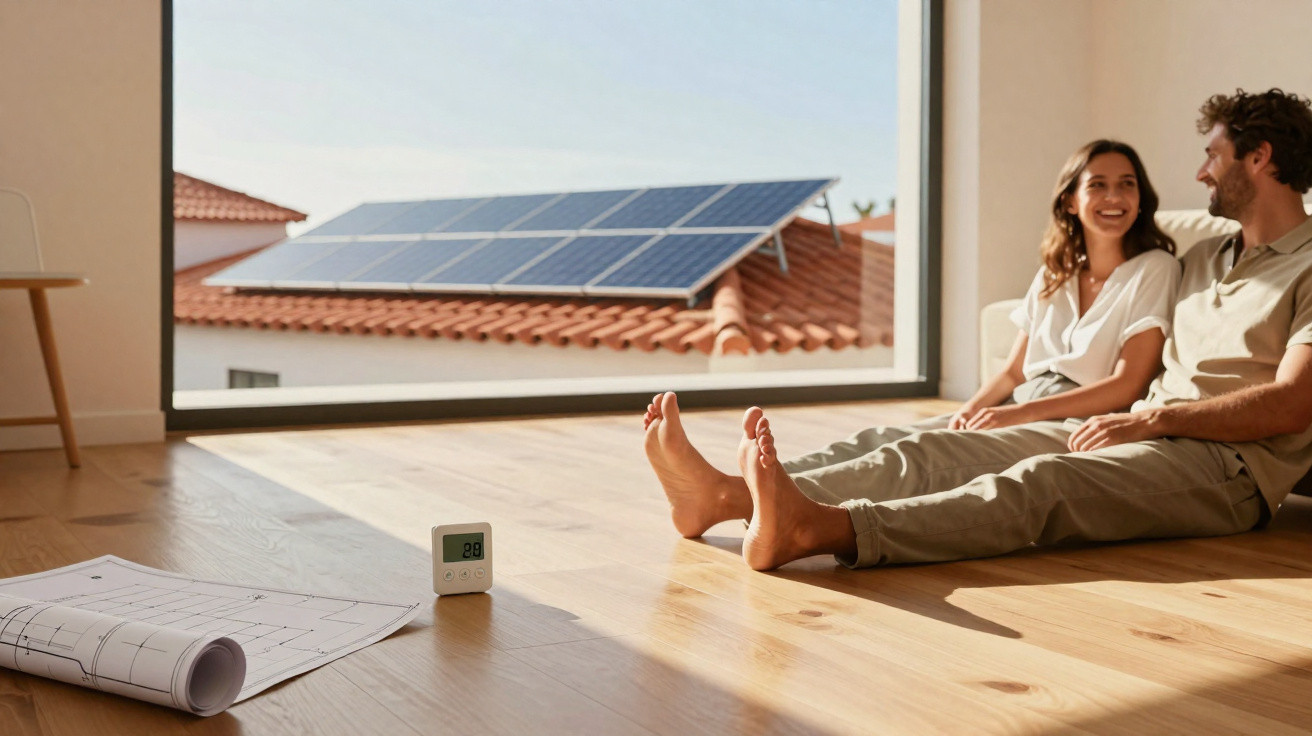
Indoors, the bills keep rising. Between those two realities, a quieter shift is changing how homes stay warm.
As winter bites across Europe and North America, plenty of households find themselves edging the thermostat up and seeing their energy costs climb with it. At the same time, a newer wave of solar-driven heating aims to keep rooms comfortable without chunky radiators, rumbling boilers, or the familiar jolt when the gas bill lands on the doormat.
A heating system with no radiators in sight
It can sound like sleight of hand: warming a house in mid-winter without any obvious heaters bolted to the walls. In reality, the approach is straightforward. It links rooftop solar panels with highly efficient controls and, in many homes, underfloor heating so that daylight is converted into steady, evenly spread warmth.
Rather than burning gas or relying on a plug-in radiator, photovoltaic (PV) panels turn sunlight into electricity. That electricity is then used to run low-temperature heating elements, heat pumps or intelligent underfloor systems that can absorb heat and release it gradually across large areas.
Sunlight becomes electricity on the roof, then heat under your feet – with no traditional radiators and far lower running costs.
What matters most is the surface area involved. If heat is delivered through floors, structural slabs, or purpose-made panels concealed in walls or ceilings, the system can operate at far lower temperatures than conventional radiators while still keeping a room pleasant. That single change can sharply reduce energy demand.
From bright idea to practical “solar central heating”
Solar panels have been used for years to provide lighting and run appliances. The newer move is to treat PV as the core of the heating setup, rather than a helpful add-on.
How the setup works in practice
A typical installation brings several parts together:
- Photovoltaic panels fitted to a roof or façade generate electricity whenever there is daylight.
- An inverter converts that output into usable power for domestic systems, including heating.
- A smart controller determines when electricity should go to heating, when other appliances should run, and when energy should be stored.
- Thermal storage - commonly a hot water cylinder, a concrete slab or specialised phase-change materials - keeps heat for later use.
- Underfloor or panel heating distributes that stored warmth evenly throughout the building.
This is often referred to as “solar central heating”, even though it does not rely on a traditional boiler. In effect, the building fabric becomes a slow, steady emitter of heat.
Once the system is installed and paid off, the marginal cost of each extra degree of warmth can fall close to zero.
Why this “future heating” is attracting attention
Clean energy with no flue and no fumes
Many conventional systems depend on fuels you burn: gas, oil or wood pellets. With each kilowatt of heat comes emissions and, in many cases, local air pollution. A solar-based approach avoids combustion altogether.
PV generates electricity with no direct emissions at the point of use. When it is paired with electric heating or a heat pump, a home can do without a flue, a gas connection, and fuel deliveries. That is particularly relevant for dense cities trying to meet air-quality targets.
No gas line, no fuel tank, no chimney – and virtually no emissions during operation.
On dark winter days, the grid is still needed unless a property has exceptionally large panel and storage capacity. Even so, replacing even part of purchased energy with self-generated electricity can cut a household’s carbon footprint noticeably.
Numbers that make accountants smile
The financial case can be equally compelling. Radiators, gas boilers and direct electric heaters all require bought energy for every hour they run. By contrast, the “fuel” for a solar-led system - sunlight - is free.
Evidence from European pilot schemes indicates that once the installation cost has been amortised, running costs can drop substantially compared with standard arrangements. In well-designed homes, heating-related bills may reduce by 60–90%, depending on the local climate and electricity prices.
| Heating type | Main energy source | Typical running costs | Local emissions |
|---|---|---|---|
| Gas boiler with radiators | Fossil gas | High and volatile | Yes, at home |
| Direct electric radiators | Grid electricity | High in most countries | Depends on power mix |
| Pellet stove | Compressed wood pellets | Moderate but rising | Particles and smoke |
| Solar-powered underfloor | Solar PV + electricity | Low once installed | Very low on site |
The main sticking point is the initial spend. Panels, inverters, control systems and underfloor heating usually mean a larger upfront budget than simply replacing an ageing boiler. However, incentives and the continuing drop in panel prices are starting to reduce that difference.
Why underfloor heating makes the difference
Heat where people actually feel it
Radiators largely heat the air immediately around them, which can create warm spots near the unit and cooler areas elsewhere. Underfloor heating behaves differently: it gently warms the whole floor at a comparatively low temperature, often between 25°C and 30°C.
Because warmth rises from the floor, people can feel comfortable even when the air temperature is slightly lower than in a room heated by radiators. That small adjustment can mean less energy use for the same level of perceived comfort.
Instead of blasting a few metal panels to 60°C, the system gently heats a large surface to a much milder level.
The outcome is typically a more uniform temperature, fewer draughts and, for many, a more comfortable kind of warmth - especially in bathrooms and living rooms with hard flooring.
Design freedom for architects and renovators
Removing radiators also releases wall space. It may sound minor, but for architects and interior designers it changes what is possible: furniture no longer has to be arranged around bulky heaters, glazing can extend closer to floor level, and narrow hallways do not end up feeling like lines of radiators.
In new builds, the heating can be designed into the slab or screed from day one. Retrofitting is trickier because floors may need lifting, raising or opening up, but thinner underfloor solutions are increasingly available for renovation projects.
Who stands to gain the most from radiator-free heating?
At present, solar-led heating tends to suit certain properties and places best:
- New low-energy houses with strong insulation and good airtightness.
- Detached or semi-detached homes with enough roof area for PV.
- Areas with cold but sunny winters, where clear days still produce substantial electricity.
- Households thinking long term, prepared to wait several years for the initial investment to pay back.
In tightly packed city blocks with limited roof space, or in locations that are heavily shaded, the solar contribution can be smaller. In those situations, hybrid systems - where solar covers part of the load and a backup boiler or very efficient heat pump handles the rest - are already widespread.
What about cloudy days and freezing nights?
No heating option runs under perfect conditions all year. Solar-powered systems face their own constraints: during long, overcast spells, rooftop output drops, and after dark it falls to zero.
That is where storage and intelligent control make the difference. When the sun is out, the system can “charge” a thermal store - a hot water cylinder, a thick concrete slab or specialised storage materials. The stored heat then seeps back into the home gradually after sunset.
Think of the house as a rechargeable thermal battery: it soaks up heat when the sun shines, and lets it out when frost hits the windows.
In colder regions, most installations still retain a secondary heat source, such as a grid-connected heat pump, a compact boiler or even a modern wood stove. The aim is not to remove backup entirely, but to reduce the number of hours it needs to run.
Key terms worth unpacking
Photovoltaic versus solar thermal
Two solar technologies are frequently confused. Photovoltaic panels use semiconductors to turn sunlight into electricity. Solar thermal collectors, on the other hand, heat a liquid directly - typically water, or a water/antifreeze mix.
The radiator-free systems described here mainly depend on photovoltaics because electricity can be used in several ways: it can power a heat pump, run household appliances and export surplus back to the grid. Some schemes combine PV with solar thermal, particularly to supply hot water, in order to capture as much free energy as possible.
Heat pump synergy
A heat pump does not conjure heat from nowhere; it transfers it, much like a refrigerator operating in reverse. Using electricity to move warmth from the outside air or the ground into a building, it can provide three to five units of heat for every unit of electricity used, when conditions are favourable.
If some of that electricity comes from solar panels and the heat is delivered through low-temperature underfloor heating, the benefits reinforce each other. Less purchased energy is needed, the PV output is used more effectively, and occupants experience a steady, comfortable indoor climate.
Future scenarios: how this could change daily life
Picture a winter morning in a near-future suburb. Through the night, an underfloor slab has slowly given up heat captured from the previous afternoon’s sunshine. The indoor temperature stays stable, without the familiar rhythm of radiators clicking on and off.
As daylight returns, the roof-mounted panels begin supplying electricity to the house. A smart controller notices the living room floor has cooled slightly and sends a gentle top-up. At the same time, it delays the washing machine until lunchtime, when solar generation will be stronger.
For the person living there, it feels almost uneventful. There is no roaring burner, no scorching metal grille, no boiler pilot light to check. Instead, there is consistent, quiet warmth - and an annual bill that hurts far less than it once did.
For renters and people in flats, the shift is more likely to come via building-wide systems. Developers are already trialling shared solar roofs paired with centralised heat pumps and underfloor heating serving whole blocks. Residents pay a stable, predictable heating charge, while landlords recover installation costs over a longer period.
Challenges remain: gaps in policy, the upfront price tag, and too few trained installers. Still, as energy prices swing and climate targets become stricter, heating homes without traditional radiators is moving from a futuristic idea to a realistic planning assumption in many countries.






Comments
No comments yet. Be the first to comment!
Leave a Comment