
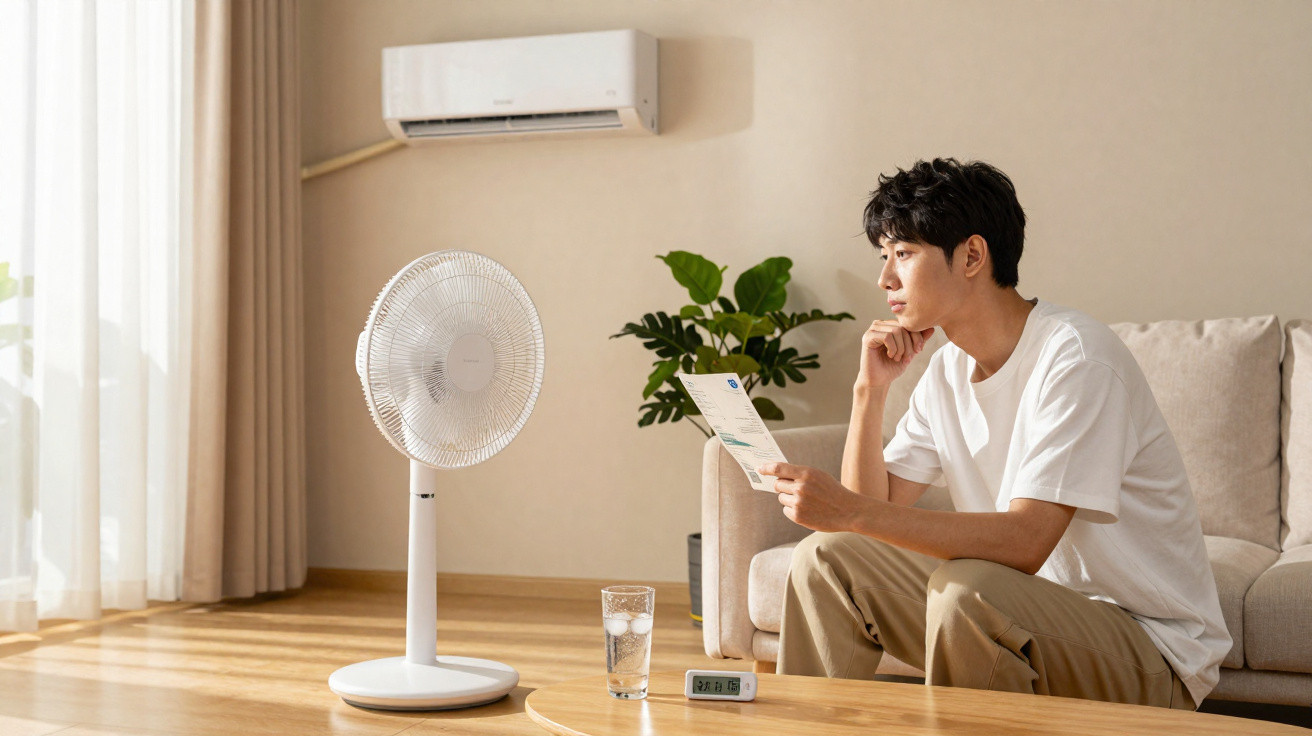
With summer approaching, should you opt for a fan or an air conditioner to cool your home? We looked into it for you.
It’s going to be a hot summer - at least, that’s what meteorologists are forecasting as we write. Heatwaves are expected to become more frequent in the years ahead, which makes it worth getting properly equipped. Today, there are two main options: a fan or an air conditioner. But which one helps you stay cool without breaking the bank? We worked through ADEME’s reports to understand the typical energy use of both devices.
The fan: a low-cost, low-energy option
A fan is the simplest device for moving air around a room. It doesn’t actually produce cold air, but it creates a feeling of freshness because the moving air passes over your skin. Its biggest advantage? Very low electricity consumption. According to ADEME, a fan uses up to 20 times less energy than an air conditioner. On average, a standard fan is rated at 45 to 70 watts, which means you can run it for several hours without sending your bill soaring.
When it comes to upfront cost, a fan is also the most affordable choice, with entry-level models from €20. It needs no installation and no particular maintenance, and it doesn’t emit greenhouse gases. From a purely financial perspective, a fan appears to be the most economical solution - although during a heatwave it will still be circulating warm air.
Air conditioner: real cooling, higher running costs
An air conditioner genuinely lowers the room temperature (it works by extracting heat from the air and expelling it outside), but that comes with a significant energy requirement. A portable air conditioner typically draws between 1,000 and 2,000 watts, equivalent to several household appliances running at the same time. In practice, that means a much higher electricity bill, especially if you use it for long periods during heatwaves.
The purchase price is also clearly higher, with entry-level portable models starting at around €300. On top of that, there are environmental impacts linked to refrigerant gases and the creation of urban heat islands if you live in a town or city. Lastly, maintaining an air conditioner can prove more expensive, particularly if it breaks down. That’s why it’s important to weigh up the comfort-to-cost trade-off.
Evaporative air coolers: the ideal middle ground?
For anyone looking for a compromise, evaporative air coolers are now widely available. They use less energy than an air conditioner, and they can be more effective than a simple fan in areas with low humidity. Their power consumption remains moderate, and prices range from €50 to €500.
Good habits to keep a home cool for less
Finally, adopting the right habits to cool your home can help you cope with the heat at minimal cost. Good thermal insulation, using electrical devices in moderation, and ventilating the home at night are all effective measures.




Comments
No comments yet. Be the first to comment!
Leave a Comment