
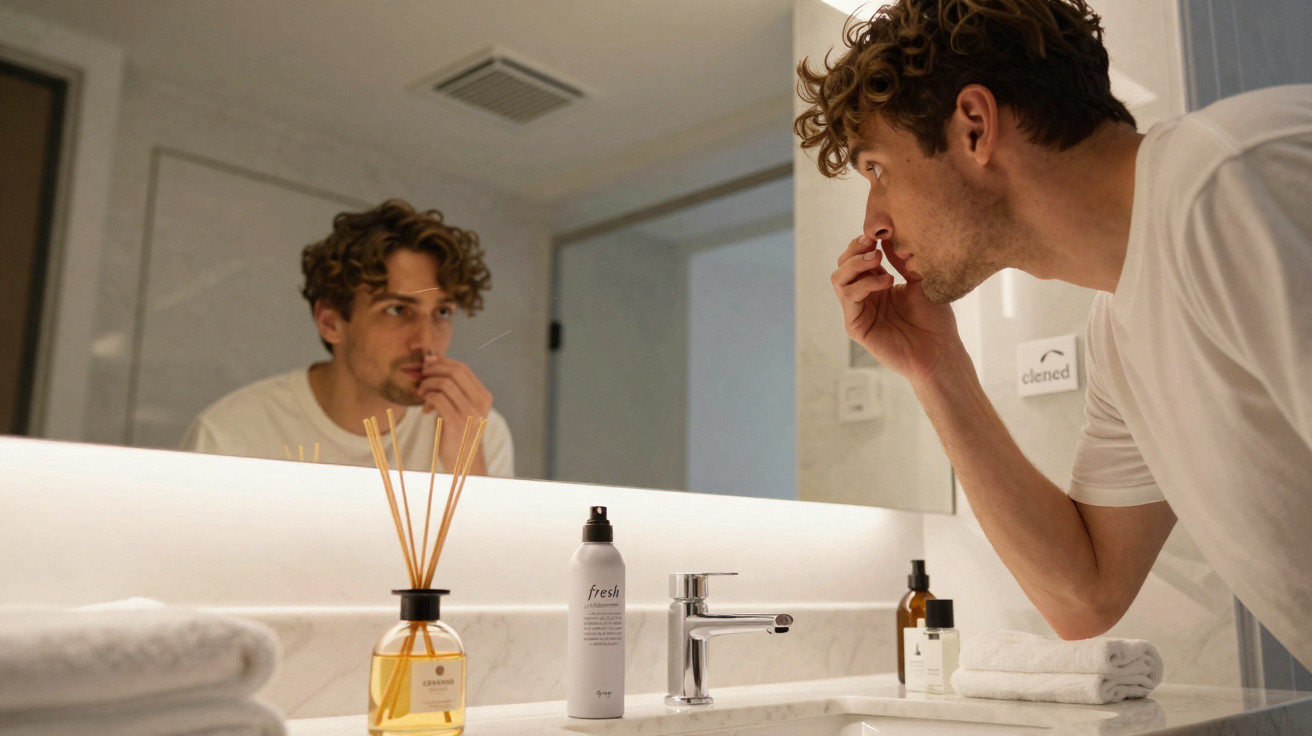
The bathroom door clicks shut with that muted, hotel-style hush, and for a moment it feels like you’ve wandered into an advert. Bright white towels with a bit of bounce, gleaming chrome taps, and a mirror that somehow makes you look less knackered than you are. Then there’s the smell: clean, “fresh”, vaguely sea-like, with a floral note you can’t quite place. You unwind. If it smells this good, it must be spotless - surely?
You hang up your bag and take another breath. The fragrance sits in the air, clings to the shower curtain, and even seems to catch on your clothes. Somewhere between the tiles and the miniature soaps, your brain quietly swaps “perfume” for “hygiene”. No need to look too closely. No need to ask what might be lurking beneath the shine.
That’s exactly where the trick begins.
The comforting lie of the “fresh” hotel bathroom
Step into almost any mid-range or higher-end hotel and the bathroom is presented as a little sanctuary. The air feels crisp - like linen dried in a bracing breeze - with a touch of citrus or something “marine”. Your shoulders drop before your suitcase even touches the floor. That reaction isn’t accidental. It’s engineered.
In marketing, it’s called scent branding. Big hotel groups spend huge sums developing a signature fragrance that communicates calm and cleanliness the instant you walk in. Your nose receives the signal before your eyes have properly taken it in. Your brain fills in the blanks. You’re not merely smelling lemon; you’re smelling “this place is safe”.
That’s the illusion hotels are quietly betting on.
A receptionist in Lisbon once told me, half-joking, that their hotel’s “biggest cleaning tool is an aerosol can”. She meant the bathroom spray they fire off between guests. My room did smell pristine. The grout lines didn’t.
Everything looked shiny at first glance. But around the base of the tap was a crusty ring of limescale. In the shower, there was a faint shadow of old mould tucked behind the bottom edge of the curtain. The air, though, carried that comforting “just cleaned” haze. My immediate impulse was to trust the scent and overlook the details.
We’ve all had that moment: the nose beats the eyes, and we decide not to investigate.
A straightforward psychological quirk is doing the heavy lifting: we instinctively link “pleasant smell” with “clean”, even when they have nothing to do with one another. Hotels understand this and often lean on heavy fragrance to distract from what proper scrubbing didn’t have time to tackle. Tight changeover windows, low-paid housekeeping, and constant pressure to keep rooms turning over all encourage that shortcut.
So you end up with a bathroom that feels disinfected when it may only have been deodorised. The drain might be partly clogged, the showerhead could be carrying biofilm, yet the ocean-breeze mist wipes away your doubts. A fresh scent is cheaper than an extra fifteen minutes of detailed cleaning.
That’s the quiet economy behind your “wow, it smells so clean” moment.
What hotels really do to your bathroom air
Watch housekeeping on a busy check-out morning and the pace is ruthless. Bedding stripped fast, bins emptied, surfaces wiped at near-Formula 1 speed. Bathrooms get their own routine: cleaner sprayed on the obvious areas, a quick scrub, a wipe or two over the mirror - then the defining move: spray. Plenty of it.
The air freshener isn’t a final flourish; it’s part of the method. A long hiss into the shower, another near the loo, a last mist close to the door. The cloud hangs in place, ready to meet the next guest with a faceful of “reassuring cleanliness” the second they walk in.
You’re not smelling hygiene. You’re smelling strategy.
Luxury hotels don’t tend to show this on Instagram, but former housekeeping staff will tell you the same story. In anonymous online forums, cleaners regularly say they’re told to “focus on what guests see and smell first”. That translates into mirror, sink, toilet seat - and then a generous helping of the brand’s signature scent.
One ex-housekeeper from a London four-star said that on fully booked days they were given less than 15 minutes per room, bathroom included. Deep-cleaning shower tiles or taking apart the drain simply wasn’t realistic on that timetable. What was realistic? A powerful diffuser out in the corridor and a concentrated spray bottle for the bathrooms.
The outcome is predictable: photo-ready shine, instant olfactory reassurance, and the bits you don’t stare at quietly ageing in the corners.
There’s also been a shift from neutral “clean” to outright perfume. Instead of a mild hint of soap, plenty of hotel bathrooms now smell like a fragrance counter. That isn’t generosity by accident; it’s deliberate. Strong smells linger in memory. They become part of the brand, the detail you recall later on the train home: “Their rooms smelled so fresh.”
Here’s the blunt truth: a bathroom can smell like a spa and still harbour invisible bacteria on the shower curtain, or hair and grime in the drain. Your nose can’t detect hygiene; it detects molecules. Those molecules might come from bleach, or from a synthetic “ocean rain” blend pushed through a hidden diffuser.
Cleanliness is about what’s removed; scent is about what’s added. Hotels sometimes cut corners on the first and lean heavily on the second.
How to see past the perfume and protect yourself
Next time you enter a hotel bathroom and that familiar wave of “freshness” hits, give yourself ten seconds before you fully relax. Pause. Let the scent settle - then actually look, rather than doing the tired traveller’s quick scan.
Inspect the grout between tiles. Check the silicone sealant around the bath or shower. Slide a tissue beneath the base of the tap and see whether it comes away grey or clean. Look at the bottom edge of the shower curtain, the floor corners behind the toilet, and the grille on the extractor vent.
You’re not being paranoid. You’re simply separating fragrance from hygiene.
Many of us feel a bit awkward doing this, as though we’re accusing someone personally. Nobody wants to be “that” guest. So we inhale the citrus mist, decide everything’s fine, and set a toothbrush down next to a tap that hasn’t been properly de-gunked in months.
Let’s be realistic: hardly anyone disinfects every hotel surface they touch, every day, without fail. But you can adopt a few easy habits. Don’t leave your toothbrush directly on the sink - use a glass or keep it in a travel case. If you carry sanitising wipes, give the flush button and the door handle a quick once-over.
And if the fragrance is so strong it’s almost choking, don’t treat that as proof of extra care. Treat it as a reason to look more carefully.
A veteran hotel cleaner once told me, “If you want to know how serious a place is about hygiene, ignore the smell and check the places we don’t have time for-the corners, the hinges, the underside of things.”
- Check the shower curtain hem: yellowing or mould spots tell you more than any “fresh linen” scent.
- Look at the drains: visible build-up or hair is a sign corners are being skipped.
- Check the air vent: a thick layer of dust suggests deeper cleaning isn’t a priority.
- Use your own small toiletries rather than open hotel bottles that may be refilled.
- Listen to your body: if the fragrance triggers a headache, open a window or ask for a room without scent diffusers.
Behind the good smell: what kind of “clean” do you really want?
Once you notice how heavily hotels lean on fragrance to signal cleanliness, it’s difficult to stop noticing. The spray in the bathroom. The discreet diffuser in the corridor. The same “signature aroma” turning up again in the lobby and, oddly, in the lift too. Together they deliver one message: this place is fresh, safe, hygienic.
But genuine hygiene is mostly invisible - and it doesn’t always smell like a Pinterest board. A truly clean bathroom may have a faint trace of chlorine, or almost no scent at all. It doesn’t require a thick layer of perfume to persuade you; the details do that. Clear grout. Dry, mould-free corners. A shower curtain that looks properly laundered, not merely freshly sprayed.
Next time you catch yourself thinking “smells great” equals “must be clean”, pause and mention it to whoever you’re travelling with. Compare the tricks you’ve clocked and the quick checks you now do. That small bit of awareness changes how you move through hotel rooms from here on.
Perhaps the real luxury isn’t a bathroom that smells like a spa, but one that doesn’t need perfume to prove it’s genuinely clean.
| Key point | Detail | Value for the reader |
|---|---|---|
| Smell ≠ hygiene | Hotels use strong fragrances and scent branding to create a “clean” feeling even when deep cleaning is rushed | Helps you stop treating perfume as proof of sanitation |
| Check hidden zones | Grout, shower curtain hems, drains, and vents show whether cleaning is superficial or serious | Gives you quick ways to judge real cleanliness in seconds |
| Simple protective habits | Keep your toothbrush off the sink, wipe key touch points, and be sceptical of overpowering scents | Lowers health risks without turning your trip into a military operation |
FAQ:
- Do hotel air fresheners kill germs or just mask smells? Most hotel air fresheners mainly cover odours; they don’t disinfect surfaces or meaningfully kill bacteria.
- Is a strong perfume smell in the bathroom a red flag? It can be: an overpowering scent often suggests the hotel is covering smells rather than tackling the underlying cause with deep cleaning.
- What should I quickly check first in a hotel bathroom? Check the shower curtain hem, grout lines, the drain area, and the corners behind the toilet - these spots show the real effort.
- Are hotel toiletries safe to use? Sealed single-use items are usually safer; refillable or already-open bottles can sometimes be topped up without proper sanitising.
- Can these fragrances be bad for my health? Yes. Some synthetic scents can trigger headaches, allergies, or asthma; if you feel unwell, ask reception for a room with less or no fragrance.


Comments
No comments yet. Be the first to comment!
Leave a Comment