
Garden centres often pitch it as the herb that even a complete novice can’t mess up. In France, gardeners prize it for infusions, mojitos and sunny-season salads. But beneath that crisp aroma and rapid growth is a plant capable of quietly smothering a whole garden-one creeping underground shoot at a time.
A dream plant for lazy gardeners – with a catch
The irresistible charm of a “can’t fail” aromatic
Mint seems tailor-made for anyone short on time. It’s perennial, shrugs off a bit of neglect, copes with the occasional missed watering, and stays green for a long stretch of the year. Walk past and you get that fresh, clean scent in the air. For people trying to grow herbs with minimal effort or know-how, it can feel like an instant win.
In France, that appeal dovetails with a rising taste for home-grown produce and “simple” gardens. Beginners slip mint into a spare corner of the veg patch or beside the terrace, picturing endless herbal teas, lemony drinks and big cocktail jugs. It’s also common for parents to give children a mint plant as their first mini gardening project.
Mint looks gentle and domestic, yet behaves like a determined coloniser once settled in the soil.
The problem shows up later. That tidy little clump almost never remains where you first put it. Mint’s reputation as a safe starter herb masks a much more forceful streak-one that plenty of French gardeners only recognise once it has already spread far beyond its original spot.
Why garden centres keep mint front and centre each spring
Step into a French garden centre in March and you can hardly miss it: pots packed with dense greenery, a strong fragrance, and tags suggesting iced teas and tabbouleh. From a retail point of view, it’s an easy sell.
Mint fills out quickly in nursery containers, looking abundant earlier than many other herbs. That makes it ideal for spur-of-the-moment buys when people are sketching out beds for the new season. It moves fast off the shelves and is easy to restock.
What customers seldom see is a blunt message such as “highly invasive in open ground”. The packaging tends to spotlight recipes and lifestyle imagery rather than long-term control. Many plants purchased in late winter 2026, while French gardeners plan their new layouts, will be the same ones creating frustration in 2027 and 2028.
The very quality that makes mint easy to sell – explosive growth – is exactly what later threatens the balance of a garden.
The underground enemy: how mint spreads without you noticing
A hidden network of rhizomes
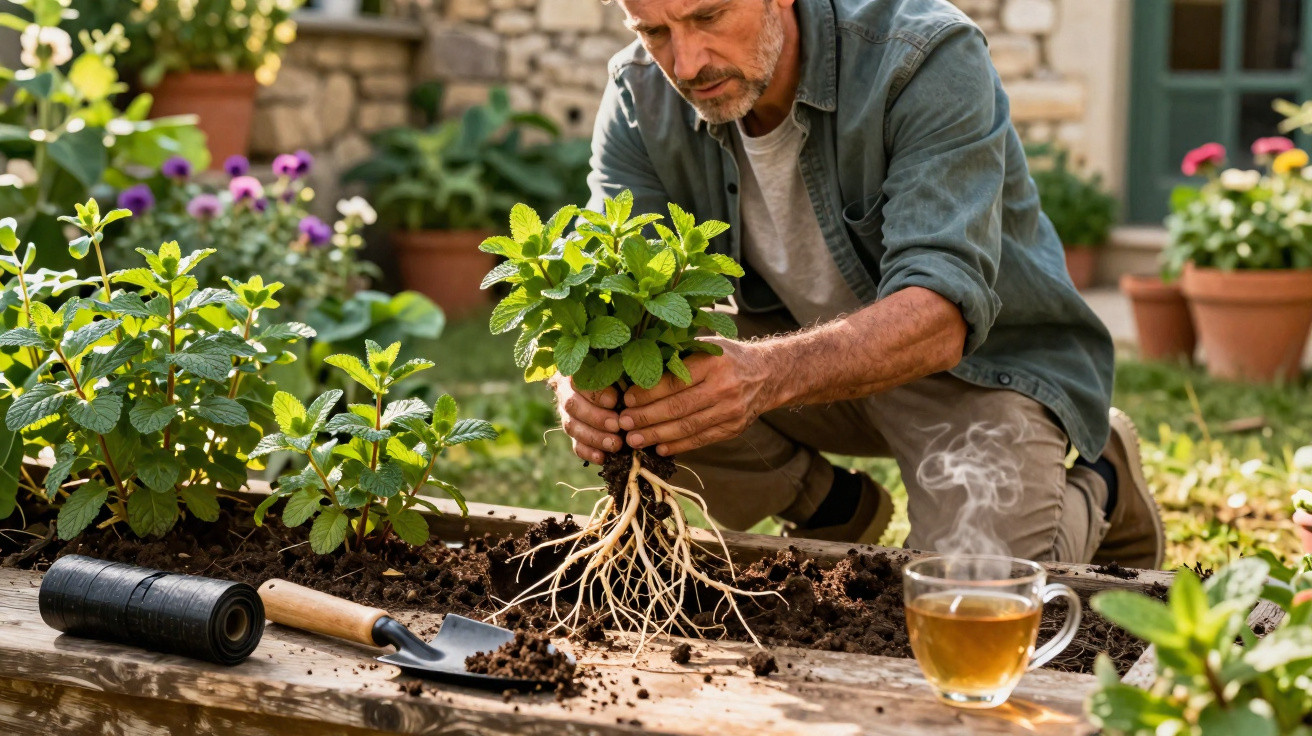
Above ground, mint advertises itself with square stems and serrated leaves. Underground is where the real takeover happens. Mint expands via creeping rhizomes-specialised underground stems rather than ordinary roots.
These rhizomes travel sideways through the soil, sometimes stretching many tens of centimetres beyond the original plant. Along the way they store energy and can send up fresh shoots wherever conditions suit. So a plant set beside a path one year can reappear in the middle of a salad bed the next.
Over time, the rhizomes knit into a tight, fibrous web. While the gardener is tying in tomatoes or sowing carrots, mint is quietly threading itself beneath the surface, ready to surge when spring warmth arrives.
Dodging stones, edging and even fabric
French gardeners often find mint outsmarting almost every “soft” barrier they try. A slim wooden border? The rhizomes dive underneath. A stone or rock? They curve around it. Weed-suppressing fabric under gravel? Shoots can force their way through tiny gaps.
Mistaking mint’s adaptability for harmless vigour is one of the fastest routes to a garden taken over.
Because mint copes with many soil types and conditions, it takes advantage of any weakness in the layout: a slightly looser pocket of soil, a gap between paving slabs, or a torn lining in the corner of a raised bed. Each becomes a launch site for another patch. In only a few seasons, carefully separated areas for vegetables, perennials and herbs can blur into one continuous, mint-scented carpet.
A bad neighbour: when mint suffocates everything around it
A ruthless competitor for water and nutrients
Once mint establishes itself in a bed, it competes aggressively. Its shallow yet densely packed root system acts like a sponge, hoovering up water and nutrients before neighbouring plants can get to them. Nitrogen-rich soil-often nurtured for vegetables-turns into mint’s personal buffet.
Vegetables planted near a spreading clump frequently show signs of strain: paler foliage, slower growth, reduced flowering. Herbs with finer, weaker roots, such as chives or coriander, tend to suffer most.
Mint does not share well. In mixed planting schemes, it quickly tips the balance in its favour.
During French summer droughts the issue intensifies. Mint’s heavy water use can push less robust plants beyond recovery, particularly in organic gardens where watering is already restrained.
Shading, crowding and quieter chemical effects
The competition isn’t only below the surface. Mint also races upwards, forming a thick canopy of leaves. Low-growing herbs-thyme, marjoram and oregano, common in Mediterranean-style French gardens-can simply vanish under its shade.
Some gardeners also suspect a subtler influence: the high levels of essential oils, together with that dense root mat, may slightly shift local soil conditions. If so, certain plants may struggle to establish, and mint can drift towards a small monoculture at the expense of diversity.
For anyone following permaculture ideas or diverse companion planting, a mint-heavy patch can be a genuine setback. One casual choice to plant a small clump near the veg bed can unravel years of biodiversity work in only a few seasons.
Once it’s in, getting rid of mint is a long campaign
Why pulling it out often makes things worse
When gardeners first realise mint is spreading, the natural reaction is to pull it up. The immediate satisfaction of yanking out long stems and roots is misleading. Under the soil, the rhizomes usually break, leaving dozens of living fragments behind.
Those fragments respond to disturbance like an emergency signal. Every snapped piece can become a new plant. Instead of removing one large patch, you may end up with many smaller ones poised to return.
With mint, rough weeding can act less like removal and more like large-scale propagation.
Many French gardeners describe year after year of battling areas they tried to clear quickly, only for fresh shoots to pop up elsewhere after each “tidy-up”.
A tiny root piece can restart the invasion
Mint is remarkably persistent. A rhizome segment just a few centimetres long can regrow into a full plant. That’s why using a rotavator or power tiller on an infested plot is such a costly error: it slices rhizomes into hundreds of pieces and spreads them throughout the bed.
Successful removal is closer to careful excavation than everyday weeding. You need to loosen the soil gently and work through it, removing every visible white or pale section of rhizome by hand.
- Loosen soil using a fork rather than a spade so you don’t chop rhizomes.
- Lift small portions of soil and patiently tease out the roots.
- Seal rhizomes in closed bags or burn them; do not add them to compost.
- Keep checking for new shoots for at least one full growing season.
Even with meticulous effort, a stray sprig can still surface weeks later. The real tools here are persistence and repeat visits.
How French gardeners are learning to contain mint
Growing in sealed pots: the safest compromise
Banning mint entirely would be an overreaction. The most realistic approach is firm containment-and for most home gardeners that means using pots and containers properly.
Choose containers with solid sides and position them where roots can’t reach the ground. A terracotta pot or plastic tub placed directly on bare soil is a gamble, because roots can slip out through drainage holes and take hold in the earth underneath.
The safest place for mint is in a pot on a hard surface: terrace, balcony, courtyard or paving.
Some French gardeners keep a cluster of pots on paving near the kitchen: one for mint, with others for more delicate herbs such as basil or coriander. Mint gets the regular watering it enjoys, without robbing neighbouring vegetables or perennials.
Rhizome barriers in open ground: effective, but demanding
For gardeners set on creating mint ground cover under trees or scented borders around terraces, experts often advise underground barriers like the ones used for bamboo. These are thick plastic or rubber sheets installed vertically around the planting area, sunk to 30–40 cm, with a lip left showing above soil level.
It’s hard work and can be expensive, especially across a large space. And even then, mint will probe for weaknesses. If the barrier sits too low, stems can creep over the top; if the joins aren’t properly sealed, rhizomes can exploit the gaps.
In reality, many French gardeners opt for a smaller in-ground patch paired with routine edging-cutting back any growth that tries to cross its boundary. It becomes a continuing maintenance job, much like mowing or hedge-trimming.
Why gardeners still forgive mint: taste, health and habit
Culinary and medicinal benefits that keep it in favour
Mint’s popularity in French gardens isn’t just nostalgia. In the kitchen, it’s genuinely difficult to replace: a bulgur salad piled with chopped herbs, a mug of fresh mint tea after a rich meal, or a jug of citrus-and-mint water on a hot August day.
It suits savoury food, puddings and drinks alike: with lamb, with peas, scattered over strawberries, or blitzed into a yoghurt sauce. That flexibility is why, once it’s growing by the back door, it becomes one of the most frequently used herbs in many homes.
For many families, having mint on hand feels as natural as having salt in the cupboard.
On the health front, both traditional practice and modern herbalism point to similar uses. Peppermint and spearmint infusions are widely taken to relieve digestion issues, bloating and mild nausea. When diluted, the essential oils can feel cooling and fresh-an effect many people find comforting.
Living with a controlled invader
Growing mint successfully is less about faith and more about setting boundaries. It will produce leaves from early spring until the first frosts, needing little feeding and offering generous harvests. In exchange, the gardener commits to limiting its spread and watching for escape routes.
For new gardeners in France, it can help to think of mint as semi-wild: a joy to have close by, but never something to let roam freely through the vegetable plot. A mint pot on a balcony and a mint thicket in the centre of a lawn lead to two very different long-term outcomes.
Practical scenarios and tips for keeping mint on your side
Where mint works – and where it causes trouble
| Location | Risk level | Notes |
|---|---|---|
| Pot on balcony or terrace | Low | Best option; easy to water and control. |
| Pot sitting on bare soil | Medium | Roots can escape through drainage holes into ground. |
| Mixed veg bed in open ground | High | Rhizomes spread among crops, hard to remove later. |
| Dedicated “mint corner” with barrier | Medium | Works if barrier is deep and checked yearly. |
Picture a small French urban garden with raised beds for tomatoes, salads and beans. Put mint straight into one of those beds and, within two or three seasons, removing it risks damaging crop roots and still leaving rhizome pieces behind. Grow the same mint in a large container on the nearby patio and you keep it within easy reach, while the vegetables carry on undisturbed.
Key terms gardeners should know
Two terms on a mint label matter more than most people expect:
- Rhizome: an underground stem that spreads sideways and can generate new plants-far more invasive than simple fibrous roots.
- Perennial: returns year after year; with mint, that means the underground system keeps expanding unless you actively restrict it.
Knowing these terms helps gardeners read between the lines when they pick up that tempting, fragrant pot in early spring. Mint still earns its place in French gardens and kitchens-but only when its relentless energy is directed and contained, rather than allowed to roam through the soil.






Comments
No comments yet. Be the first to comment!
Leave a Comment