
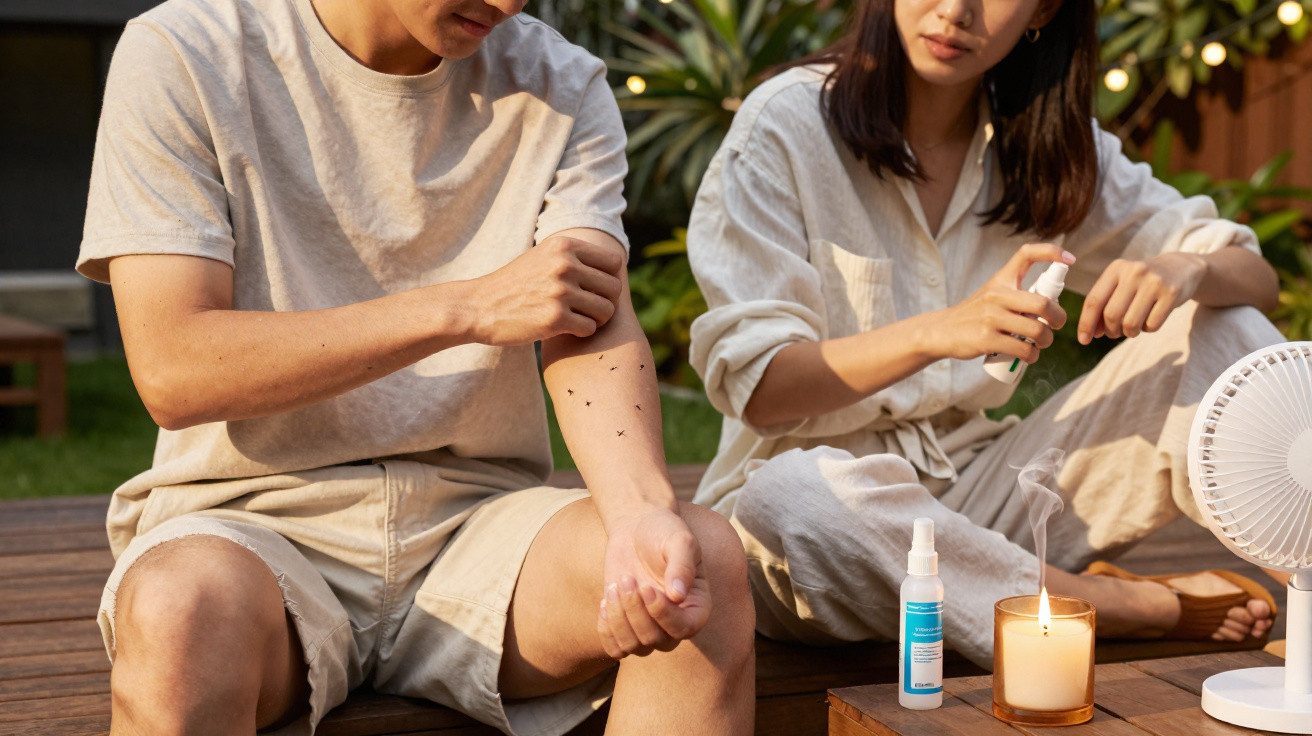
You may feel as though you have tried everything to break the curse: citronella, repellent wristbands, foul-smelling smoking coils, or the sugar-free diet your brother-in-law swears by. Sorry - you have wasted both money and time. The real issue is your skin, and that is not something you can easily swap out.
It is one of summer’s great unfairnesses: at a pleasant barbecue or during a stifling night, your forearm ends up looking like a calculator, while the person next to you escapes without a mark. This is not an urban myth - mosquitoes have preferences, as Frédéric Simard, Research Director at the Institute of Research for Development (IRD), explains. “We are not all equal when it comes to [their] appetite […]”. Even so, he adds, we are not consistently attractive to them. In practice, how sensitive mosquitoes are to us comes down to tiny physical and gaseous variations that are completely beyond our awareness.
So how is it that these six-legged vampires, with their unbearable whine, treat certain people as priority targets while leaving others entirely alone - with neither location nor circumstance seeming to make any difference?
Mosquitoes really do have favourites
Do mosquitoes favour certain blood groups? Hair colour, eye colour, or skin colour? No. Those claims do the rounds, but they are misconceptions: none of it has been scientifically proven.
It’s down to your skin
CO₂, odours, heat and humidity: how mosquitoes find you
When female mosquitoes go looking for blood, they can pick out their next victim from several dozen metres away. They respond well to movement and light, yet their eyesight is blurred; they make up for that weakness with a remarkable ability to detect carbon dioxide (CO₂) produced by the human body. We release it constantly, through breathing and through the pores of our skin - to them, we are essentially enormous scent beacons.
Once they are within roughly 10 metres, they begin to register the smell of our skin. At very close range, the warmth and moisture coming off it become the final cues, guiding them to land precisely where blood is closest to the surface.
Your microbiome’s “molecule soup”
On average, each of us gives off between 300 and 1,000 different odour compounds, blending into a personal body scent. It is, in the words of Swedish entomologist Rickard Ignell, “a soup of molecules produced by our microbiome, more or less appetising depending on the individual”. Bacteria living on the skin break down our secretions and, in return, generate a mix of volatile molecules. Mosquitoes can decode this cocktail in mere milliseconds to pinpoint the most accessible blood source.
Another differentiating factor is 1-octen-3-ol, a compound created as sebum breaks down. It is produced in greater quantities by pregnant women during the second trimester. Mosquitoes are particularly fond of it, and just a few nanograms are enough to stimulate their nervous system and steer their flight towards the source of the emission.
Stay covered - and stay sober
If you are a beer fan, bad luck: several studies suggest that this drink can make you more interesting to mosquitoes - indirectly, of course. Alcohol more broadly tends to raise body temperature, which makes the job easier for these flying little sadists, who are outstanding at thermal detection. On top of that, after drinking, your breathing rate speeds up slightly, increasing your CO₂ output, and the mix of volatile compounds on your skin changes. In other words, your scent profile becomes far more appealing to the enemy’s sensory equipment.
At present, there is no scientific consensus confirming that some people are permanently more attractive to mosquitoes than others. It is a multifactorial phenomenon, and dozens of contributing factors remain poorly documented.
Still, you do have control over certain things to protect yourself from their attacks: wear covering clothing if you will be outside for a long time (easier said than done, especially with summer approaching), fit mosquito nets at home if you can, and use approved synthetic repellent sprays carefully, such as DEET, icaridin or IR3535. If you would rather choose a “natural” option, look for citriodiol - an extract from lemon eucalyptus essential oil - which is highly effective as well.
One last set of tips: go for lighter meals in hot weather and consider raising your elbow a little less often. Alcohol should be consumed in moderation in any case, but it is up to you to decide whether mosquitoes are really worth that particular sacrifice.




Comments
No comments yet. Be the first to comment!
Leave a Comment