
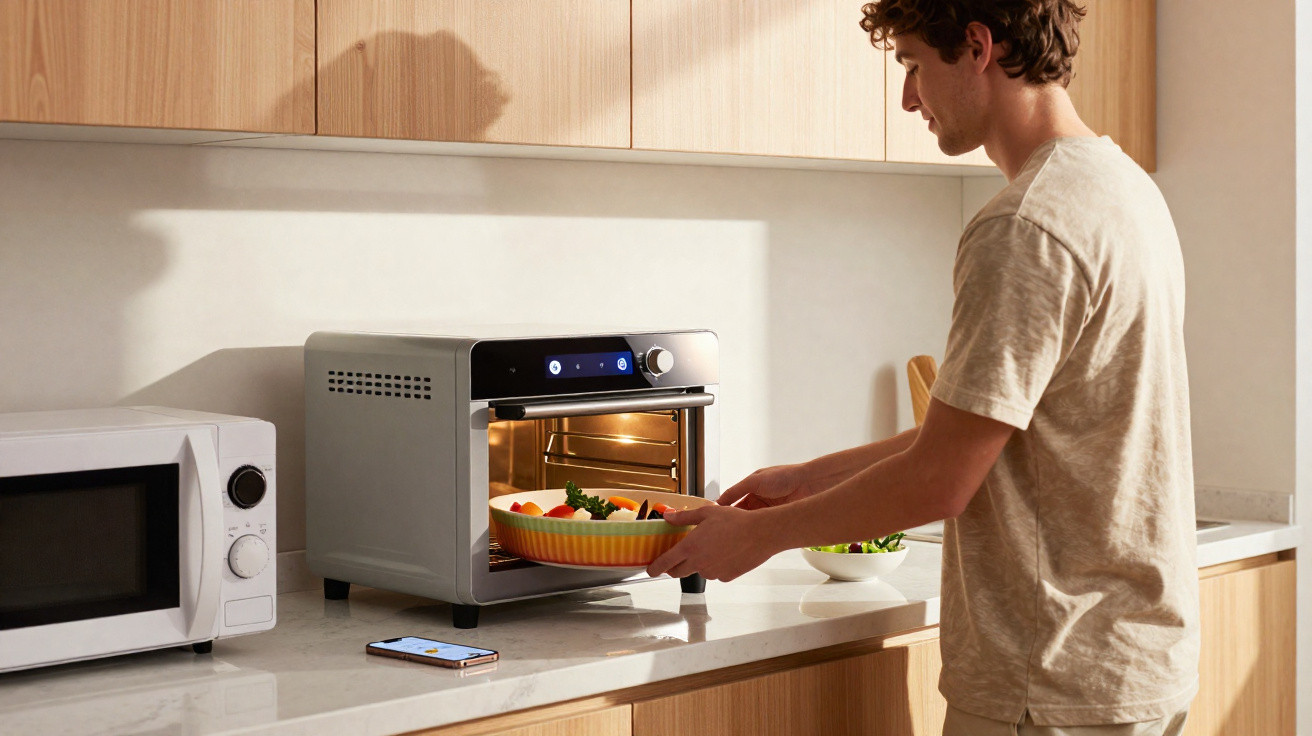
No more bowls that are lukewarm in the middle and scorching at the edges; less of that resigned “it’ll do”. TikTok clips keep rolling, sales figures keep climbing, and big kitchen brands are starting to swallow a little harder. A new breed of appliance claims it can reheat, cook and grill in a single move, without yesterday’s compromises. Some people are already calling it “post‑microwave”. Others are more cautious, watching the glow behind the glass of an oven that doesn’t behave like the ones we know.
On a weeknight, in an ordinary suburban kitchen, a mum puts a dish of lasagne on the table with a slightly disbelieving smile. Dinner has just come out of a shiny countertop oven packed with sensors-supposed to cook at microwave speed, but with the finish of a proper oven.
The children tap the top to check the crust. Their dad lifts the plate to see if the centre is cold-an old reflex shaped by decades of hit‑and‑miss reheating. Instead, steady steam rises with no frozen patch in sight. The whole thing took under ten minutes.
On the display, a small icon shows the time, the temperature and even the crispness level selected. The family doesn’t realise it yet, but the device sitting on their worktop looks a lot like the microwave’s next replacement.
The “smart oven” that wants the microwave’s throne
The challenger already has a name doing the rounds in trend‑led kitchens: the smart countertop oven-often driven by rapid convection, infrared heat and smart sensors. It has the footprint of a compact oven, but it behaves like a microwave with judgement.
Inside, cameras and thermal sensors monitor cooking as it happens. The system tweaks heat, fan speed and even which direction the heat is coming from. You select “leftover pizza” or “salmon, 200 g”, and it takes it from there.
On a good day, it toasts, roasts, bakes and reheats with almost absurd ease. On a bad day, it still outperforms the limp, soggy plate rotating in a humming box that hasn’t changed much since the 1990s.
The numbers tell a clear story. In the US and UK, sales of smart ovens and high‑speed countertop ovens have surged over the past three years, often showing double‑digit growth while traditional microwaves flatline.
Social feeds are stacked with before‑and‑after shots: pale, rubbery leftovers from a microwave versus golden, blistered plates that look close to restaurant quality from these newer machines. It resonates because most of us have eaten a microwaved meal that felt like a downgrade from what it should have been.
Early adopters tend to report the same pattern: once the smart oven arrives, the microwave door gets opened less and less. It starts with pizza and roasted veg. Then it spreads to bakes, whole fish, even breakfast. The shift happens quietly-no grand announcement required.
Technically, the trick is speed without brutality. A microwave excites water molecules in food-fast, yes, but often uneven. A smart oven leans on powerful elements, convection airflow and, in some models, light‑based technology to deliver intense heat that’s still controlled.
Because sensors can effectively “see” what’s going on, the oven doesn’t rely on time alone. It responds to changes at the surface and, in certain models, at the core too. The aim is straightforward: warm as quickly as a microwave, then finish like a professional oven.
That reshapes the unspoken deal of weeknight cooking. You’re no longer forced to pick between “quick and disappointing” or “proper but slow”. A new question appears: what if fast could still feel like a real meal?
How to actually use one so it replaces your microwave
The first step is almost comically simple: relocate the old microwave. Shove it to the side, unplug it, or put it in a cupboard for a week. If the smart oven sits in the prime spot, your hand will reach for it first-nearly on autopilot.
Begin with a single task: reheating leftovers. That’s where the difference is most immediate. Choose the reheat setting, pick the dish type (pasta, pizza, stir‑fry), and let the automatic programme do its job.
Experiment a bit. Use “crisp” or “air fry” in the moments when you’d normally give up and accept a limp result. The sooner you get one or two proper “wow” outcomes, the sooner your brain files the microwave under “backup”, not “default”.
After that, routine does the heavy lifting. Use the smart oven for the jobs you’d usually blast-reheating a single slice, warming a small portion, dealing with leftovers day after day. Yes, some tasks may take an extra minute or two. The payoff shows up on the plate: no more scalded edges hiding a cold centre.
Many people find batching makes it even easier: roast extra vegetables on Sunday, then revive them during the week with a quick high‑heat burst. On a busy evening, that five‑minute roast‑reheat can feel like you’ve hacked the clock.
It helps to be honest about your habits. If your microwave mostly handles popcorn and melting butter, this will feel like a bigger change. If, instead, the microwave is your go‑to for nearly every meal, a smart oven can quietly reshape your evenings.
One of the biggest early mistakes is using a smart oven like a standard oven-same trays, same shelf positions, same timings. Airflow is part of the point. Leave space around the food. Don’t cram the basket “just this once”. You’ll lose the crispness you bought it for.
Another common pitfall is refusing to use pre‑sets out of stubbornness. These devices are trained on thousands of cooking cycles; they generally know what a portion of lasagne needs. Starting from scratch every time with manual settings is like buying a smartphone and using it only for phone calls. Let’s be honest: hardly anyone does that day in, day out.
Burnt corners, smoking crumbs at the bottom, soggy chips because you didn’t blot off excess oil-it happens. Treat the first fortnight as a trial run, not a final judgement. This is the period when “no‑microwave” cooking either sticks or gets abandoned.
“The first time our smart oven reheated roast chicken without drying it out, my teenage son asked if we’d ordered takeout,” confides Emma, 42, who swapped her microwave after a kitchen renovation. “That’s when I realized this wasn’t just another gadget. It was changing what we expected from fast food at home.”
To keep things practical, here are a few real‑world checkpoints that often decide whether a smart oven gathers dust-or genuinely replaces the microwave:
- Give yourself a two‑week “microwave break” and force all reheating into the smart oven.
- Stick a short cheat sheet on the fridge: best settings for pizza, pasta, roasted veg, frozen meals.
- Use the oven once each weekend for something “fun” (biscuits, wings, garlic bread) to build positive memories.
- Clean the crumb tray and filters weekly so it doesn’t start smoking at the worst moment.
- Talk as a family about what actually works; then adjust pre‑sets and favourites to match.
What this shift really changes in our kitchens
Under the glossy technology, something more personal is going on. For decades, the microwave has represented a certain style of eating: quick, functional and not particularly proud. You heat, you eat, you move on. If it delivers on its promise, the smart oven nudges that mindset.
Leftovers stop feeling like a penalty. A gratin stays a gratin rather than turning into a soft, watery imitation. Pizza gets its crackling base back. Vegetables keep their colour the next day. It won’t transform every Tuesday into a dinner party, but it does lighten the emotional drag of “second‑rate food”.
On a packed weeknight, that can matter more than specs and wattage. It’s the difference between automatically eating in front of the telly and, almost without discussion, choosing to sit at the table for ten minutes.
Zoom out and you can see where manufacturers think this is heading: a modular, intelligent “post‑microwave” kitchen. Smaller multi‑function ovens on the worktop. Induction hobs that communicate with them. Fridges that propose precise programmes as you scan leftovers.
Smart ovens may simply be the first visible wave. If they really take over, microwave meals will have to change too: less plastic, more crisp‑friendly textures, and instructions that read “smart oven, 6 minutes on high air roast” right alongside the classic “microwave 800 W, 4 minutes”.
There’s also a quiet question about energy use. These ovens often draw more power per minute than a microwave, but they run shorter cycles and can reduce the need to switch on a full‑size built‑in oven. The real balance depends on how you cook, not just what the label says.
The cultural angle may be the most striking. For anyone raised on grim office microwaves and sad tubs of leftovers, an appliance that treats reheating with respect feels oddly radical. It acknowledges that time is limited, but insists the meal can still deserve a plate-not just a container.
On a Sunday evening, with the week ahead looking long, you might slide a tray of vegetables and halloumi into that softly whirring box and watch the heat move behind the glass. Nothing heroic-just a small shift away from survival mode and towards something a bit warmer.
We’ve reached a point where “good enough” kitchen technology no longer feels satisfying. The microwave once seemed miraculous, then became background furniture. These smart ovens arrive with hype, yes, but also with a very real ability to change how Tuesday’s leftovers taste.
In one group chat, someone will boast about perfect chips without deep‑frying. In another home, an older parent finds they can cook safely again without bending down to a big oven. Elsewhere, a young couple skips takeaway because their countertop device can turn out roasted veg in nine minutes.
What’s clear is that the fight for that patch of worktop is only just starting. The microwave won the first era of fast cooking. The question now-between two beeps and a rapid preheat-is simple: how long will we settle for speed without soul, when a shoebox‑sized oven starts offering both?
| Key point | Details | Why it matters to readers |
|---|---|---|
| Reheating quality | Smart ovens reheat using convection and radiant heat, so lasagne, pizza and roasted meats come out hot all the way through, with a crisp surface rather than rubbery edges. | Makes leftovers feel like “real food” again, which can reduce food waste and make home cooking more appealing than last‑minute delivery. |
| Speed vs. microwave | Microwaves remain quicker for liquids and very small portions, but smart ovens can get close: 6–10 minutes for full plates, using pre‑sets and high‑intensity modes. | Helps you decide whether the trade‑off is worth it on busy nights, and where a smart oven can realistically replace your current habits. |
| Energy and footprint | Most smart ovens draw 1,500–1,800 W, but their smaller cavity and shorter preheat often mean they use less electricity than a full‑size oven for the same dish. | Offers a clearer picture of running costs and whether swapping from “big oven + microwave” to one smart device could simplify bills and free up space. |
FAQ
Can a smart oven really replace a microwave for everything? Not completely. For heating a mug of coffee or a bowl of soup in under two minutes, the microwave still wins on raw speed. Where the smart oven tends to take over is reheating meals, crisping leftovers, cooking small trays of veg, fish or chicken, and dealing with frozen food with better texture. Many households keep a small microwave as a backup, but use it far less.
Are these ovens hard to clean compared with a microwave? They usually need a bit more attention, because crumbs and fat splatter can burn on heating elements. Most models include removable trays and baskets that can go in the dishwasher, and a quick wipe inside after greasy foods prevents smells and smoke. In practice, a five‑minute clean once a week keeps them in good condition.
Do smart ovens work well in small kitchens or studio flats? Yes-provided you measure carefully. Many units are roughly the size of a large toaster oven and can sit where a microwave used to be. You simply need enough clearance around the oven for ventilation. For people without a built‑in oven, it can become the main cooking appliance, handling everything from toast to roast chicken.
What about safety for kids or older relatives? Many smart ovens stay cooler on the outside than traditional ovens, and doors often lock or pause when opened mid‑cycle. Interfaces typically use clear icons and straightforward pre‑sets, though touchscreens can be confusing at first. For older users, sticking to a few saved programmes such as “reheat plate” or “toast” keeps things simple-and can be safer than bending down to a large gas oven.
Are they worth the higher price compared with a basic microwave? It depends on how often you cook and reheat at home. If you mainly defrost bread and warm milk, a microwave is cheaper and sufficient. If you regularly eat leftovers, frozen meals or quick roasted dishes, the improvement in taste and texture from a smart oven can repay itself in fewer takeaways and more enjoyable dinners at home. Many people find that spread over three to five years, the cost feels reasonable for something used daily.



Comments
No comments yet. Be the first to comment!
Leave a Comment