
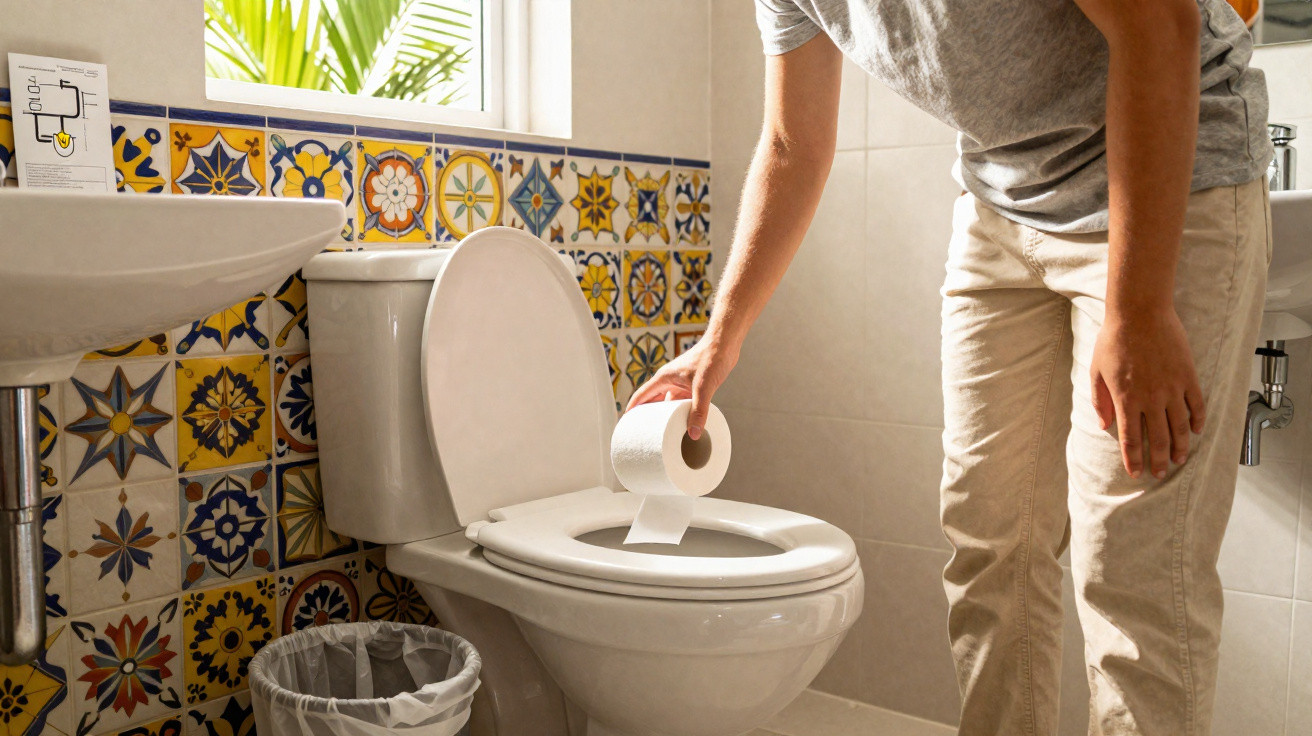
Flushing used toilet paper is standard in many countries, but that approach cannot be automatically applied to every home in Brazil. The right choice depends on the sewer network, the diameter and condition of the pipework, and whether the property uses a septic tank. In Brazil, sanitation providers such as Sabesp and Caesb advise customers to avoid flushing it on certain networks, mainly because of the risk of blockages within the property’s own plumbing.
So, should toilet paper go in the toilet or in the bin?
Where sanitary systems are designed to take quickly disintegrating paper, putting it in the toilet is technically feasible and avoids keeping contaminated waste inside the bathroom. That is exactly what happens in many countries whose networks are built to carry paper along with wastewater. The wider international discussion starts from that premise: the pipework, the flush volume and the treatment system all need to be compatible with flushing.
In Brazil, however, local guidance should come first. Sabesp states that toilet paper should not be thrown into the toilet because it can block the internal network, and Caesb also advises against the practice in its condominium-based system. So, for any home served by a provider that gives this instruction, a lidded bin remains the recommended destination.
Why does the same habit work in one country and cause blockages in another?
The key difference is less about the paper and more about the infrastructure. Standard toilet paper is manufactured to lose strength when wet, but it still has to travel through the entire pipework before reaching the treatment system. Narrow pipes, insufficient gradient, older installations, low-flow flushes or faults in the plumbing increase the chances of material building up.
- Older networks may have pipe diameters or conditions that are unfavourable for carrying paper.
- Low-flow flushes may not move the material through effectively.
- Systems with too many bends create more points where waste can get caught.
- Septic tanks require extra care depending on capacity and maintenance.
- Properties with a frequent history of blockages should be assessed before changing habits.
How can you tell which option is right for your home?
Start by checking the recommendation from the company responsible for the city’s or the condominium’s sewer service. It is also worth watching how the toilet behaves: a slow flush, rising water, gurgling noises and repeated blockages indicate that adding paper to the pipework could make an existing issue worse.
- Check guidance from the local sanitation provider.
- Confirm whether the property uses the public sewer or a septic tank.
- Factor in the age and condition of the plumbing.
- Note whether the toilet flushes slowly or blocks frequently.
- If you are unsure, ask a qualified plumbing professional to assess the system.
Which products should never be thrown into the toilet?
Even where the installation can handle toilet paper, that does not turn the toilet into a rubbish bin. Wet wipes, paper towels, sanitary pads, nappies, cotton buds, condoms and dental floss do not behave like toilet paper in water and can create obstructions in the network. Brazilian sanitation services repeatedly warn against disposing of solid waste through the toilet.
Even items marketed as disposable need caution. The standard is not simply whether something fits through the toilet opening, but whether it can travel through the network without staying intact, snagging other waste, or reaching pumping and treatment structures. Kitchen roll and wipes, for example, are made specifically to remain more resistant when wet.
What rule helps prevent problems in both the bathroom and the sewer network?
There is no single universal answer that suits every home. In plumbing designed to receive toilet paper, using the toilet may be appropriate; where the concessionaire advises the opposite-as happens in different Brazilian systems-the correct approach is to use a lidded bin and empty it frequently. Local sanitation guidance matters more than copying a habit seen in another country or city.
What matters most is understanding the route that begins at the toilet and ends at the sewer network or the septic tank. Following the real capacity of the pipework reduces blockages, sewage backflow and unnecessary plumbing call-outs. And one rule applies in any system: nappies, sanitary pads, wipes, cotton buds, dental floss and other solid waste should stay out of the flush.



Comments
No comments yet. Be the first to comment!
Leave a Comment