
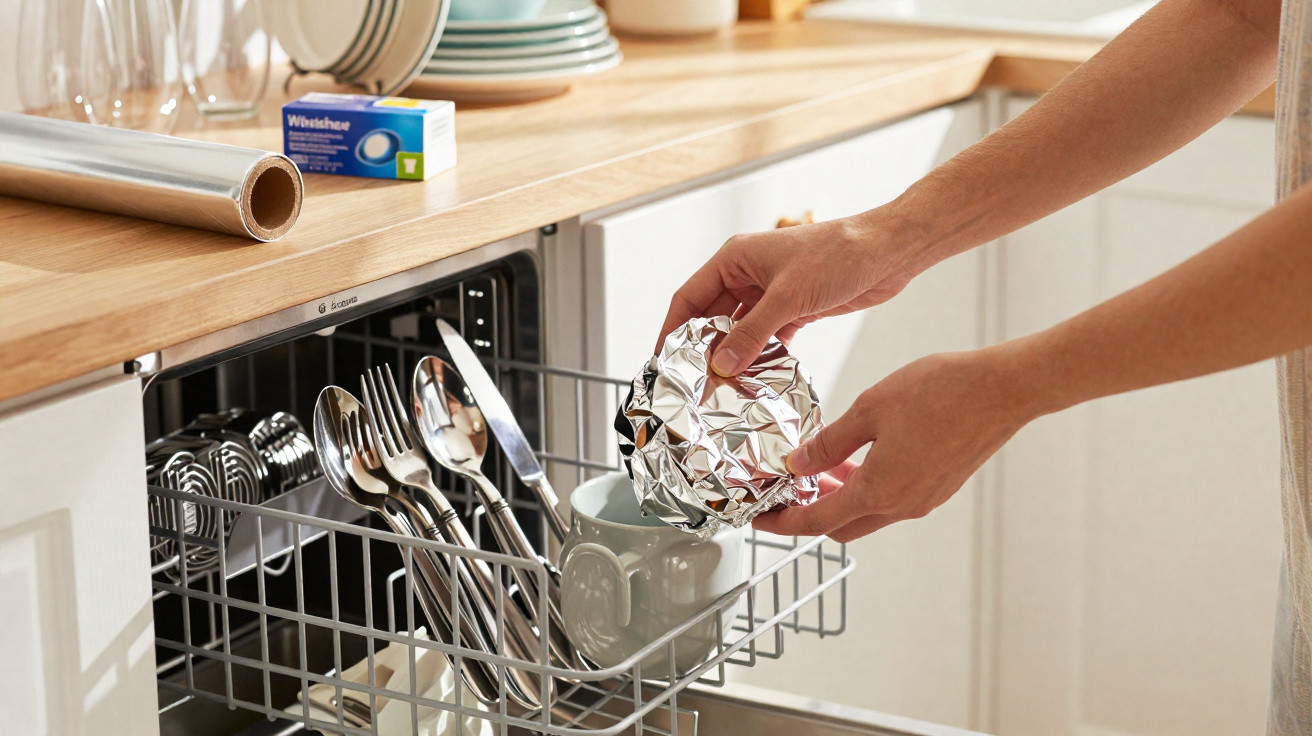
More and more households are swearing by a straightforward little hack that happens right in the dishwasher’s cutlery basket. Instead of buying new tablets or specialist cleaners, the claim is that a tightly scrunched ball of aluminium foil is enough - and that tarnished knives, forks and spoons come out looking noticeably better.
Why a dishwasher can still disappoint, despite all the tech
A dishwasher is meant to keep the peace at home. Plates in, a tablet in, press the button - job done. No more arguments about whose turn it is to wash up, and no more bickering about wet hands in the evening. On paper, it’s ideal.
In everyday use, it doesn’t always work out that way. Users repeatedly report:
- spoons and forks that have gone dull
- brown spots on knives
- cloudy glasses after a few cycles
- faint rust marks in the cutlery basket
Especially with cheaper cutlery or older knives, tiny rust specks are a common annoyance. You wash and wash, yet the cutlery still seems to look a little more tired with every run.
"According to household fans, a tiny piece of aluminium foil can step in at exactly this point - right in the cutlery basket, in the middle of the wash."
The aluminium foil trick in the dishwasher
The trend started in household blogs and is now widely shared on social media. The principle is simple: before you start the programme, you put a small ball of aluminium foil into the dishwasher’s cutlery basket.
How to use the aluminium foil trick properly
If you want to test it, do it like this:
- Tear off a piece of aluminium foil roughly the size of your palm.
- Crumple it tightly into a firm ball, about the size of a table tennis ball.
- Place the ball in the cutlery basket - not in the compartment for the tablet or the salt.
- Run the machine as usual with a tablet or powder.
- After the cycle, check how the cutlery (and any older, duller items) look.
Many people say stainless-steel spoons and forks, in particular, look much shinier afterwards. Light discolouration or fine speckling on the surface is said to be less noticeable.
What’s behind the aluminium ball’s effect
The idea isn’t pure fantasy. The effect can be explained, broadly speaking, by an electrical process that can occur when metals come into contact with water.
Electrolytic effect in the cutlery basket
Inside a dishwasher, several things come together: water, detergent, heat and different metals. Stainless-steel cutlery, any metal parts in the basket, and the aluminium foil can all interact.
In damp conditions, aluminium gives up particles more readily than many other metals - it, in a sense, “sacrifices itself”. As a result, it may attract or bind rust particles and other deposits that would otherwise cling to the surface of cutlery and glasses.
"In a way, the aluminium foil acts like a shield for your cutlery, catching some of the substances that make surfaces look dull."
The upshot: spoons and forks that are already slightly affected can appear fresher again after several wash cycles, and new rust specks may form less often or be less obvious.
Which items the trick suits - and which it doesn’t
The aluminium foil trick won’t be equally effective for every dishwasher or every type of crockery. Keeping expectations realistic helps avoid unnecessary disappointment.
Suitable for
- stainless-steel cutlery without gold edging or decoration
- older cutlery with small rust specks
- glasses that look slightly dull (used alongside rinse aid)
- stainless-steel knife blades that aren’t extremely high-end or coated
Less suitable for
- cutlery with a silver coating or silver-plated items
- pieces with decoration, gilding or coloured coatings
- delicate kitchen knives with specialist grinds
If you own expensive designer cutlery, it’s usually better to stick to traditional care: hand-washing, a gentle cleaner, and occasional polishing.
Risks, limits, and what you should avoid
As effortless as this hack seems, it’s not completely without drawbacks. There are a few things worth keeping in mind.
- Contact with sensitive metals: If the ball touches soft or coated metal directly, it can make scratches more likely.
- Ball too large: An oversized ball can interfere with the water jets or damage the cutlery basket.
- Reusing it: You can use one ball for a few cycles, but it will eventually start to crumble. Replace it at the latest when that happens.
- Environmental aspect: Aluminium foil is resource-intensive. The trick only really makes sense if you already have foil at home and reuse the ball several times.
If sustainability matters to you, use the ball for as long as possible rather than tearing off fresh foil for every wash.
Other easy tweaks for shinier dishes
Aluminium foil is only one part of the picture. Many issues with cloudy dishes come down to hard water or incorrect settings.
These adjustments are worth making
- Set the water hardness correctly: In the machine’s menu, you can match the setting to your local water hardness so dishwasher salt and rinse aid are dosed properly.
- Top up salt and rinse aid regularly: If either is missing, deposits can build up on glasses and cutlery much more quickly.
- Keep the filters clean: Blocked filters can spread food particles around the entire interior.
- Check the spray arms: Clogged nozzles mean the water jets no longer reach every area.
- Don’t overdo pre-rinsing: Modern tablets work best when there are some soil particles to deal with. Plates that are rinsed completely clean don’t improve cleaning performance.
When you get these basics right, you often need fewer specialist products because the machine can simply do its job properly.
When it’s better to stick with classic care
However tempting a viral household hack may sound, some kitchen tools and utensils shouldn’t be exposed indiscriminately to metal contact and strong detergents. High-quality chef’s knives, for example, can lose sharpness quickly in a dishwasher. Wooden handles swell, and glued joints can loosen.
For anything delicate, the simple rule still applies: warm water, mild washing-up liquid, a soft sponge, and dry straight away. Aluminium foil in the cutlery basket is more of a stopgap for everyday cutlery that’s already seen plenty of use - not for your best silver for special occasions.
A no-fuss conclusion: it can be worth a try
The aluminium foil trick doesn’t replace proper care or a well-chosen programme. However, it may help freshen up slightly tarnished cutlery and keep new rust specks under control. If you already use aluminium foil at home and you’re curious, you risk very little by putting a small ball in the cutlery basket - and, at best, you end up with noticeably shinier knives, forks and spoons.

Comments
No comments yet. Be the first to comment!
Leave a Comment