
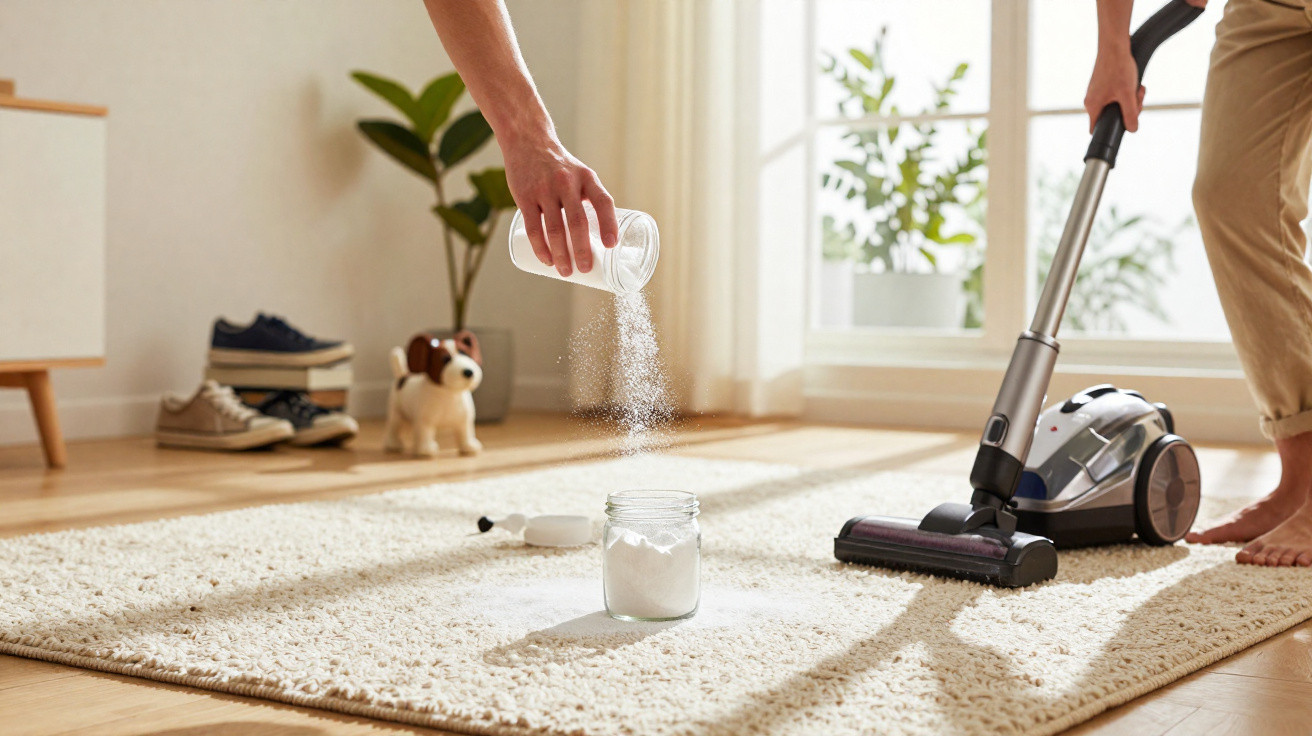
It usually starts without any drama: you get home after a long day, kick off your shoes, walk barefoot across the carpet - and there it is. A faint, musty whiff that somehow wasn’t there yesterday. Not a catastrophe, just enough to make you pull a face for a second. Maybe it was the wet dog, the children’s hot chocolate that’s half dried into the fibres, or simply years of “a quick vacuum will do”. Carpets hold on to our lives. Unfortunately, they also hang on to the smells. And suddenly you’re searching at midnight for a fast fix that doesn’t make your home smell like a chemistry lab.
Why carpets start smelling so quickly - and what that has to do with everyday life
Carpets are like quiet diaries. They remember every damp shoe, every spilled drink, every party night with crisps and red wine. They just don’t tell their stories with words - they tell them with odours. At first you barely notice it, and then you have guests round, someone steps through the door, raises an eyebrow - and you realise the carpet is sending signals. We don’t talk about it much, but smell is brutally honest. Far more honest than tidy shelves or a freshly mopped hallway.
A housing psychologist once said that people often claim in surveys that they “deep-clean carpets regularly”. Let’s be honest: nobody is doing that every day. In a British study, 62% of respondents admitted they hadn’t had their carpet professionally cleaned for over a year. Meanwhile, children spend their time down there, pets nap right on top of it, and we eat on the sofa as if tomorrow isn’t coming. No wonder odours don’t simply vanish because a vacuum has passed over the surface once.
The straightforward truth is that carpet fibres are tiny odour magnets. They absorb moisture, trap microscopic food residue, and hold on to skin flakes and pet hair. Bacteria love those conditions, and they’re exactly what “cook up” smells. What we register as “musty” or “animal” is often just the end product of their work. Suddenly, the idea of reaching for something as ordinary as bicarbonate of soda from the kitchen cupboard doesn’t seem ridiculous at all - because that powder tackles the problem where the smell begins.
The bicarbonate of soda method: simple, quiet - and surprisingly effective
Using bicarbonate of soda is almost embarrassingly easy. You need: a pack of bicarbonate of soda (pure bicarb - not baking powder), ideally a shaker or spoon, a vacuum cleaner, and a bit of patience. That’s it. The steps sound unexciting: vacuum the carpet, sprinkle bicarbonate of soda generously over the affected areas, leave it to work, then vacuum again. Yet the result can be genuinely impressive - especially if the smell has been irritating you for weeks.
The real secret is the waiting time. Bicarbonate of soda doesn’t behave like an air freshener that simply lays a vanilla scent over everything. It binds and neutralises odour molecules. Depending on how strong the smell is, leave the powder on the carpet for anything from 30 minutes to several hours - overnight is ideal. In the morning, vacuum thoroughly. Many people say the room then smells “clean”, not perfumed. As if someone opened a window inside the smell.
The most common mistake happens in the supermarket aisle: plenty of people accidentally grab baking powder instead of bicarbonate of soda. Similar name, very different outcome. Baking powder contains added acids and starches that don’t belong in a carpet. Another classic error is using too little bicarbonate of soda. A carpet that’s gone stale after a holiday with the dog needs more than a timid dusting. And then there’s patience. If you reach for the vacuum after ten minutes, you’ve barely given the powder time to do its quiet work.
“Bicarbonate of soda isn’t magic - it’s chemistry in slippers: understated, calm - and yet impressive in the end,” a cleaning expert told me when I asked about home remedies.
- Always apply bicarbonate of soda dry - moisture creates clumps and can leave marks.
- Test first on an inconspicuous area - especially with delicate or highly coloured carpets.
- Sprinkle generously, don’t hold back - the stronger the smell, the thicker the layer.
- Don’t underestimate the contact time - for pet odours, six to eight hours is not an exaggeration.
- After vacuuming, air the room well - it makes the change in smell feel even clearer.
What’s really going on in the powder - and why it feels so freeing
There’s something deeply satisfying about a problem being solved so simply. No pricey specialist cleaner, no glossy TV-ad promises, no scented cloud that gives you a headache after three minutes. A plain white powder - more often associated with biscuit dough than carpet rescue - suddenly becomes the household’s quiet star. You can almost feel a small sense of victory when the room smells noticeably more neutral and no one can tell how little effort it took.
Bicarbonate of soda is alkaline and takes on odour molecules at a chemical level. Acidic smells in particular - common examples include sweat, many foods, or urine - can be toned down this way. The powder attracts them, then neutralises or binds them. It works silently, without foam, without theatre. That’s exactly what makes it so practical for everyday life: you sprinkle it on, get on with your day, the carpet sits under a white layer, and meanwhile the thing happens that expensive labels like to dress up with shiny buzzwords.
It’s also interesting how the mood of a room shifts once the smell disappears. Suddenly the living room feels “fresh” again, even though you haven’t rearranged anything or bought new décor. Anyone living in a small flat knows the effect of one musty carpet dragging the whole space down, even visually. A neutral-smelling floor creates mental breathing room. And a practical trick starts to feel almost like a small act of self-care: you take seriously what your nose has been quietly telling you for weeks.
A carpet that doesn’t smell embarrassing - and what this small routine does to your life
This simple bicarbonate of soda method works like a reset button for your home. Not a full spring clean, not a weekend swallowed by “housework”. More like: sprinkle before bed, vacuum in the morning, done. Many people turn it into a rhythm - once a month, or whenever the dog’s been indoors more than usual, the kids have been unwell, or a gathering got a bit out of hand. Carpet care stops being one of those tasks you endlessly put off.
We all know that moment when visitors arrive and we briefly hope nobody “notices” anything. A neutral carpet takes the edge off that feeling. No obsessive perfectionism - just the sense that: “It smells like us in here, but not in an unpleasant way.” And yes, real life will always bring new stains, mishaps, and odours. That’s precisely why it helps to have a low-drama plan in the back of your mind. No guilt, no complicated products.
In the end, your carpet keeps telling your story - rainy days, film nights, the dog secretly hopping onto the sofa. The bicarbonate of soda method doesn’t erase those stories. It simply removes the unpleasant note from them. Maybe you’ll pass it on at the next coffee when a friend sighs, “My carpet smells a bit odd, but I haven’t got time for a whole cleaning programme.” Then there’s that line that sticks: one packet of bicarbonate of soda, one quiet night - and that’s often enough.
| Key point | Detail | Benefit for the reader |
|---|---|---|
| Bicarbonate of soda neutralises odours instead of masking them | An alkaline powder binds and reduces mainly acidic odour molecules in the carpet | The room smells neutral and pleasant, without an artificial fragrance cloud or headaches |
| Simple application in three steps | Vacuum the carpet, sprinkle bicarbonate of soda generously, leave for several hours, then vacuum it up | A quick, doable routine that’s easy to fit into everyday life |
| Common mistakes are easy to avoid | Don’t use baking powder, don’t apply too little, don’t vacuum too soon, use it dry | Readers save time, money and frustration because it works better on the first attempt |
FAQ:
- Can I use baking powder instead of bicarbonate of soda?
Baking powder is a mixture of bicarbonate of soda, acids and starch. These additions can leave residue in the carpet and reduce the effect. Pure bicarbonate of soda (often sold as bicarb of soda) is much better suited.- How often should I treat my carpet with bicarbonate of soda?
For a typical household, once a month or every six to eight weeks is enough. With pets, small children, or frequent spillages, applying it every two to three weeks can make sense.- Does bicarbonate of soda work against strong pet odours?
Yes - especially for dog smells or cat urine, bicarbonate of soda can work well. With very intense, old odours, you may need to repeat the treatment several times or additionally clean specific areas with moisture.- Can bicarbonate of soda damage my carpet?
For most carpets, bicarbonate of soda is harmless as long as it’s sprinkled on dry and then vacuumed up thoroughly. With delicate or very high-end carpets, test an inconspicuous spot first or check the manufacturer’s guidance.- What should I do if the smell is still there after using bicarbonate of soda?
In that case, the cause is often deeper in the fibres or in the underlay. You can repeat the bicarbonate of soda routine and extend the waiting time. If the smell remains stubborn, professional deep cleaning may be the only solution - or replacing the carpet underlay.

Comments
No comments yet. Be the first to comment!
Leave a Comment