
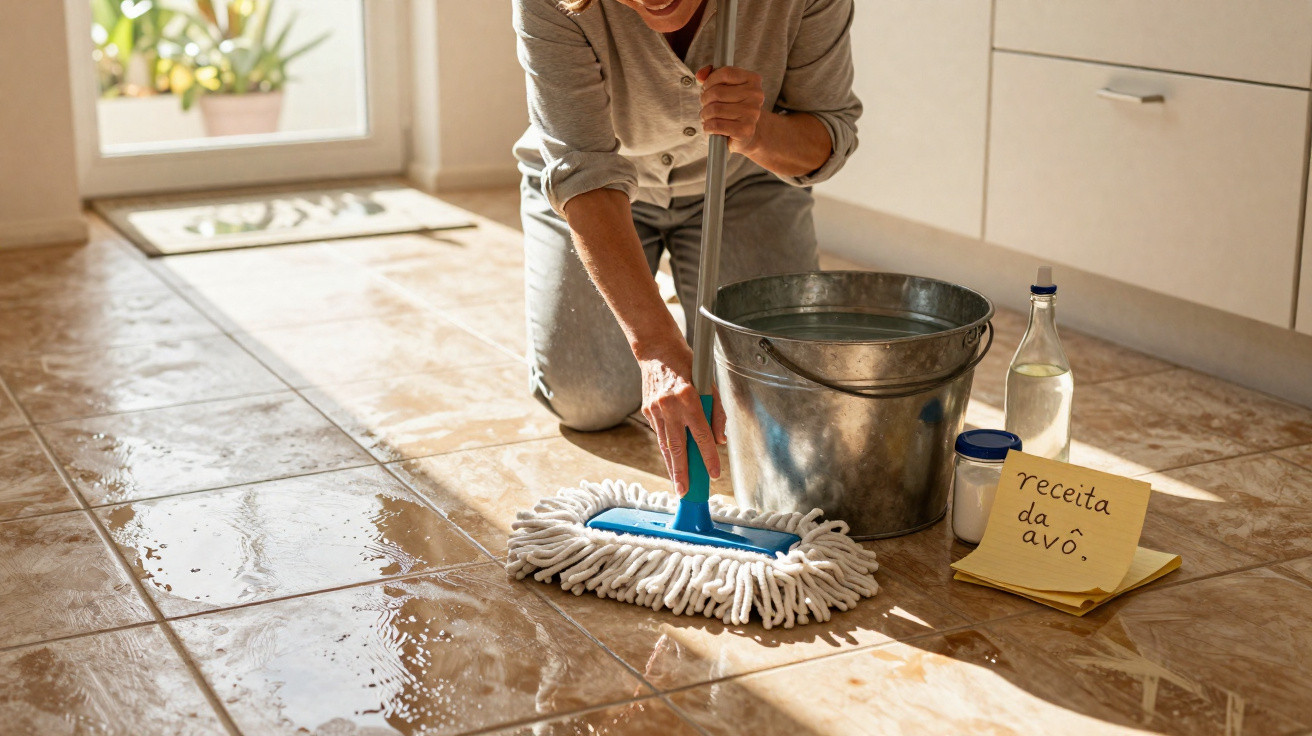
When tiles start to look dull, laminate seems to swallow up every bit of light and even regular mopping no longer helps, professionals often reach for a surprisingly simple solution.
In many homes, the assumption is: more cleaning product equals more shine. Cleaning experts disagree, and instead rely on a well-known grandmother’s mixture that uses just a few ingredients - and frequently delivers better results than pricey specialist cleaners from the high street.
Why modern floors look dull so quickly
Whether it’s tiles, laminate or vinyl, most floors don’t lose their original sheen because they’re “old”. The real culprit is build-up. Residue from multipurpose cleaners, plasticisers, fragrances and “floor care” products can settle as a thin film on the surface. Add limescale from hard water and fine dust, and the floor quickly starts to look tired.
The grandmother’s mixture isn’t about more fragrance or more foam - it’s about gently loosening these layers and revealing the floor again.
Many traditional household cleaners leave behind silicones or polymers. At first, the finish can look impressive; after a few weeks, though, the floor may appear flat, patchy or even greasy. If you respond by mopping more often, you can end up making the build-up worse.
The grandmother’s mixture: what’s actually in it
When cleaning experts talk about the famous “grandmother’s mixture”, they usually mean a straightforward three-part combination that has proved itself for decades - and is still remarkably versatile.
The basic recipe at a glance
- Warm water: the base and a solvent for dirt and grease
- Household vinegar (5–10%): lifts limescale, neutralises residue, tackles odours
- Neutral soft soap or a small dash of mild washing-up liquid: breaks down greasy grime and tracked-in dirt
For a standard cleaning bucket (about 5 litres), many professionals suggest:
- 5 litres of warm water
- 1 small cup of vinegar (about 100 ml)
- 1 tablespoon of liquid soft soap or a squirt of mild washing-up liquid
The trick isn’t a secret-ingredient hack - it’s the balance: little product, lots of water, and no unnecessary extras.
If you want a scent, you can add 2–3 drops of essential oil (for example lemon or lavender). Experts caution against overdoing it: more oil won’t make the floor cleaner or shinier, but it can increase streaking.
How to bring back the shine: step-by-step
1. Prepare the floor
Before you mop, you need a thorough dry clean. Otherwise you’re just pushing sand and dust around.
- Vacuum or sweep the floor carefully
- Don’t skip corners, skirting boards or the areas under furniture
- Remove coarse debris such as sand, crumbs or pet hair
Especially on smooth finishes like porcelain stoneware or high-gloss tiles, even a few crumbs can be the difference between a streak-free shine and fine scratches.
2. Mix it correctly
Start by filling the bucket with warm (not boiling) water. Add the vinegar and then the soft soap. Stir gently until everything has dispersed. A stronger mix doesn’t improve results - and too much soap, in particular, will leave streaks.
3. Mop properly - don’t “soak” the floor
The classic mistake is using a mop that’s far too wet. Laminate, parquet and many modern vinyl floors are especially sensitive to standing water.
- Dip the mop or pad into the solution
- Wring it out well until it’s only damp
- Mop in passes, ideally following the direction of the light or the length of the room
- Rinse the mop regularly - don’t keep going with the same dirty water for ages
Shine doesn’t come from more water - it comes from the right mixture, a well-wrung mop and careful, methodical movement across the floor.
Which floors benefit - and where to be careful
| Floor type | Suitable for the grandmother’s mixture? | Expert notes |
|---|---|---|
| Ceramic tiles / porcelain stoneware | Yes | Vinegar removes limescale haze; works very well in hard-water areas |
| Vinyl / PVC | With moderation | Halve the vinegar; avoid mopping too hot |
| Laminate | Carefully | Mop only slightly damp; allow water to evaporate quickly |
| Sealed parquet | Only very diluted | Reduce the vinegar substantially; ideally complement with specialist wood cleaners |
| Unsealed wood, marble, natural stone | No | Acetic acid can attack the surface; use specialist products here |
Why the mixture works so well
The principle is straightforward but effective: warm water loosens dirt, soft soap binds grease, and vinegar targets limescale and leftover cleaning-product residue. At the same time, vinegar neutralises many odours - particularly useful in the kitchen and hallway.
A lot of modern floor-care routines rely on strongly perfumed products that effectively “cover” the surface. The grandmother’s mixture behaves more like a reset button: it removes old layers rather than adding another one on top. That often leaves a more natural shine, rather than a greasy-looking gloss.
Cleaning experts repeatedly report that when clients switch from a flood of products to the simple mixture, after a few weeks the floor looks “like it did when they first moved in” for the first time.
Common mistakes that ruin the shine
Too much product in the bucket
Many people think, “If one spoonful is good, three must be better.” The result is streaks, sticky patches and dust that clings again more quickly. With the grandmother’s mixture, restraint matters.
Dirty mop heads and pads
A mop that’s already grey and stiff will spread more grime than it removes. Professionals recommend washing mop covers after every bigger clean at 60°C. Avoid fabric conditioner, because it can leave a film on the floor again.
Cleaning in the wrong order
If you dust first and vacuum later, you end up pulling dirt back down onto the floor. A more sensible sequence is:
- Vacuum / sweep
- Clean surfaces
- Finish by damp-mopping the floor
How often should you mop? Experts’ rule-of-thumb guidance
Cleaning experts recommend a middle path. Wet-mopping every day is unnecessary for many floors, especially wood and laminate. A practical rule of thumb:
- Kitchen and hallway: 1–2 times per week
- Living room: every 7–10 days
- Bedroom: every 10–14 days
- Households with children or pets: as needed, often more frequently in high-traffic routes
In between, a thorough dry clean with a vacuum cleaner or microfibre cloth is often enough.
Risks and limits of the grandmother’s mixture
As popular as it is, this mixture doesn’t replace correct care for delicate finishes. Natural stone, marble and unsealed wood are sensitive to acids. On these surfaces, vinegar can cause dull patches or roughen the finish.
If you have a fresh seal, special coatings or unusual floor types, check the manufacturer’s guidance first. Some surfaces tolerate only pH-neutral products.
Practical example: when the hallway becomes the problem area
A typical case from consultancy work: a heavily used hallway with grey tiles still looks slightly patchy despite regular mopping. The residents use a strongly scented multipurpose cleaner, sometimes at double strength.
Experts often recommend a “detox” phase:
- Mop two or three times in a row using only the grandmother’s mixture
- Let the floor dry completely between cleans
- Change mop covers more often and wash them hot
After just a few cleaning cycles, the old film lifts away, the tiles start reflecting light again, and the dark shadows around the walkways become noticeably weaker.
Why the mixture also scores environmentally
Fewer ingredients, fewer plastic bottles and a lower chemical burden in wastewater: the grandmother’s mixture performs well on several environmental fronts. Vinegar and soft soap are relatively simple products with clear, uncomplicated formulations.
Many households also cut down their collection of specialist cleaners: bathroom sprays, floor polishes, fragranced cleaners, limescale removers. One basic mix can cover a large part of everyday cleaning - as long as the floor type can tolerate it. That saves money and frees up space in the cleaning cupboard.
When it’s worth paying attention to the details
If you want to genuinely improve how your floor looks, it helps to understand the small-print terms on labels: “pH-neutral”, “sealed”, “with care additives”, “residue-free”. pH-neutral cleaners protect sensitive surfaces; products “with care additives” deliberately leave a film, which may look shiny in the short term but can lead to a grey haze over time.
The classic grandmother’s mixture works without these care films. It cleans and degreases without deliberately sealing the surface. If you then choose to apply a specific care product for parquet or design floors, you’re starting from a clean, low-residue base - and you can get far more out of expensive specialist products.

Comments
No comments yet. Be the first to comment!
Leave a Comment