
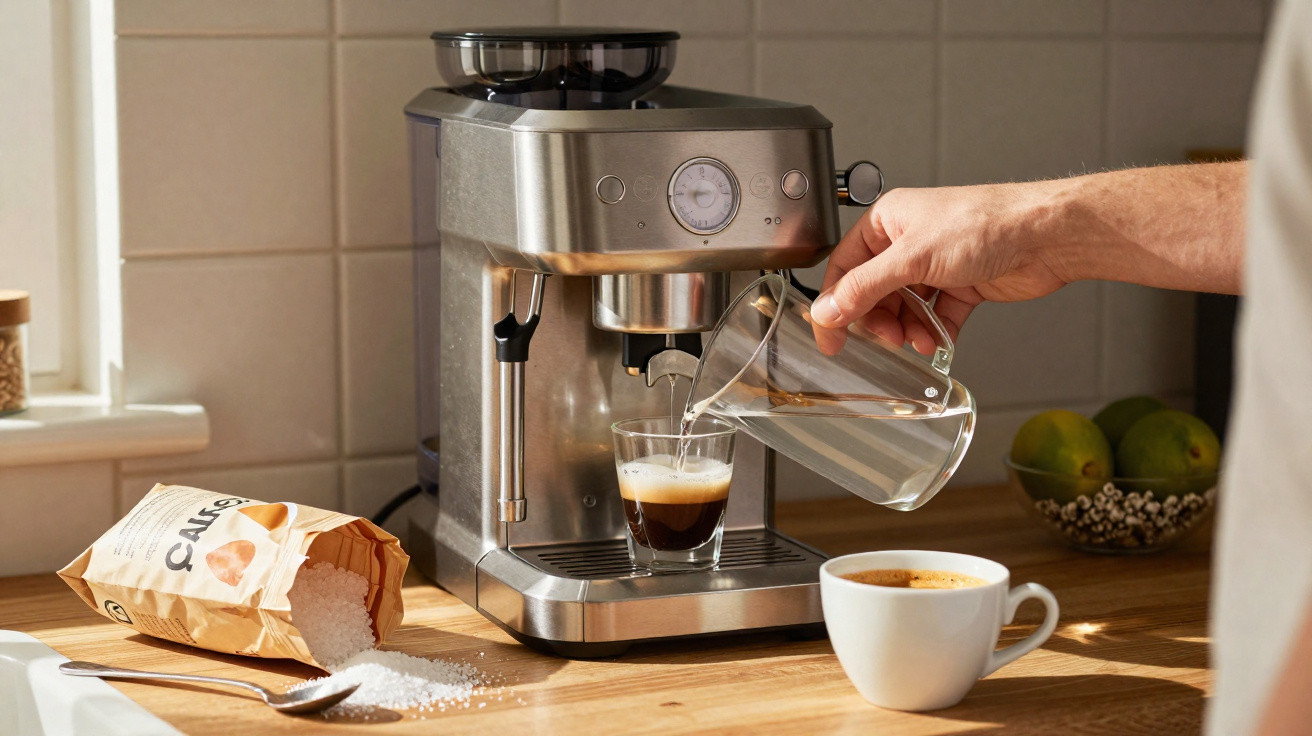
My coffee machine didn’t so much break as let out a weary little sigh.
The cheery buzz it used to make had turned into a grumble, the crema had faded into a moody beige, and that first mouthful tasted as though someone had mixed it with a chalky spoon. London tap water comes with its own character: mineral-rich enough to give kettles a stony jacket and leave faint marks on glasses. Most of us tolerate it, shrug, and get on with the day. Then one morning the machine that usually felt reliable suddenly seemed sluggish and heavy. I cleaned the worktop, checked the beans, blamed the milk, and still the coffee came out oddly… muted. The issue wasn’t the roast or the romance. It was calcium quietly constructing a small fortress inside the pipework. And what shifted it wasn’t a fancy new gadget or a trip to a repair counter. It was an everyday cleaning product, sitting in plain sight.
The quiet chalk inside your coffee
Hard water creates limescale: a hard layer of calcium carbonate that coats the routes your coffee depends on. It tightens up tubing, dulls the heat, and robs the system of pressure. The machine strains, temperatures wobble, and the flavour goes dull-often in a way your palate spots before you consciously work it out. These are tiny, fussy mechanics: how water flows, how it extracts, how heat meets the grounds at the right moment. Scale wedges itself in there like grit in a hinge, and the smooth part of the ritual starts to falter.
Most of us know the sound: a sputter you pretend you didn’t notice. A brief hiss, a little cough, maybe a sandy speck at the bottom of the cup you try not to think about. It’s the soundtrack of domestic denial. It rarely ends with more beans or a new grind setting. It ends with a proper descale.
The cleaning product hiding on the baking aisle
Here’s the surprise: the hero isn’t exotic at all. It’s citric acid-sharp, snow-like crystals you’ll find in the baking aisle or ordered online in an unassuming bag. It’s food-safe, generally kind to most metals, and excellent at breaking down calcium. A chemist might say it chelates; a home cook might mention lemony syrup; a barista will tell you it clears a machine’s arteries better than a lecture ever could. I picked mine up in a plain, no-frills packet, the sort that crinkles like an apology.
Citrus also feels oddly appropriate around coffee: clean, bright, and a bit lifting-much like the ritual itself. The chemistry supports the feeling. Citric acid turns calcium carbonate into soluble compounds that wash away, and it does it without the nightclub tang that vinegar brings. Your kitchen won’t reek of pickled regret. You’ll get warm water and the faintest hint of lemon for a moment, and then nothing.
Why citric acid beats the usual suspects
Vinegar has loyal supporters because it’s cheap and usually already in the cupboard. Yes, it will dissolve limescale, and it will do a job on a kettle or jug without much fuss. The trade-off is the smell: it creeps into rubber seals and can haunt espresso for days. Vinegar works, but your nose won’t thank you. Citric acid delivers the same outcome, with a rinse that’s far easier to live with.
Shop-bought descalers are useful too, particularly for machines with strong opinions-some brands insist on lactic acid formulas or tablet systems to keep warranties happy. Those products are designed to be effective while staying safe for specific materials, and they’re ideal when you want something straightforward. Citric acid is the nimble alternative: no branding, no added perfume. It costs pennies per go, dissolves quickly, and leaves very little fuss behind.
A small ritual: how to descale without drama
You don’t need a free weekend or a lab coat. Mix 1 to 2 tablespoons of citric acid into 1 litre of warm water. Tip it into the reservoir of your drip machine, pod machine, or espresso machine. Run a cycle as though you’re making coffee-no coffee in the basket-then pause halfway so the solution can sit in the warmed pipework for ten minutes. Start it up again and let the cycle complete.
Then comes the rinse, which is where patience turns into flavour. Refill with fresh water and run two full tanks through, pausing once again for a brief soak. Descale, then rinse. Twice. If your machine has a steam wand, let a small amount of the solution pass through it as well, followed by clean water. You’ll be able to hear the difference: freer, like breathing after a blocked nose.
If you prefer exact numbers, aim for about 10 to 20 grams of citric acid per litre of water. That’s a gentle mix-friendlier to seals and metal, but still thoroughly impolite to limescale. Espresso machines with heat-exchanger or dual-boiler layouts often do best with a detergent backflush for coffee oils, plus a separate descale for mineral build-up. If that sentence made your eyes glaze over, don’t worry: the simple reservoir cycle still saves most home machines.
What your coffee tastes like after
The improvement isn’t a fireworks display. It’s definition. Bitterness relaxes, sweetness has more room, and the finish feels neater. Milk texture comes together faster, with a softer, silkier sound, and the crema shifts from timid to convincing. It’s as if the coffee has remembered what it’s meant to taste like.
I stood in a quiet kitchen and listened to the machine sound like itself again. The pour had a lightness it hadn’t had the week before, the stream catching the light like sun on a kettle spout. The first sip wasn’t dramatic so much as… correct. Like removing cotton wool from your ears. It briefly made me want to tidy my entire life, and then I remembered who I am.
If your machine has opinions (and many do)
Some manufacturers are particular about what goes into their machines. De’Longhi nudges you towards lactic acid solutions, Siemens prefers a tablet, and certain espresso brands treat vinegar like a bad ex. Aluminium boilers deserve extra care-mild citric mixes are usually fine for short descales, but long soaks can leave marks. Stainless steel and brass tend to be more forgiving. It’s worth a quick glance at the manual, if only to avoid the theatrical sigh of a repair desk later.
Pods, drip machines, manual espresso-each has its own little routine. Pod machines often respond well to slower pulses through the brew head, a pause, then another pulse. Drip machines prefer a full reservoir and an unhurried run. Espresso machines typically benefit from a grouphead backflush for coffee oils, then a separate descale through the tank for scale. Treat it like housekeeping, not surgery.
The stuff you notice only when it’s gone
Limescale robs heat-sometimes only a few degrees, but coffee is sensitive about temperature. Too cool and extraction loses its hold; too hot and bitterness moves in like an awkward lodger. Once the scale is gone, the temperature settles, and you can taste the steadiness in the cup. Lighter roasts show it most: floral notes stop hiding and reappear. Darker roasts gain cleaner edges and less muddiness in the centre.
You’ll likely trim your electricity use a little as well. A scaled heating element is like putting a winter coat over a radiator: it wastes energy just to get water to the same point. You won’t fund a holiday with the savings, but a bit of efficiency is its own kind of courtesy. The machine feels cooler to the touch, the steam wand wakes up more quickly, and the morning rhythm stops catching on those awkward coughs.
Keeping scale at bay without turning into a lab tech
Water hardness runs this entire plot. If you live in the UK’s chalk belt, your kettle’s crust tells you everything you need to know. A jug filter takes the edge off and makes your descale schedule less relentless. Change the cartridge when you’re meant to, or it stops doing its job. In-tank and in-line filters help too, but they’re more like bouncers on the door than miracle workers.
As a rough guide, descale monthly in hard-water areas if you brew every day, or every two to three months if you’re more of a weekend drinker. Smaller machines scale up more quickly because there’s less water to dilute the minerals. You’ll hear the need approaching: the pump gets louder, the flow turns uneven, the shot timing starts drifting. Scale isn’t dramatic-until it suddenly is, and then it’s an expensive phone call.
Let’s be realistic: nobody truly keeps on top of this daily.
So set up a habit that makes room for your own laziness. Keep a jar of citric acid by the beans, with a teaspoon inside it. Put a repeating reminder in your phone for the first Sunday of the month. When it goes off, you’ll be halfway through the job before your mind has time to argue. The best routine is the one you’ll actually do.
Little checks that change everything
On espresso, keep an eye on shot times; a slow, steady creep upwards usually points to restricted pathways, not “better extraction”. After rinsing, taste the water the machine produces-it should be clear and smell like… nothing. If there’s even a faint sour note, run another tank. For steam wands, purge before and after milk, wipe the tip, and clear the holes with a pin once a week. Oils and milk residue aren’t limescale, but they do trap heat where it shouldn’t be.
One caution for enthusiastic cleaners: don’t leave rubber gaskets or silicone parts soaking in strong acid solutions. Brief contact with a mild mix is fine; long soaks make elastomers sulk. If you take anything apart, snap a photo first so the screws don’t start swapping places on the way back in.
When vinegar is the only thing left in the cupboard
Sometimes the need to fix things hits at 10 p.m., and all you’ve got is spirit vinegar and optimism. In a pinch, you can use it-well diluted-and then rinse like your reputation depends on it. Run three full tanks of clean water afterwards, and expect a slight tang that hangs around for a day. Your machine won’t explode, but your cappuccino may smell faintly of chips. Think of vinegar as your emergency option, not your standard habit.
If odour is a deal-breaker, there are odourless commercial liquids that work beautifully and disappear without ceremony. They cost more and come in shinier bottles. The result is the same result citric acid delivers from a paper packet. The only real variables are price, convenience, and what you want your kitchen to smell like while you wait.
The day my machine forgave me
I did the descale on a grey Sunday-the sort where the street sounds muted and the flat smells of toast. The solution moved through in small, soft sighs, and the machine felt as though it stood a little straighter afterwards. I rinsed, ran a cloth over the counter, and watched water bead more brightly on the stainless steel.
Then came the first espresso: richer and rounder, not louder. The crema pulled itself together like a well-made sentence.
There’s a particular satisfaction in small, domestic redemption. You fix the thing you’ve been postponing, and the reward turns up every morning without demanding attention. It’s not a new car or a weekend by the sea. It’s a quiet cup that tastes like care. Scale leaves, and the machine remembers you’re on the same team.




Comments
No comments yet. Be the first to comment!
Leave a Comment