
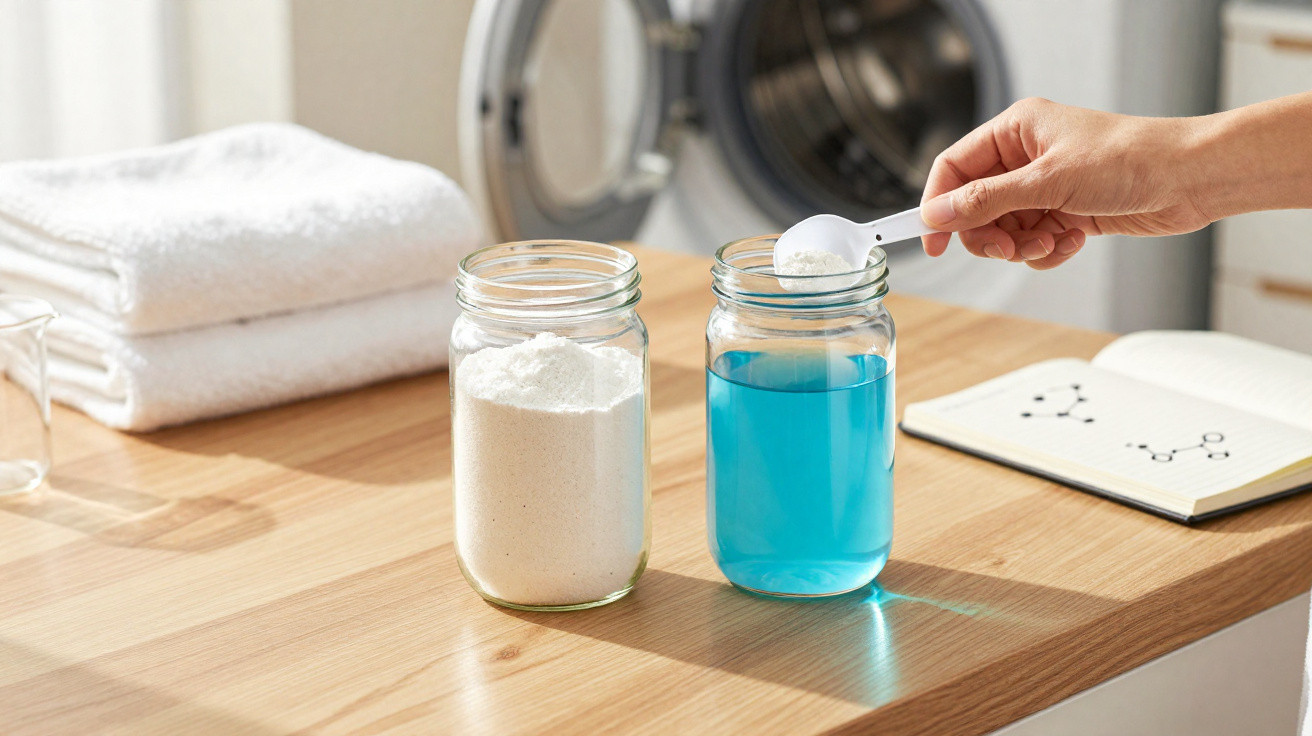
Choosing a laundry detergent can feel overwhelming: the shelves are packed with options, and most of them will make your washing at least a bit cleaner. The real question is which choice gives you the best results for your clothes without wasting money.
Are you chasing brighter whites? Do you actually need enzymes? And how does powder detergent really differ from liquid detergent?
As with many everyday decisions, a basic grasp of the chemistry makes those questions much easier to answer.
What is a detergent?
In both laundry powders and laundry liquids, the key cleaning chemicals are surfactants - also called detergents (which is where the product category gets its name). Surfactants are usually charged (or “ionic”) molecules with two clearly different sections: one part mixes readily with water, and the other part prefers oils.
Because of this two-part structure, surfactants can pull grease and dirt away from fabric and keep it dispersed in the wash water. They can also create bubbles.
However, dissolved metal salts in your tap water can reduce how well surfactants work. In so-called hard water, there are high levels of dissolved calcium and magnesium salts, which can easily lead to soap scum.
To prevent this, modern detergents include phosphates, water softeners and other metal “sequestrants” designed to stop soap scum forming. Phosphates can trigger algal blooms in freshwater systems, which is why current formulations generally use lower phosphate levels than in the past.
A lot of products also add optical brighteners. These absorb ultraviolet light and emit blue light, creating the "whiter white" or "brighter colour" effect.
Fragrances are common too. They are not essential for the cleaning chemistry, but they help make clothes smell “fresh”.
Finally, some detergents include enzymes - discussed further below.
What's in laundry powder?
Although surfactants and anti–soap scum ingredients are central to performance, they are not the largest portion by volume. Laundry powders are mostly made up of salts (such as sodium sulfate), which provide bulk and help prevent the powder sticking together.
Another salt you’ll often find in powdered detergents is sodium carbonate, better known as washing soda. Washing soda (closely related to bicarbonate of soda) helps chemically alter greasy and grimy material so it becomes more soluble in water.
Powder products also commonly include oxidising agents such as sodium percarbonate - a stable combination of washing soda and hydrogen peroxide. A further additive, tetraacetylethylenediamine, “activates” the percarbonate to produce a gentle bleaching action.
From a formulation standpoint, powders have a chemical edge: ingredients can be blended while still remaining separate as solids. (That’s why you can often spot different granules within the powder.)
What's in laundry liquid?
In liquid detergent, the primary component is simply water. Everything else in the formula has to be chosen with care so the mixture stays stable in the bottle and then performs properly together in the wash.
Liquids can contain many of the same types of components found in powders, including alkaline salts, metal sequestrants, water softeners and surfactants.
On liquid labels, surfactants are often described as ionic (charged) and non-ionic (uncharged). Non-ionic surfactants are frequently liquid by nature, which makes them unsuitable for many powdered recipes. They are effective at keeping oils suspended in water, and they do not create soap scum.
Liquid detergents also require preservatives to stop microbes growing and spoiling the product.
Microbes matter inside the washing machine as well. Liquid formulations cannot include the peroxide-based mild bleaches used in powders. Peroxides help kill microbes. Without them, liquid detergents make it more likely that mould biofilms can develop in the machine and that bacteria can be passed from one garment to another.
Instead of peroxide sources, liquids typically rely on optical brighteners only.
Liquids do offer one practical benefit: you can apply them directly to a stain before putting the item into the wash.
A newer “convenience” format for liquid detergents is the highly concentrated detergent pod. These are brightly coloured and can look like sweets; studies have found them to be hazardous to young children and to people with cognitive impairment.
Pods also take away the ability to dose down - for example, when washing a smaller load or when you simply want to use less detergent overall.
So, what about enzymes?
Enzymes are proteins that have evolved in nature and are added to laundry products to target particular types of stains. In chemical terms, they are catalysts: substances that accelerate chemical reactions.
Enzyme names typically reflect what they act on, followed by “-ase”. For instance, lipase breaks down fats (lipids), protease acts on proteins, and amylase and mannanase help break down starches and sugars.
These enzymes are sourced from organisms found in cool-climate regions, which helps them operate effectively at the relatively low temperatures used in washing.
If you run the wash much too hot, the enzymes can be damaged or denatured, meaning their structure changes and they stop helping. A useful comparison is egg white turning from translucent to white when cooked - that’s protein denaturing.
So, if your detergent includes enzymes, the wash temperature needs to avoid extremes at either end. As a reference point, standard laundry tests commonly use 15–20°C.
Is powder or liquid better?
People choose detergents based on a mixture of factors: cleaning performance, psychology, cost, fragrance, environmental impact and convenience.
It can be helpful to trial a few options to see what suits you best, while also matching your household budget and priorities such as recyclable packaging.
Personally, I wash at 20°C using half the recommended amount of a pleasantly scented laundry powder that comes in recyclable cardboard and includes a broad selection of enzymes plus an activated peroxide source.
A little chemical understanding can make a meaningful difference to how clean your clothes come out.
That said, detergent brands do not always print a complete ingredient list on the packaging.
If you want more detail on what your particular product contains, you’ll need to check the manufacturer’s website. You can also go further by consulting safety data sheets (SDS). Any product containing potentially hazardous chemicals must have an SDS.
Nathan Kilah, Senior Lecturer in Chemistry, University of Tasmania
This article is republished from The Conversation under a Creative Commons licence. Read the original article.






Comments
No comments yet. Be the first to comment!
Leave a Comment