
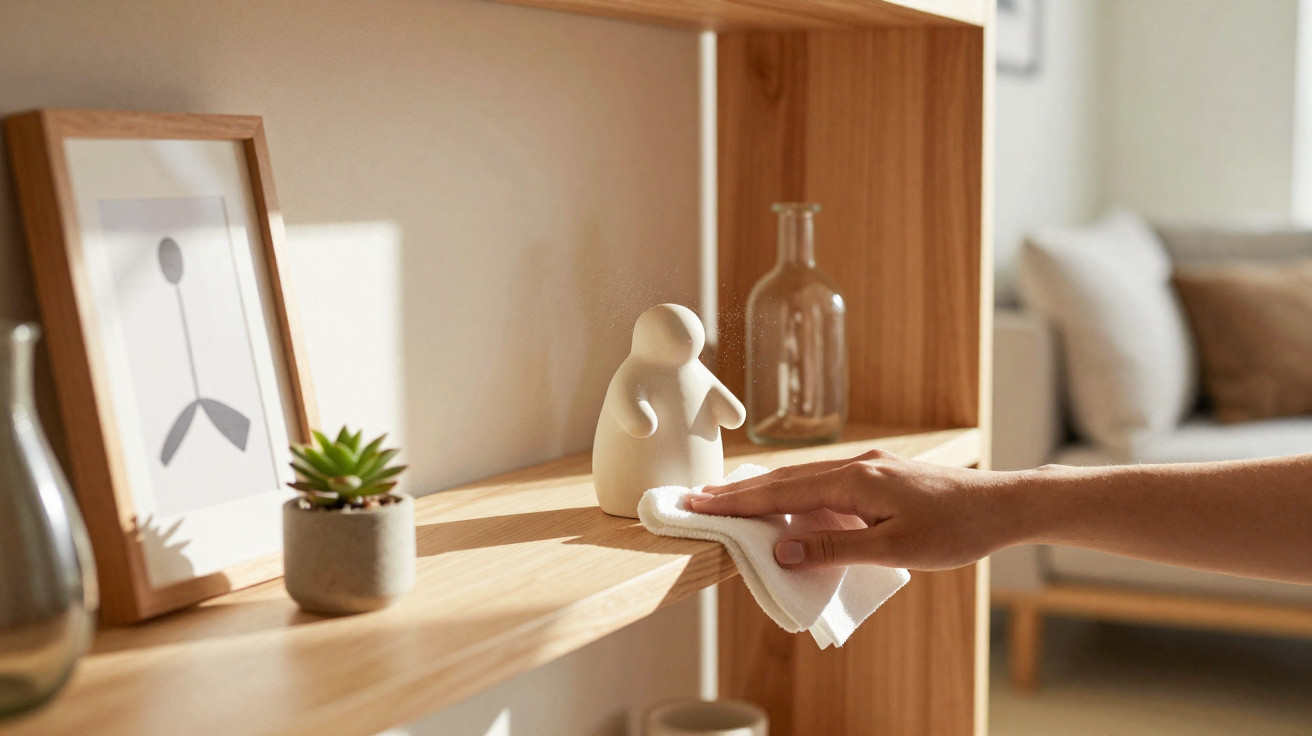
Sunday morning: the living room is freshly tidied, the candles are lined up like troops, and that ceramic vase you adore catches the light perfectly. You pop off to make a coffee, reply to a couple of messages, get on with your day. A few days later you step back into the room, the sun hits the shelf… and it’s there: a faint grey haze across every ornament, as if your home has aged a decade overnight.
You exhale at a little figurine, run a finger along a photo frame, and it clicks-your “pretty things” are basically dust magnets. The more objects you display, the more your shelves start to resemble a museum of particles. It isn’t that you’re messy; it’s that you’re outnumbered.
A silent battle is going on between your decor and the dust you can’t even see.
Why dust loves your decorative objects so much
Scan any packed shelf and you can sense it: dust has moved in. It settles on every ledge, clings to each tiny groove in a carved wooden box, and gathers on the uneven finish of a clay pot. The items that give a room character are often the ones that collect dust the quickest. A smooth television screen is a quick wipe; the delicate mementos from that holiday five years ago are another story.
Most “decorative objects” share a few traits: they’re small, they sit still, and they’re left untouched for weeks. For airborne particles searching for somewhere to land, that’s the ideal arrangement.
Imagine someone spending hours styling a corner: a gallery wall, little sculptures, travel treasures, neatly spaced frames. It looks like a Pinterest board brought to life. Then, two weeks on, a beam of sunlight catches the shelf edge and suddenly everything looks worn out. Each piece carries a fine border of dust, like it’s been stored in a sealed loft.
She attempts a frantic save-snatches whatever cloth is nearby and rushes through the items one by one. The cloth mostly redistributes the dust, the smallest ornaments wobble dangerously, and by the end she’s irritated because the “perfect corner” somehow looks worse. The mood she wanted from her decor has turned into a maintenance problem.
Dust also isn’t simply “dirt from outdoors”. It’s a constantly circulating blend of fabric fibres, dead skin cells, pet hair, pollution, cooking residue and microscopic particles. These float around, bump into surfaces, cling via static electricity or natural oils, and then settle. The more irregular and textured the object, the more firmly the dust holds on.
Placement makes a difference too. Shelves near windows or radiators tend to catch more airflow. Open-plan layouts can carry dust from the kitchen into the sitting room. And when objects are clustered tightly together, they create tiny micro-corners where dust gets trapped. So when it feels as though dust appears “from nowhere”, it’s actually arriving in a very predictable way.
Simple habits that quietly block dust buildup
The best defence against dusty decor isn’t a magical spray-it’s a small, consistent habit. A quick pass once a week, using the right tool, goes a long way. A soft microfibre cloth or electrostatic duster, lightly dampened for non-porous items, will handle most of it. Work your way round the room: the tops of frames, the rim of vases, the shoulders of figurines, the leaves of artificial plants.
Treat it like brushing your teeth: fast, routine, and not theatrical. When you stop waiting until dust is obvious and start wiping before you can “see” it, the film never gets a chance to build up-and delicate pieces don’t end up needing stressful deep-clean sessions.
A second helpful shift is to cut down on how many items sit out in the open. Not to get rid of them, but to organise them more intelligently. Put perfume bottles on a tray, place a glass dome over a special figurine, use a box for small souvenirs. Your style stays the same; you’re simply changing what the dust lands on.
Realistically, nobody keeps this up every single day. But if you make one rule-every new decorative piece must be grouped or protected in some way-you stop creating extra work for your future self. You’re designing a display that’s maintainable, not just attractive on day one.
The biggest mistake is going in too hard. People reach for abrasive cloths, overuse cleaning products, or spray straight onto delicate items. Liquids can soak into wood, fragrances can discolour, and paint finishes can dull. Dust leaves, but the damage stays.
“Dust is light and stubborn at the same time. If you fight it too hard, you hurt the object more than the dust,” says a professional home stager who spends her life arranging and preserving decor for photoshoots.
- Choose microfibre over paper towels for most surfaces.
- Dust first, then vacuum, so anything that falls gets picked up.
- Cover candles when they’re not in use to prevent a waxy dust layer.
- Turn or rotate objects occasionally so the hidden sides don’t become dust traps.
- For intricate pieces, think about enclosed shelving or glass-fronted cabinets.
Living with objects you love, not objects you serve
Underneath the whole dust issue is a quieter question: do your decorative objects support your life, or are you constantly working around them? When a room is packed with things that need regular wiping, lifting and rearranging, it’s hard to truly unwind. You end up treading carefully, and each time you walk past that crowded shelf you feel a flicker of annoyance-because you know one shaft of sunlight will reveal it all again.
When you pick a few statement pieces, cluster the smaller items, shield the fragile ones and stick to a simple weekly dusting pass, everything feels lighter. Cleaning day stops being something you dread. You already know the routine, and it takes about ten minutes.
| Key point | Detail | Value for the reader |
|---|---|---|
| Controlled routines | Short, regular dusting with proper tools | Less buildup, no overwhelming “deep clean” sessions |
| Smart object placement | Grouping items, covering delicate or textured pieces | Same decor style with much lower maintenance |
| Material awareness | Gentle methods adapted to wood, glass, ceramics, metals | Longer-lasting objects, fewer scratches or faded finishes |
FAQ:
- Question 1 How often should I dust decorative objects to prevent buildup?
Once a week works well in most homes. If you live in a city or a particularly dusty area, doing a quick extra pass twice a week on the most exposed items (near windows, vents or radiators) keeps it manageable without becoming a nuisance.- Question 2 What’s the best way to dust very intricate or fragile objects?
Use a soft make-up brush or a small artist’s brush. Lightly tap or sweep the dust away, and hold a microfibre cloth underneath to catch what falls. Avoid spraying anything directly onto the object-especially older wood, painted items or collectibles.- Question 3 Do air purifiers really help with dust on decor?
They can lower the amount of particles floating around, particularly if you have pets or live near a busy road. They won’t eliminate dust completely, but they can slow how quickly it settles-meaning fewer visible layers on shelves and ornaments.- Question 4 How can I keep fake plants from looking dusty and dull?
Once a month, take them to the shower or outside and rinse gently with lukewarm water, then leave them to dry upside down. Between rinses, use a dry microfibre duster or a cool hairdryer on a low setting to shift loose dust.- Question 5 Are there materials that collect less dust than others?
Glass and smooth ceramics are generally easiest, because dust doesn’t grip them as firmly. Rough wood, carved stone, highly textured fabrics and open-weave decor (such as some baskets) tend to trap more particles and will need more frequent, gentle dusting.


Comments
No comments yet. Be the first to comment!
Leave a Comment