
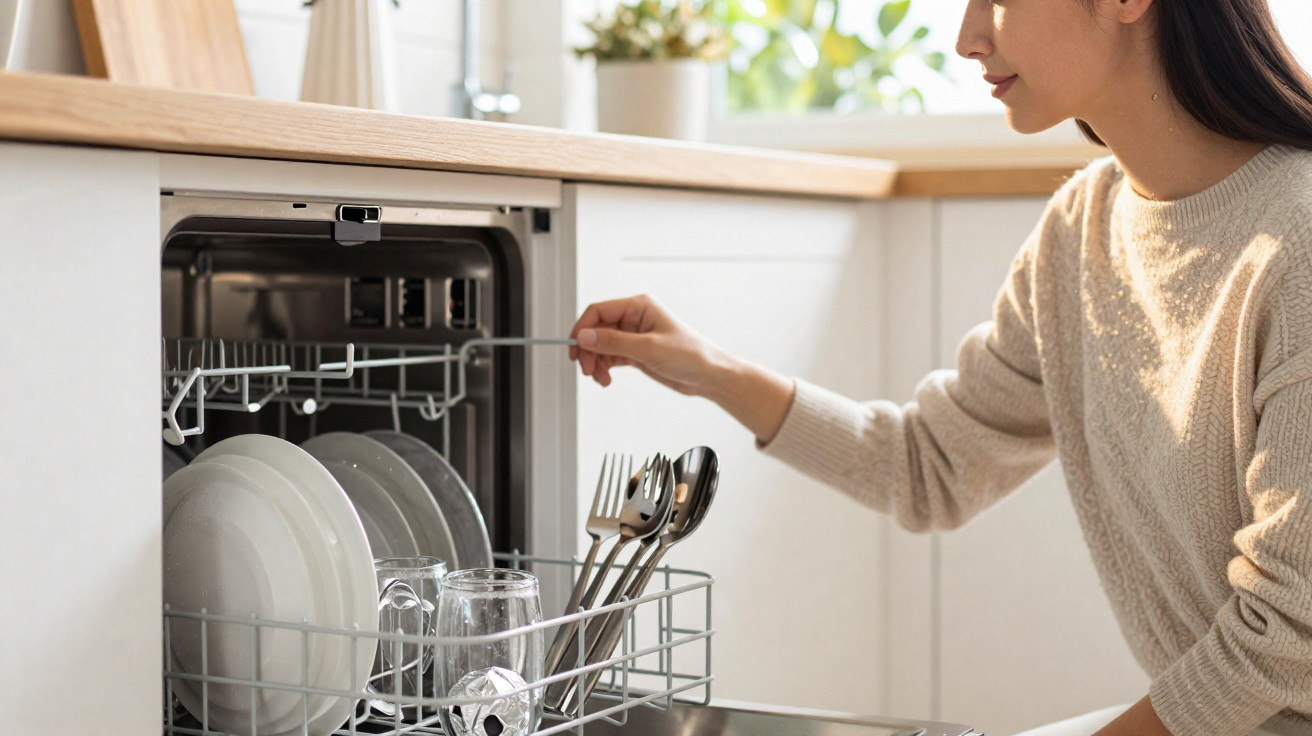
I ran a set of controlled loads to find out what, if anything, really changes.
I didn’t alter my normal routine: identical programme, identical detergent, identical water. The one and only variable was a loose, scrunched ball of aluminium foil dropped into the cutlery basket. After each run, I looked for differences in shine, water spots, drying performance, and any limescale marks on glass and metal.
What the trick claims to do
The claim is straightforward: leave a crumpled foil ball inside the dishwasher during a wash. People who swear by it say it helps items dry better, reduces scale marks, and makes metal look brighter. The explanation usually blends two mechanisms: light rubbing as pieces move during the wash, plus a galvanic interaction near stainless-steel items that may slow tarnishing on silver-plated cutlery.
"In my tests, stainless steel cutlery looked cleaner and brighter, with fewer water spots. Glass saw a small improvement. Aluminum cookware did not benefit."
How I tested the foil ball in the dishwasher
I put four consecutive loads through a mid-range dishwasher that’s about five years old:
- Eco 50°C programme, hard water, built-in softener adjusted to match local hardness.
- The same dose of powder detergent and rinse aid each time.
- A mixed load: plates, glasses, stainless cutlery, plus a few pans.
- Two washes without foil, then two washes with a foil ball (roughly the size of a table-tennis ball up to a tennis ball) placed in the cutlery basket.
What changed with the foil
With the foil in place, the cutlery showed fewer spots and a more polished-looking finish. The beaded water marks on spoons, in particular, dropped noticeably. I also noticed a slight improvement on the inner stainless-steel walls.
Drying seemed faster on metal items, but I didn’t see the same effect on plastics. The foil didn’t magically lift baked-on residue either; the detergent and the heat were still doing most of that work.
What didn’t change
The cloudy film on glasses caused by hard water looked largely unchanged. That type of haze is often etching from minerals, not simply leftover residue-and the foil won’t undo etching.
It also didn’t rescue greasy pans that really needed a pre-soak. Non-stick surfaces didn’t improve at all, and they shouldn’t be exposed to any extra abrasion.
"The sweet spot: stainless steel knives, forks, and spoons. The question mark: delicate glassware and aluminum pans."
Why it might work
There are probably two things going on. First, the foil ball introduces extra contact points in the cutlery basket, which can disrupt how water sits on surfaces and help knock a few droplets loose before they dry into spots.
Second, in hot, alkaline wash water, aluminium and stainless steel in close proximity can create a small galvanic effect. That can, in some cases, reduce sulfide tarnish on silver-plated items-similar in principle to the familiar baking-soda-and-foil bath. Inside a dishwasher the effect is weaker and not always consistent, but on some sets it can still be visible.
How to try it safely
- Crush a loose ball roughly table-tennis to tennis ball size.
- Put it in the cutlery basket, not on the base where it could interfere with the spray arm.
- Keep it well away from non-stick coatings and delicate crystal.
- Swap the ball out after 8–10 cycles as it starts to break down.
- Don’t wash silver alongside stainless if you have fragile silverware; hand-wash valuable pieces instead.
"A foil ball is a tweak, not a substitute for rinse aid, softener salt, or proper loading."
How it compares with common fixes
| Method | Main benefit | Best for | Risks or limits |
|---|---|---|---|
| Foil ball in basket | Slightly brighter metal, fewer spots | Stainless cutlery, silver-plated in good condition | No help for etched glass; keep away from non-stick |
| Rinse aid | Improved sheeting and drying | Glasses, plastics, cutlery | Too much can leave streaks |
| Softener salt | Reduces hard-water minerals | Cloudy glass, limescale | Only suitable for models with a salt reservoir |
| Citrate or dishwasher descaler | Clears scale inside the machine | Spray arms, heater, sensors | Follow dosage; run empty maintenance cycles |
Results you can expect
In a typical hard-water setup, the foil ball removed some of the dullness from forks and spoons. It didn’t dramatically change every glass, and it didn’t clean heavy grime on its own.
Treat it as a small advantage on top of the basics. If your dishwasher is already dialled in with the correct salt setting and a dependable rinse aid, you may see a modest improvement on metal. If you’re not doing those fundamentals, you’ll get more by fixing them first.
Loading and settings matter more
Leave gaps between spoons so water can reach every side. If it’s safe in your household, place knives and forks facing up, or alternate directions to prevent nesting. Choose a hotter programme for greasy loads.
Clean the filter weekly. Inspect the spray arms for seeds or shells trapped in the jets. These practical steps outperform any hack.
Beyond the dishwasher: other foil uses, tested with caution
- Camping scrubber: a foil ball can shift carbonised residue from steel pans. Don’t use it on non-stick or enamel surfaces that scratch easily.
- Quick knife refresh: folding a sheet and cutting through it around a dozen times may smooth tiny burrs. It’s a temporary fix, not proper sharpening.
- Fridge myth check: a foil ball won’t improve cooling. Proper airflow, clean vents, and not overfilling the fridge matter. Foil can reflect a bit of light into a dark corner, but that’s purely cosmetic.
"Use foil as a helper, not a cure-all. Choose the right tool for delicate surfaces."
Practical tips to boost shine without new gadgets
- Match detergent to your water hardness: too little can leave a film; too much can cause streaking.
- Set the softener correctly using your council’s hardness figure or a test strip.
- Use glass-care programmes for stemware and avoid heated drying if etching is a concern.
- Run a hot maintenance wash with a machine cleaner every six to eight weeks.
- Aim for roughly 1–1.5 cm gaps between plates so the spray can reach properly.
What to avoid and what to monitor
Don’t allow loose foil to drift towards the heating element area. After the programme finishes, check that the ball stayed where you placed it.
If you have antique silver or soft aluminium pans, don’t mix them with stainless loads. Etched glass won’t come back; focus on prevention by correcting hardness settings and choosing glass-safe programmes. And if your dishwasher manual warns against foreign objects in baskets, follow that guidance.
Extra context that helps decisions
Most dishwasher “problems” come down to water chemistry. The cloudy veil on glasses is often mineral etching-a permanent change to the surface-so prevention is the only real option.
If you’re renting in a hard-water area, a small adjustment such as increasing the salt setting or switching to a detergent with more citrate can make a bigger difference than any hack. If your home already has soft water, reduce detergent to avoid streaking and rainbow sheen.
If you like to quantify things, try this: photograph a spoon and a glass against a dark background before you start, then again after three cycles using the foil ball. Compare how sharp the reflections look and how many spots remain. If metal improves but glass doesn’t, you’re seeing the same pattern I recorded. Keep the foil trick for cutlery, and depend on rinse aid, correct softening, and good loading for everything else.

Comments
No comments yet. Be the first to comment!
Leave a Comment