
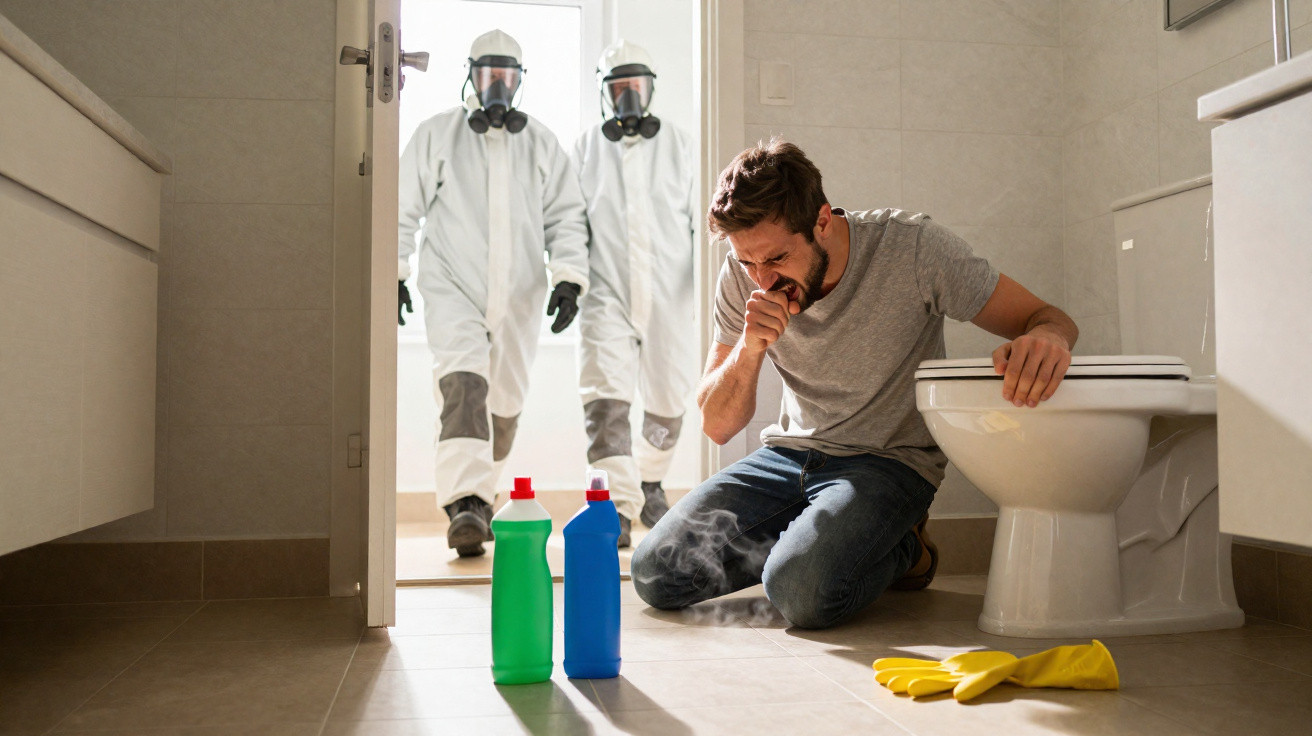
What sounded like routine cleaning turned into an emergency response with blue lights and breathing apparatus. In a flat, a 35-year-old combined everyday household cleaners to make his bathroom tiles shine. The result was a toxic gas, the man could barely breathe, and 13 firefighters were called out.
Bathroom cleaning spirals: breathlessness instead of shine
The incident happened on a Thursday evening in a block of flats in the area around the city of Albi in southern France. Initial reports say the 35-year-old wanted to scrub his bathroom walls especially thoroughly. To do so, he poured a mixture of chlorine cleaner and vinegar-based cleaner into a spray bottle and sprayed the room liberally.
Within a short time, he developed severe irritation of the airways. The air felt as if it was burning, he began coughing heavily, and soon he was struggling to breathe. Neighbours noticed something was wrong and alerted the emergency services.
What had been intended as a “secret cleaning recipe” turned out to be a chemical hazard mix that released a toxic gas.
Fire crews arrived shortly after the call. Because the situation was unclear, responders entered the building wearing breathing apparatus, tested the air, and brought the man outside.
Why mixing cleaning products is so dangerous
Firefighters later explained that combining chlorine-based cleaners with acidic products - such as vinegar, bathroom descalers or toilet cleaners - can release highly irritating gases. In this specific case, fumes formed that aggressively attacked the mucous membranes.
Such gases can:
- severely irritate eyes and nose
- trigger coughing fits
- cause breathlessness and chest pain
- damage the lungs at higher concentrations
Many people underestimate the risk because the individual products are freely available in supermarkets and seem “harmless”. The belief that “more is better” or that “two strong cleaners will work even better” persists - and repeatedly leads to call-outs.
13 firefighters and several vehicles deployed
According to media reports, 13 firefighters responded in the Albi area with three vehicles. The concern was not only for the man’s condition, but also the possibility that gas could spread into the stairwell.
The crews had to:
- ventilate the flat and check air quality
- secure the area to protect other residents
- provide medical assistance to the patient
- neutralise and dispose of the toxic mixture
After initial treatment by paramedics, the 35-year-old was taken to hospital. The fire service reported irritation of the airways and noted that the severity of any harm depends on the duration and intensity of exposure.
Even a few breaths of a high concentration can have long-term consequences for the lungs.
Cleaning products you should never combine
This case shows how quickly an everyday task can become dangerous. Many household products are chemically incompatible. Particularly risky are combinations such as:
| Product 1 | Product 2 | Possible outcome |
|---|---|---|
| Chlorine cleaner / bleach | Vinegar-based cleaner or bathroom descaler | irritating gases, severe airway irritation |
| Chlorine-based toilet cleaner | Acid-based toilet or drain cleaner | toxic fumes in the bathroom, danger to lungs and eyes |
| Drain cleaner (strongly alkaline) | Acidic cleaners | violent chemical reactions, splashes, heat build-up |
| Alcohol-based cleaner | Strongly oxidising agents | fire risk, irritating fumes |
Manufacturers explicitly warn on labels not to mix products. In practice, these instructions are often forgotten - especially when someone quickly tops up a bottle or uses two cleaners one after the other in the same spray bottle.
Common mistakes when cleaning the bathroom
In many homes, bathroom cleaning involves a whole line-up of products: limescale remover for the shower, chlorine for grout, glass cleaner for mirrors and taps. Used one after another, with thorough rinsing in between, this is usually unproblematic.
Risk increases when several factors come together:
- poor ventilation in the bathroom, for example with no window
- using a spray bottle that puts fine aerosols into the air
- combined use, or use in quick succession, of different cleaners
- not wearing gloves or protective eyewear
In this incident, the man mixed the cleaners directly in a spray bottle. That meant any fumes produced reached his airways very quickly. Add the tight, enclosed space of a bathroom alcove and it becomes a classic high-risk scenario.
How to clean the bathroom and toilet safely
If you want to keep your bathroom hygienically clean, you do not need a home chemistry experiment. A few simple rules substantially reduce the risk:
- Never mix different cleaners in the same container.
- Always ventilate well while cleaning: open a window or switch on the extractor.
- Wear rubber gloves; with harsher products, use basic protective goggles as well.
- Leave cleaners to work only for the time stated on the packaging.
- Rinse surfaces thoroughly with clean water after cleaning.
- Keep products in their original packaging and actually read the warnings.
The safest combination at home is: one cleaner at a time - and always water and fresh air in between.
Many professional cleaning teams in commercial settings also avoid random mixtures; instead, they use clearly separated applications and strict procedures. That approach can be followed at home too.
What to do if poisoning still occurs
If you suddenly notice coughing, breathlessness, stinging eyes or a sharp smell while cleaning, act immediately:
- stop all cleaning straight away
- open windows and doors and create a through-draught
- leave the room and get into fresh air
- call the emergency services if breathlessness or severe symptoms occur
- do not inhale or drink any “remedies” without advice from professionals
For children, older people, and anyone with asthma or pre-existing lung conditions, even a smaller dose can be dangerous. That is why emergency services often respond cautiously to such calls and may attend with multiple crews.
Why this case matters for many households
At first glance, the incident from France looks like an odd blue-lights story. On closer inspection, it reflects a common pattern. In many homes, chlorine-based cleaners sit in the same cupboard as vinegar essence, descaler and drain cleaner.
If you do not read the instructions on the bottles carefully, it is easy to end up with a dangerous pairing - particularly in small bathrooms or windowless toilets. One thoughtless grab for the wrong product can release the same gases that, in this case, made it necessary to deploy 13 firefighters.
The man was fortunate: after prompt medical care, his condition stabilised, and no long-term damage is currently known. However, his mistake shows how quickly a supposedly clever cleaning idea can become a real emergency - and why reading labels and treating household chemicals with healthy respect could prevent many call-outs.


Comments
No comments yet. Be the first to comment!
Leave a Comment