
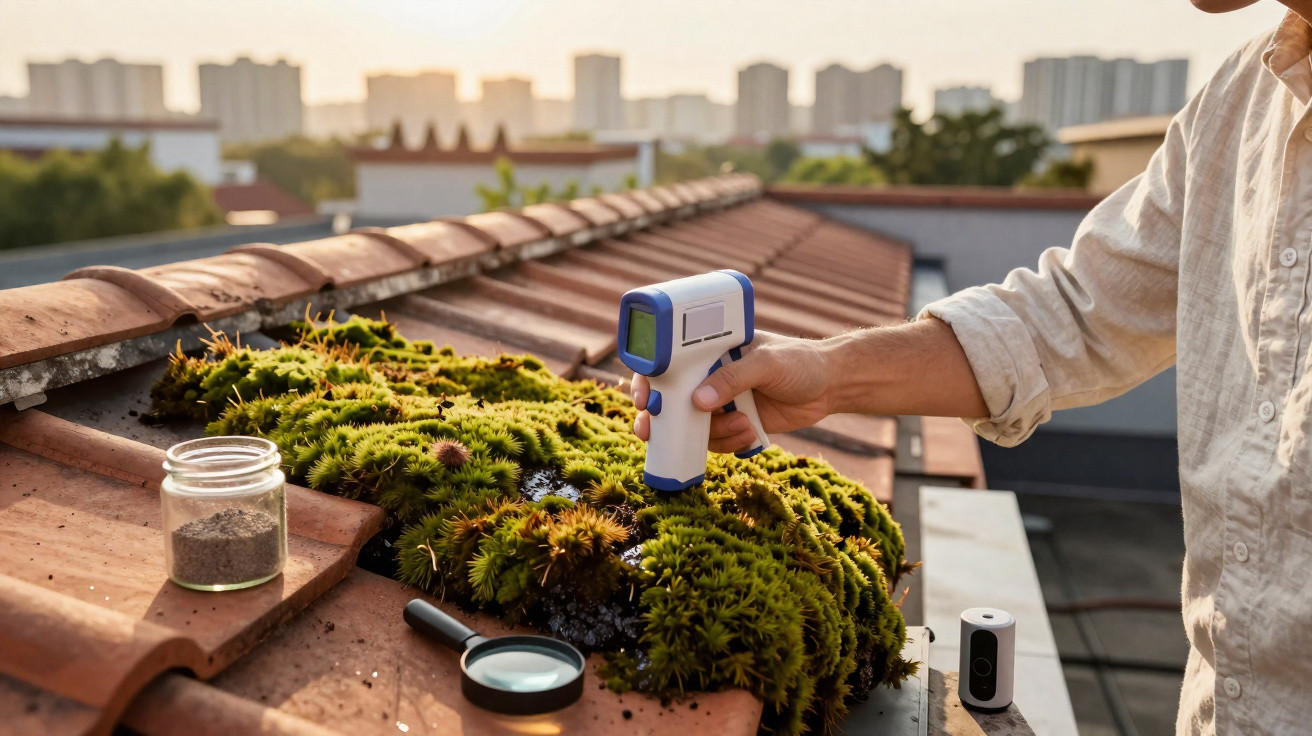
A patchwork of moss across a roofline can look charming, even as if it simply happened on its own. In practice, it may be carrying out the sort of low-key work that insulation, filters and extractor fans rarely manage on their own.
I first met the scientist on a heat-hazed street, the air shimmering above stationary cars. She had a straw hat, a surface thermometer in hand, and she kept gesturing towards the same moss-covered roof on a cottage at the corner. From close up, the moss felt velvety beneath her fingertips and was cool, like a sponge lifted from shade after soaking. She looked over to the bare slate roof next door, smiled, and called out two readings that felt unfair under the same sun: one roof searing hot, the other only mildly warm. A freight train groaned somewhere in the distance, leaving a faint grey tang on the air. She held a small white filter into the breeze for a minute, then lightly tapped it against the moss to show the dust it had gathered. The roof was doing the thinking.
The science of a living blanket on your roof
Moss’s first trick is to slow the day’s heat. It gulps down fog, dew and quick showers, then returns that moisture gradually as a cool exhale drifting off the roof and into the street. In a city, moss is an almost silent engineer. Once sunlight hits, its tiny leaves and capillary spaces hold a thin water film; as that film evaporates, surface temperatures fall in a way that paint or plastic coatings simply cannot replicate.
On a line of test sheds I visited with Dr. Amaya Ruiz, the moss-covered roof stayed 18–27°C cooler than bare bitumen at peak sun, while attic temperatures were 4–7°C lower by late afternoon. Electricity meters turned more slowly as well. On a burning August afternoon, moss can be the difference between a roof that bakes and a roof that breathes. In northern Europe trials, slender moss mats-only 1–3 cm-reduced midday heat flux by roughly a third on clear days. It is not air conditioning, but it is a steady influence on the thermostat.
None of this relies on mystery. Picture the moss as a porous, uneven layer that thickens the boundary layer-the slim cushion of air that sits directly against the roof. That roughness slows the airflow right at the surface, which limits how quickly heat can surge in or leak out. After sunset, its darker pigments shed warmth towards the night sky, and the water stored within the moss adds thermal inertia, softening sudden temperature spikes. Think of it as a living coat that cools in summer and cushions in winter. When the weather turns colder, the same porous structure holds countless tiny air pockets, slightly improving insulation and reducing heat loss driven by wind. The change is not dramatic, but the consistency is.
The hidden filter: how moss traps fine particles
Fine particles do not merely float past moss; they collide with a green labyrinth. Each small shoot multiplies the available surface area for dust to land on. Thin water films form tacky pathways where PM2.5 can stick, and the moss’s cell walls can bind metal ions via cation exchange sites. On misty mornings, capture increases. During dry spells, one simple routine-an evening spritz-can improve trapping without saturating the roof.
Most people know the moment you wipe a windowsill and the cloth turns grey immediately. Moss performs a version of that wipe again and again, quietly, throughout the day. If you are about to tear it off with a wire brush, stop. That approach can damage shingles and can also release a burst of dust you do not want to breathe. A lighter touch is better: allow moss to remain where it is safe-particularly on clay, slate or standing-seam metal. And realistically, nobody is fussing over this daily. Checking it seasonally is enough.
Here is how Dr. Ruiz explains it, along with practical steps you can take straight away.
“A moss cushion is millions of tiny hands. They hold moisture, slow the air, and give particles a place to land. Keep it hydrated enough to live, not soaked. The biology will do the rest.”
- Prefer shade to partial shade for reliable moss growth; harsh, direct sun dries the water film too quickly.
- Use a fine mist rather than a forceful hose. Aim for dampness before hot afternoons.
- Avoid bleach or strong biocides; they destroy the filter you are trying to keep.
- Check gutters: over months, small moss pieces can collect and restrict water flow.
A small green rethink for hotter cities
Moss will not solve climate change or erase rush-hour emissions. It will not magically turn a draughty loft into a high-performance home. What it can do is more modest-and unexpectedly useful: it softens the sharp edges of heat and grime right where your house meets the sky. That subtle smoothing can change how it feels indoors, and it can change how a street feels at midday.
At a time when public spending often chases glossy technology, moss can look like a throwback. Yet the longer you notice what it does, the more it resembles future-proofing: less noise in temperature swings, less particulate grit lingering around where you breathe, fewer kilowatt-hours burned at 5 p.m. It is a system built on patience. The tiniest green can edit the air. Mention it to a neighbour next time you are both squinting at the glare, wishing the day were cooler.
| Key point | Detail | Why it matters for you |
|---|---|---|
| Evaporative cooling | Moss stores dew and rain, then releases it slowly, lowering roof surface temps by 18–27°C in field observations. | Fewer heat spikes indoors and potential reductions in late-day cooling demand. |
| Particle capture | Rough, moist surfaces form a micro-maze that traps PM2.5 and metals via water films and binding sites. | Cleaner air around windows and outdoor spaces, with a passive filter that runs all day. |
| Gentle care | Light misting, no harsh chemicals, seasonal checks, and compatible roof materials matter most. | Keep benefits without harming shingles or sending dust back into the air. |
FAQ
- Does moss damage a roof? Moss has no true roots, so it doesn’t drill into materials. Problems arise when it wedges under loose shingles, holds water against already damaged surfaces, or blocks gutters. On sound slate, clay, or metal, it’s typically safe with light maintenance.
- How much can it cool my home in summer? Expect gentler swings, not miracles. Studies on thin moss and green mats show roof surfaces 15–25°C cooler at midday and attic temps 3–7°C lower, which can trim late-day cooling loads in warm months.
- Can moss really trap dangerous fine particles? Yes. The combination of huge surface area, sticky water films, and biochemical binding captures PM2.5 and metals. Moist mornings or a light mist increase capture, especially near busy roads.
- Which roofs are best for moss? Clay tiles, slate, and standing-seam metal tolerate moss well. Ageing asphalt shingles and wood shakes are riskier, as trapped moisture can speed decay. If the roof is already fragile, prioritise repairs before encouraging moss.
- How do I start a moss patch without making a mess? Pick a shaded section, gently roughen a test spot, and press small, clean moss pieces onto a damp surface. Mist in evenings for a few weeks. Keep gutters clear. If it fails in full sun, try a shadier face or beneath a ridge.






Comments
No comments yet. Be the first to comment!
Leave a Comment