
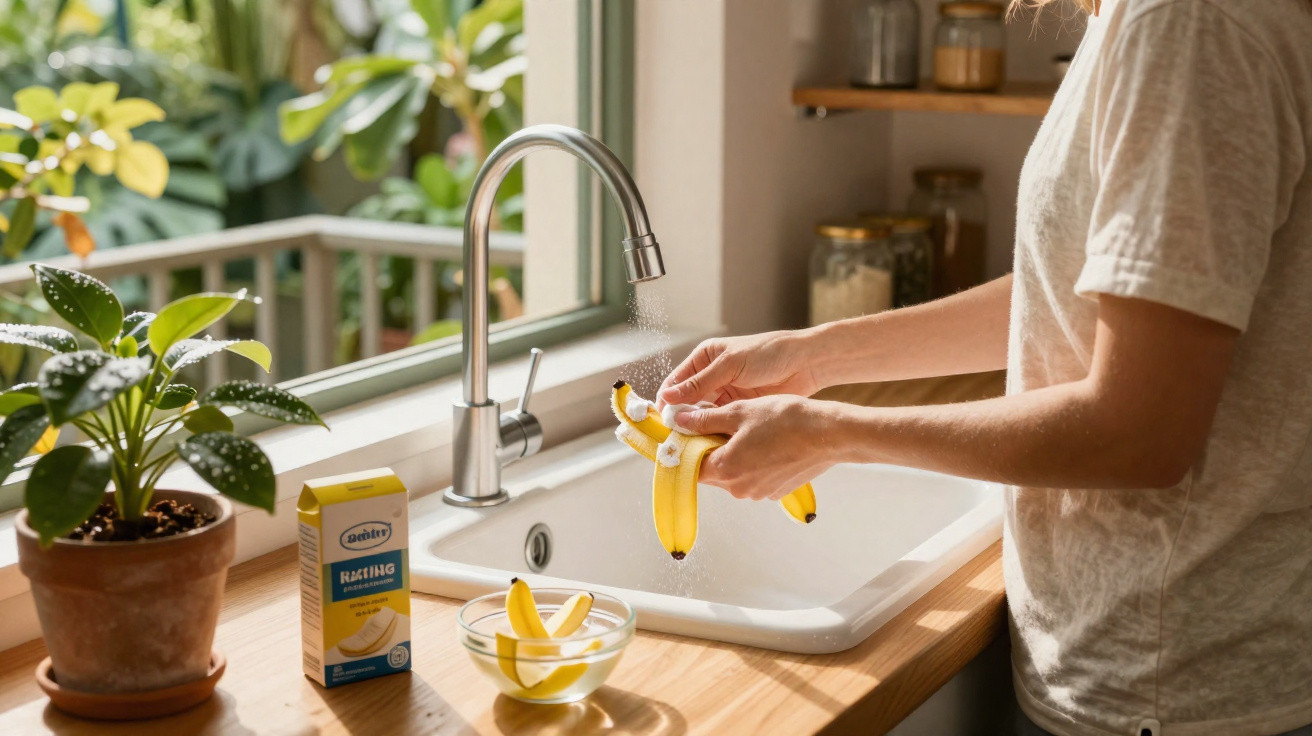
Among the everyday products used to clean the home and look after the garden, a few simple ingredients stand out for how many jobs they can do. The combination of banana peel with bicarbonate of soda has been adopted by many people as a budget-friendly option for cleaning certain items and treating plants, making use of scraps that would usually go in the bin and, in specific situations, cutting down on the need to buy some shop-bought products.
How does the banana peel with bicarbonate of soda mixture work?
Banana peel with bicarbonate of soda brings together organic substances-such as potassium and other minerals-with bicarbonate’s mildly abrasive, odour-reducing action. Used gently, this pairing can help with small-scale cleaning tasks as well as targeted care for soil.
In practice, people typically make it either as a paste or as a water-based solution. It is then applied to particular surfaces, or diluted for use in gardens and plant pots. The intention is for it to support straightforward jobs, not to replace stronger cleaning products or fully balanced fertilisers.
Watch the video on the YouTube channel Receitas da Bo about homemade recipes and mixes that use the fruit peel combined with the properties of bicarbonate.
How to use banana peel with bicarbonate in household cleaning
For cleaning around the home, the banana peel and bicarbonate mixture is often used for polishing and shifting light grime, taking advantage of the peel’s soft texture alongside the fine grains of bicarbonate. Before using it more widely, it is always advisable to try it first on a small, hidden area of the surface.
To make a basic, multi-purpose cleaner, many people use roughly the following amounts:
- 1 fresh, ripe banana peel
- 1 to 2 teaspoons of bicarbonate of soda
- A little water-just enough to make a paste
Using this as a starting point, it is common to apply the paste to polish metals such as cutlery, door handles and chrome taps, to clean tougher plastics, and to help reduce odours in containers. Afterwards, it is important to rinse thoroughly and dry, to prevent marks from the darker part of the peel or any build-up of organic residue.
How to use banana peel with bicarbonate of soda on plants
In the garden, banana peel with bicarbonate of soda should be used with care, because overuse may change soil pH or lead to a build-up of salts. The peel adds nutrients, while bicarbonate-when well diluted-may help with managing mild fungal issues in certain situations.
One common approach is to make a simple “nutrient tea” for occasional watering:
- Cut 2 to 3 banana peels into smaller pieces
- Put them into a container with about 1 litre of water
- Add 1 small coffee spoon of bicarbonate of soda
- Leave it to sit for 24 hours, tightly covered
- Strain, then use the water for watering in small amounts and at spaced intervals
It is not recommended to apply it every day, or to use it on very young seedlings or sensitive species. Pay close attention to the plants and stop using it if you notice yellowing, unusual wilting, or signs of stress. Keep in mind that this preparation ferments quickly and should be used within a short time.
What are the benefits and precautions when using banana peel with bicarbonate?
Among the advantages of banana peel with bicarbonate of soda are its low cost, the re-use of waste, and the chance to reduce reliance on harsher chemicals for straightforward tasks. For cleaning, it can support quick polishing; in the garden, it can act as a nutrient top-up-provided it is used in moderation.
However, the mixture also has important limits: it does not replace disinfectants for deep hygiene, it may stain light-coloured surfaces if it is not rinsed off properly, and too much can harm soil balance. For that reason, it is best treated as an occasional helper-used on small test areas first and with results monitored-so you can make the most of the combination without compromising safety or common sense.



Comments
No comments yet. Be the first to comment!
Leave a Comment