
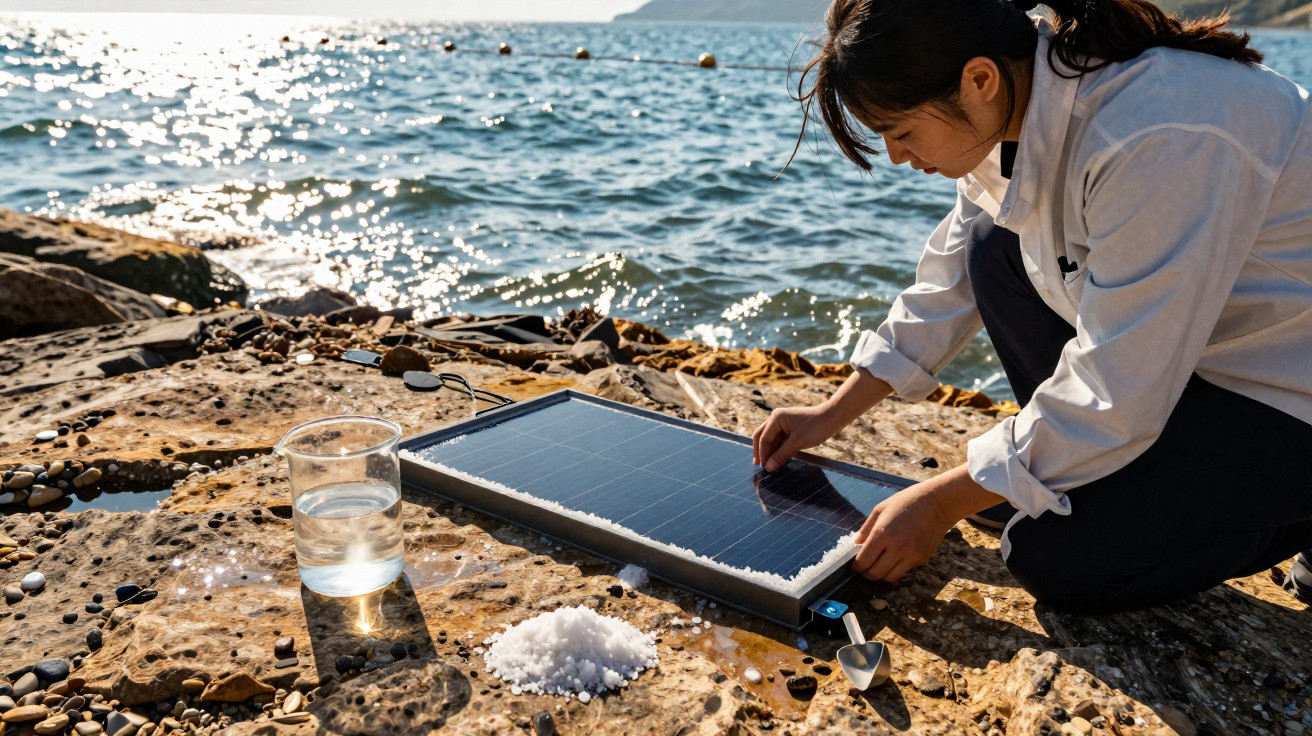
Solar desalination panels - devices that harness sunlight to convert seawater into drinking water - have looked like a compelling idea for years.
In practice, however, almost all prototypes have relied on a stand-in: ordinary water with table salt added. Genuine ocean water typically fouls their surfaces, clogging them until performance collapses.
A panel developed in a New York laboratory now operates using real seawater. It keeps itself clear without intervention, produces no toxic waste, and turns the remaining salt into something worth recovering.
A salty problem
Today’s desalination largely depends on two approaches. Reverse osmosis pushes seawater through very fine membranes, and distillation separates fresh water by boiling. Both options consume vast amounts of energy.
Either way, a concentrated by-product is left behind: brine - a mixture of salt and chemicals that is far more saline than the ocean itself. Much of it is discharged back into the sea, where it sinks, depletes oxygen, and damages marine ecosystems.
For years, researchers have pursued a cleaner route. One group argues it can avoid brine altogether. Their work comes from the laboratory of Chunlei Guo, an optics professor at the University of Rochester.
Solar desalination panel
At first glance, Guo’s solar desalination panel appears unremarkable. It is a thin sheet of aluminium, darkened and etched with microscopic grooves using a rapid, pulsed laser. This textured surface absorbs almost all sunlight that strikes it.
Those grooves draw a very thin layer of seawater upwards against gravity. As the film spreads across the warmed surface, it evaporates into vapour, which is then cooled and condensed into drinking water. The salt is left behind.
The key difference is what happens to that salt. The treated centre is responsible for capturing light and moving the water, while the untreated edges gather what remains and drive it outwards - preventing any crust from forming over the active area.
Why real seawater
Earlier solar concepts often performed well in controlled demonstrations, but many took an easier path. They used simulated seawater, which tends to form porous salt grains that still allow water to pass through. Natural seawater is a harsher mixture.
When seawater is taken directly from the ocean, magnesium and calcium come with it. These minerals can solidify into a hard scale that water cannot penetrate. On previous panels, that build-up blocked the surface and throttled the process.
Guo’s group addressed this by making the grooves both deeper and wider, so the flow of salty water becomes strong enough to dissolve forming crystals and carry them away towards the edges. The adjustment sounds minor; the impact was anything but.
The coffee ring effect
The self-cleaning behaviour draws on a familiar everyday stain. As a drop of coffee dries, liquid moves towards the rim and drags particles with it, leaving a darker ring around the outside. Guo put it plainly.
“If you drop coffee on a surface, eventually the water evaporates and there’s a ring left at the outer edge that is the concentrated coffee particles,” Guo said.
This tendency for fluid to flow towards the edge is believed to transport salt away from the working surface. After that, a second phenomenon - known as salt creeping - becomes important.
At the boundary, crystals attract saltwater, repeatedly dissolving and then crystallising again slightly farther out. Viewed under a microscope, the team observed that edge migrate outwards over time, while the centre remained clean.
Salt becomes a resource
Because the salt is collected as dry crystals rather than as liquid brine, it is no longer a waste stream and can instead be treated as a usable product. The panel captures nearly all of it, and the researchers remove it manually by scraping the edges.
That recovered powder contains a mix of elements. Tests showed sodium as the main component, with traces of magnesium, calcium, and potassium. Very small quantities of gold, caesium, and uranium were also detected.
With a modification, the same type of panel was able to extract lithium - the metal used in rechargeable batteries - from saline water. Using water from Utah’s Great Salt Lake, the team recovered about half of the lithium available.
Out in sunlight
Bench-top results are only part of the story. To demonstrate real-world operation, the researchers ran the panel continuously for a week using genuine ocean water. The production rate remained consistent, and the surface stayed free of build-up.
They also tested more than one source. Seawater from the Atlantic, Pacific, and Indian Oceans behaved similarly. In every case, the water produced was drinkable, comfortably below the limits set by health authorities.
A rooftop trial provided another check. An area roughly the size of a postage stamp left in sunshine for nine hours produced about a third of an ounce (10 millilitres) of fresh water, along with a small pinch of salt.
Looking beyond the lab
Up to now, solar desalination panels have faced a credibility problem: they worked with laboratory-made saltwater yet seized up when fed the real thing. This design addresses that weakness - real seawater goes in, and no brine comes out.
The potential benefits are practical. Coastal communities dealing with water shortages could deploy low-cost panels without added chemicals or toxic discharge. Meanwhile, the salt scraped from the edges becomes a recoverable resource, including lithium.
At present, the panels are small and assembled by hand, but Guo said the concept should be straightforward to scale. If that proves true, a single technology could help relieve two pressures at once - the need for clean drinking water and the demand for more sustainable mineral supplies.






Comments
No comments yet. Be the first to comment!
Leave a Comment