
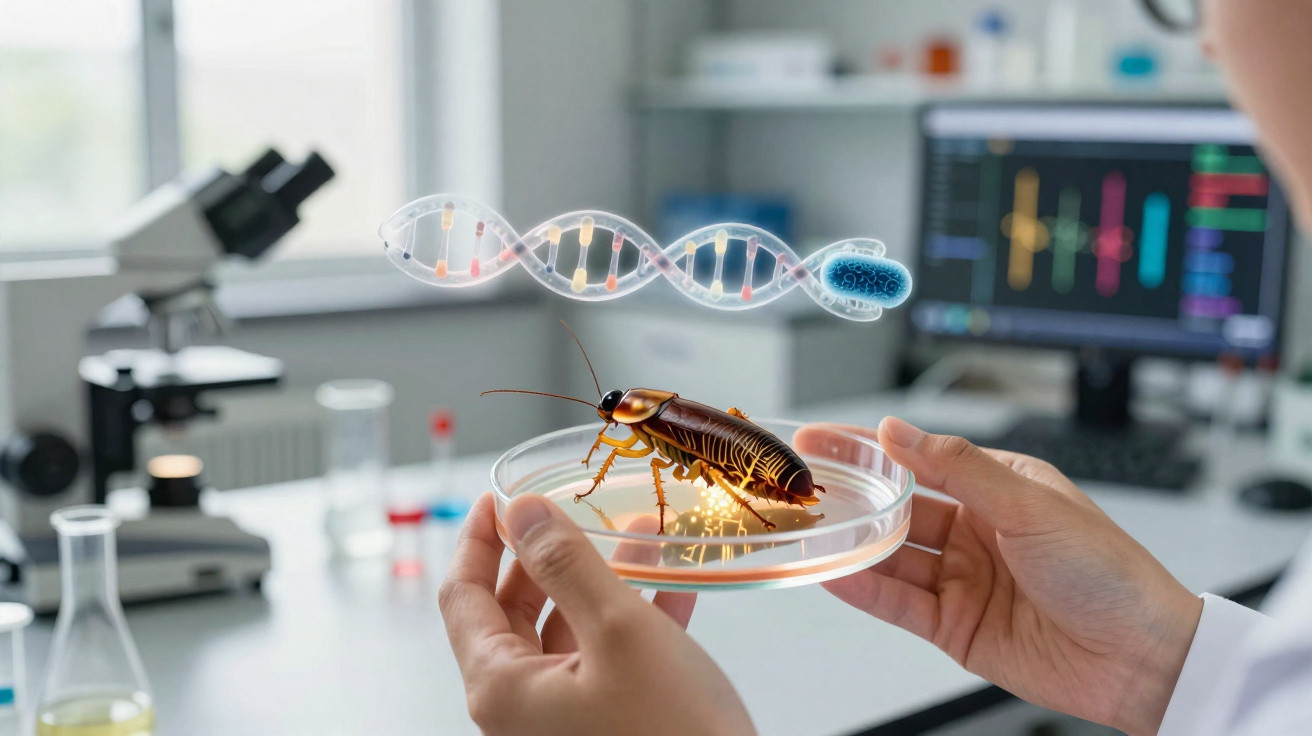
Cockroaches are often viewed as near-indestructible, and part of that reputation comes down to their DNA, which can encode a range of survival advantages - from neutralising toxins to regenerating limbs.
A new look at the cockroach genome
A new study led by researchers at the University of Sydney has revisited the cockroach genome and uncovered an unexpected twist.
According to the team, these insects appear to have acquired large quantities of DNA from a completely different organism.
The source is the bacterium Blattabacterium cuenoti, long known to live within cockroaches and assist with nitrogen recycling - but not previously suspected of passing tens of thousands of DNA fragments into its host.
Horizontal gene transfer (HGT) from Blattabacterium cuenoti
This kind of cross-species DNA movement is known as horizontal gene transfer (HGT). It is commonly observed in bacteria and other microorganisms.
Although HGT has also been reported in more complex animals and plants (eukaryotes), it has generally been considered much rarer.
"We identified numerous chimeric inserts comprising up to nine short segments from different locations in the B. cuenoti genome," write the researchers in their published paper.
"Our findings indicate pervasive HGT in eukaryote genomes, with potentially far-reaching implications for adaptation and speciation."
To investigate, the researchers examined the complete genomes of 18 cockroach and termite species. Termites and cockroaches are closely related and share common ancestors, but after the two groups diverged on the evolutionary tree, most termites lost B. cuenoti.
Unlike many earlier efforts, this study also searched for smaller, non-coding DNA fragments that do not produce proteins - pieces that earlier surveys focused on more complex, protein-coding DNA may have missed.
Using this approach, the team identified 40,485 pieces of B. cuenoti DNA in total, with individual insects carrying between 93 and 4,900 fragments. Until now, the highest number of horizontal gene transfers reported in a eukaryote had been fewer than 300.
In addition, some of the detected fragments appear to trace back to the earliest stages of the cockroach lineage.
"Some inserts appear to have persisted for ≥28.7 million years in this group, which may reflect functional roles," write the researchers.
What the DNA fragments could mean
Typically, genes are inherited from parent to offspring. By contrast, horizontal transfer can occur when cells from different species remain in extremely close contact - here, cockroach cells may have taken up loose pieces of B. cuenoti DNA.
For a eukaryote that incorporates such material, the potential outcome is a genome that becomes more flexible and resilient over time, gaining molecular capabilities it would not otherwise possess.
Even so, the researchers stress that it remains unclear whether these transferred DNA fragments do anything at all in cockroaches. It is also possible that some are mildly harmful, but not harmful enough for natural selection to eliminate them.
"The persistence of numerous inserts over millions of years indicates that they may have assumed functional roles in both genes and intergenic regions, are effectively neutral, or are only slightly deleterious," write the researchers.
As analytical methods and biological knowledge continue to advance, more examples of HGT are being found beyond the usual bacterial and microbial contexts.
The study also suggests there is far more still to uncover. Many animals live in symbiosis with bacteria, raising the possibility that similar transfers occur far more widely than previously appreciated.
Alongside extending this work to other species, the researchers also plan to probe the cockroach genome further to determine whether any of the 40,485 borrowed DNA fragments provide a genuine benefit.
"Our results reveal extensive horizontal transfer of DNA from prokaryote symbionts to eukaryotes," write the researchers.
"Future research on cockroaches and other species harboring obligate endosymbiotic prokaryotes will help to uncover any functional effects of inserts, providing a more comprehensive understanding of how HGT shapes genome evolution."
The research has been published in PNAS.






Comments
No comments yet. Be the first to comment!
Leave a Comment