
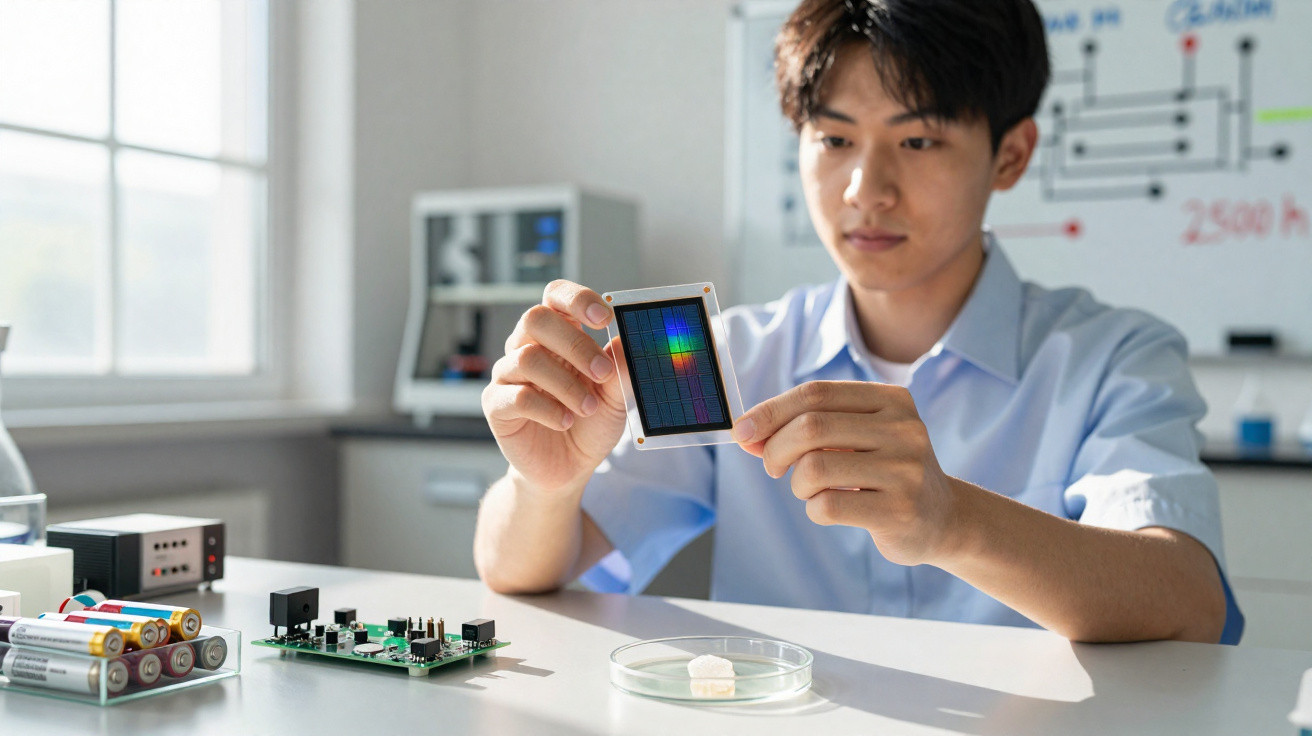
The world is becoming ever more reliant on disposable batteries. Azure Photon - a new spin-off from the Faculty of Engineering at the University of Porto - argues that “in 2025 alone, 78 million batteries will be thrown away every day”, with a sizeable economic and environmental cost, and is putting forward a clean alternative with a “long life”, designed to last for more than a decade.
Official projections suggest that, by 2030, there will be more than 40 billion IoT (Internet of Things) devices in operation. Yet although many of these products are built to last close to 10 years, the batteries inside them typically need replacing every two years, creating “a growing mountain of electronic waste”. The devices at stake include small items such as temperature, humidity, motion, or air-quality sensors, smart tags, meters, monitoring systems, and countless pieces of equipment that continuously (or intermittently) collect and transmit data - including wireless keyboards.
Azure Photon was created in response to this challenge, with the goal of replacing conventional batteries with perovskite solar cells that can harvest energy from indoor lighting and power smart devices throughout their entire service life.
A crystal in the laboratory
The technology developed by Seyedali Emami and Jorge Martins - researchers at LEPABE (the Laboratory for Process Engineering, Environment, Biotechnology and Energy) - together with Adélio Mendes, a full professor in the Department of Chemical and Biological Engineering at FEUP, uses perovskite solar cells: a crystal found in nature that can also be made in the laboratory with light-absorbing properties.
“It is an emerging photovoltaic technology, made from abundant, low-cost materials, and it stands out for its exceptional ability to generate electricity even under low light levels. Indoors, these cells have already reached a record energy conversion efficiency of 44.7%, clearly outperforming traditional silicon and thin-film solar technologies,” the researchers explain.
In practical terms, they say, the approach “makes it possible to turn the artificial light in offices, warehouses, shops or smart homes into a clean, continuous energy source that is sufficient to power sensors and IoT devices without the need for ongoing maintenance”. This is achieved by “using a hermetic laser sealing process” that shields the photovoltaic cells from humidity and oxygen - two of the main drivers of degradation - and by applying a FEUP-developed process that operates at temperatures below 100 degrees Celsius. Conventional methods, by contrast, require more than 400 degrees Celsius, which is incompatible with the sensitive materials used in perovskites.
2,500 hours
According to the company, cells encapsulated in this way have already demonstrated more than 2,500 hours of stability in accelerated tests under solar illumination - a result described as “essential for the commercial viability of the project”.
The next step is to launch the first device, providing an energy alternative that can reduce electronic waste, cut operational costs, and increase the autonomy of the smart devices underpinning the digitalisation of buildings, industry and infrastructure - “in line with Europe’s carbon neutrality targets and the United Nations Sustainable Development Goals”, they say.
Jorge Martins notes that Azure Photon’s solution - which the company says is far more sustainable than today’s batteries - “is easily adaptable to existing sensors”. He adds that “potential customers are in different sectors, from industry to civil construction, supermarkets or freight transport logistics”. Even so, he acknowledges that “it is still very difficult to compete with traditional batteries on cost. We are talking about a very early-stage technology compared with the mass production of disposable batteries”.
Two projects under way
Right now, Martins explains, “we are talking about prices of 50 cents to €1 for disposables and €3 for our solution”, even assuming scaled production “with a minimum of one million batteries”. He remains confident that the company can reach competitive production within five years, “depending on funding and the market”.
For the moment, Azure Photon has two projects running. One, under the StartUP Voucher Innovate 2025–2026 programme, worth €30,000, has been used to develop three prototypes of solar-cell-powered electronic devices and to carry out market studies. The other, under North 2030, has €900,000 allocated to manufacturing solar cells, building prototypes and validating them in the field in real buildings.
“What we have to do now is move from the laboratory to commercialisation,” the researcher says of this project, which “started from a doctoral thesis” and is beginning to draw attention from potential international customers - particularly in construction and distribution, where a single supermarket can have more than 7 million electronic labels, each with its own battery.




Comments
No comments yet. Be the first to comment!
Leave a Comment