
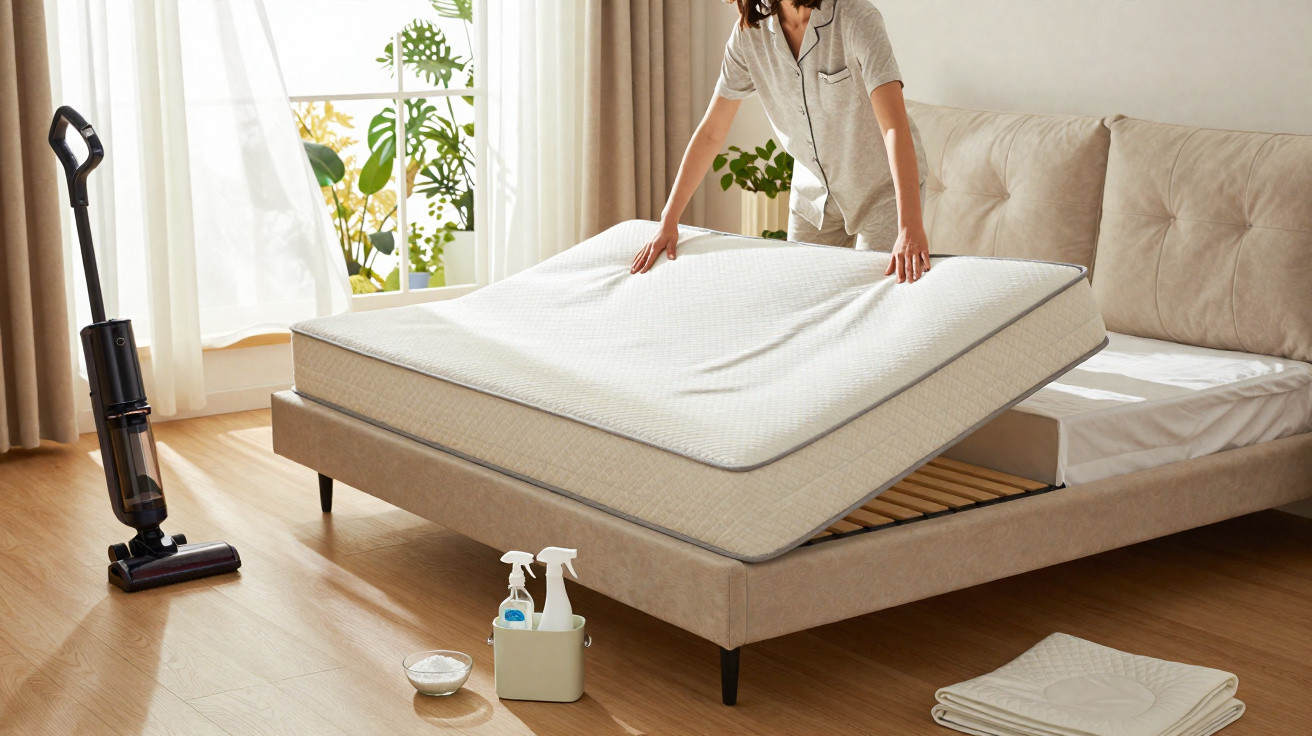
We spend hours there every night: we sweat, shed skin cells, lose hair, and now and then even a coffee ends up in the bed. It’s hardly surprising that the search term “mattress cleaning” is suddenly everywhere. The good news is you don’t need pricey specialist services or professional machines - with a clear routine and a few household basics, any mattress can feel fresh again.
Why the effort is genuinely worth it for your mattress
A clean mattress doesn’t just support better sleep; it also means fewer allergens and, over time, a more comfortable bed. Dust, mites, sweat and moisture build up quietly in the background. Eventually there’s a faint musty smell, the surface starts to feel uneven, and your back complains in the morning louder than your alarm.
"If you look after your mattress regularly, you’ll get noticeably more years and noticeably more sleeping comfort out of it."
Specialists often suggest replacing a mattress every six to eight years. If you focus on rotating it, airing it properly and keeping it clean, you can often extend that window a little - and, more importantly, improve the quality of your nights in a way you can actually feel.
Step 1: Rotate and flip your mattress correctly
Over time, small dips form exactly where you usually lie. You typically notice it first as a “hole” around the hips, or a gentle hollow in the centre when two people share a bed.
How often should you rotate your mattress?
- In the first year: rotate 180 degrees once a month
- From the second year onwards: rotate roughly every three months
- For double-sided mattresses: flip it as well, so the top and bottom swap over
When you rotate, the head end becomes the foot end. If your mattress is designed to be used on both sides, you can also turn it over. That way, body weight is spread more evenly, the materials and springs aren’t stressed on one side only, and the dreaded gap between two mattresses is less noticeable.
Step 2: Let the mattress breathe
Many people make the bed in a rush in the morning: duvet back on, done. For your mattress, that’s not a great deal. After a night’s sleep, there’s still plenty of moisture sitting in the cover and inside the core.
How to air your mattress properly
- Remove the duvet completely and set the pillows aside as well
- Open the window wide and leave the mattress “bare” for two to four hours
- Ventilate the room thoroughly - a through-draught helps here
However, many hours of strong, direct sunlight isn’t ideal, as fabrics can fade and materials may become brittle. A bright, well-ventilated room is more than enough. If you use a bed with a closed box base, it may be worth switching to a slatted base over time so air can circulate underneath the mattress. That significantly reduces the risk of mould and mildew marks.
Step 3: Deal with sagging and dips
If the bed suddenly feels like a hammock, it doesn’t automatically mean the mattress has to be thrown out straight away. Often it’s a few smaller issues combining to reduce comfort.
"If your mattress is starting to sag, it’s worth taking a closer look: is it really the mattress - or the base underneath?"
What you can do about a mattress that’s giving way
- Check the slatted base: Are any slats broken, loose or bowed? Very often the base is the real weak point.
- Rotate the mattress more often: If dips are appearing, shorten the routine temporarily - for example, rotate every four weeks.
- Use a topper: A firm, high-quality topper can smooth out unevenness and make the sleeping surface feel more stable.
If you wake up with back pain, try sleeping in a different spot on the mattress or in another bed for a night or two. If things improve, the cause is likely the mattress or its base - at that point, maintenance will only help so much and replacement becomes more likely.
Step 4: Vacuum thoroughly and remove stains (mattress cleaning)
Before you reach for home remedies or stain removers, start with the simplest step: a proper vacuum. Many people underestimate this, even though it’s where most visible and invisible particles collect.
Vacuuming properly - the right method
- Remove the cover (if there is one) and wash it separately (follow the care label)
- Use an upholstery attachment or a handheld vacuum to clean the entire surface
- Work carefully along edges, seams and borders too - dust and mites love to cling there
When it comes to stains, don’t scrub blindly. Always work out what you’re dealing with first - coffee, red wine, urine, blood or simple water marks all behave differently.
| Type of stain | First step | Caution |
|---|---|---|
| Fresh liquid | Blot with kitchen roll; dab only, don’t rub | Don’t soak the mattress, or you risk mould |
| Light soiling | Mild soapy solution; apply locally with a cloth | Use minimal moisture, then allow to dry completely |
| Odour issues | Sprinkle fine bicarbonate of soda; leave for several hours | Afterwards, vacuum thoroughly |
Harsh chemicals or steam cleaners aren’t a good idea for many mattresses. Steam penetrates deeply, dries slowly, and can create exactly what nobody wants inside the mattress: ideal conditions for mould spores.
Step 5: A good mattress protector as a “bodyguard”
If you want cleaning to stay as straightforward as possible, use a mattress protector. Ideally it should be water-resistant, breathable and washable.
"Better to put the protector in the washing machine than have to tackle the mattress with lots of effort."
What to look for when buying
- Breathability: The mattress needs protection, but it still has to “breathe”.
- Water resistance: Spilt coffee or a glass of water should stay on top rather than soaking in.
- Easy care: Washable at at least 40 °C - 60 °C is better for reducing mites.
- A secure fit: An elasticated skirt or corner straps so it doesn’t shift around.
If you sweat heavily or have small children in the bed, it’s sensible to change the protector more often - for example every four to six weeks. Otherwise, it’s enough to air it whenever you change the bedding and wash it every few months.
How often should you maintain your mattress overall?
A simple schedule makes it easier to stay on top of things:
- Weekly: Change bedding; leave the mattress uncovered briefly
- Monthly: Vacuum the mattress; check the protector and wash it if needed
- Quarterly: Rotate and/or flip the mattress; air it thoroughly
- Yearly: Inspect the slatted base; watch for dips and odours
If you have allergies, shorten these intervals. House dust mites react directly to the moisture and skin flakes that end up in the bed. A cooler bedroom, regular ventilation and lower humidity provide extra support.
Risks, mistakes and what you’re better off avoiding
Some measures cause more harm than good. Aggressive bleach can damage the cover and make fibres brittle. Too much water inside the mattress core can lead to mildew marks that are extremely difficult to remove. Fragrance sprays that simply mask smells don’t solve the hygiene issue - they only hide it.
If, despite all your efforts, you notice persistent back pain, night sweats or a musty odour, don’t keep experimenting indefinitely. That’s the point to consider a new mattress - and to start from day one with a solid protection and cleaning routine.
How a well-maintained mattress really changes sleep
After the first thorough clean, many people notice a clear difference: the bed smells more neutral, feels drier, and the surface seems firmer. Some also report fewer sneezing fits in the morning or more restful sleep, because the body no longer has to battle dust and mites.
If you’re planning a spring clean anyway, simply build the mattress into the process: strip the bed, air it, vacuum, treat stains, rotate, wash the protector - and by evening the bed can feel like a small hotel room at home. It’s exactly this routine that turns an everyday item back into a place where you genuinely enjoy winding down.






Comments
No comments yet. Be the first to comment!
Leave a Comment