
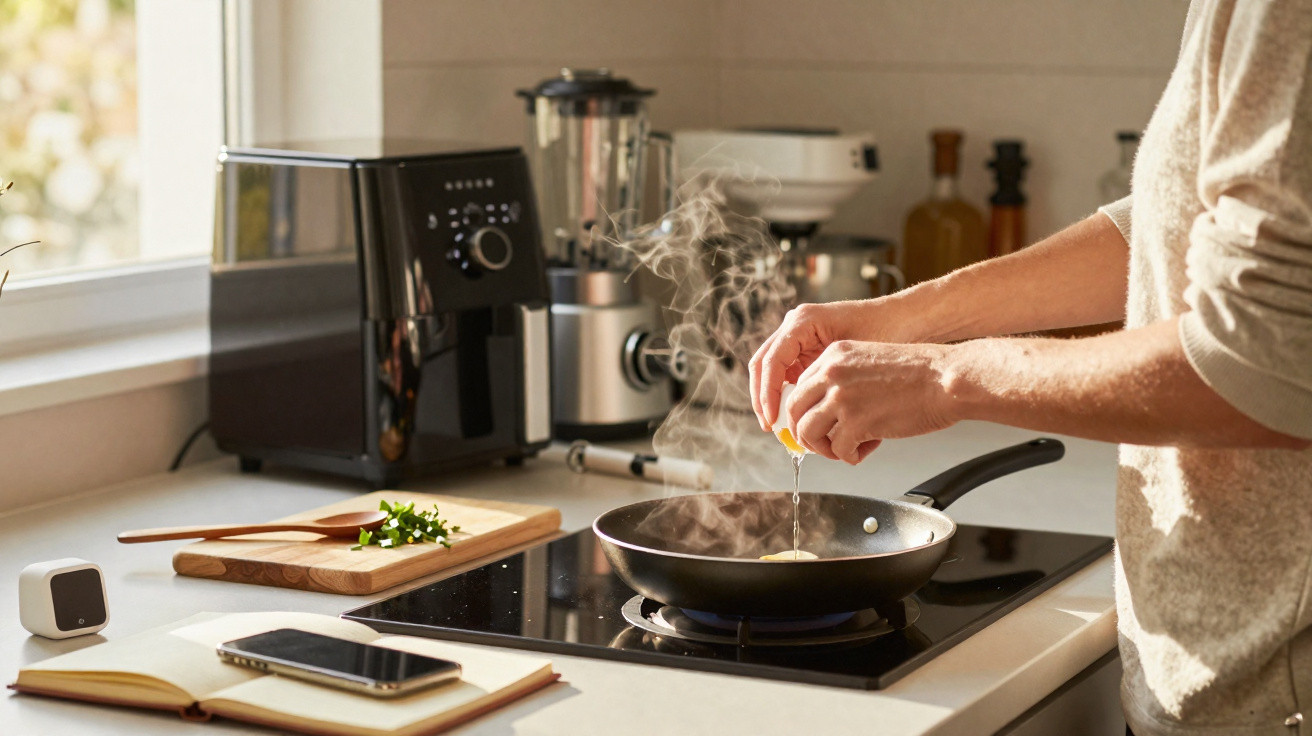
The blender growls, the food processor glows like a cockpit - and yet, in the end, it’s the same frying pan that ends up on the hob. A fried egg, pasta with pesto, a quick sandwich. The pricey appliances in the background suddenly feel like guests who never quite clicked at the party: they’re present, they look impressive, but no one talks to them.
You recognise the scene: someone opens the box of a high‑tech steam cooker, pauses for a moment in genuine fascination - and then slides it next to the coffee machine, where it gradually gathers dust. Not because it’s broken. Simply because the person standing in front of it would rather cook the way they always have.
In a lot of kitchens, it isn’t the technology that fails.
It’s routines.
When high-tech collides with the fried-egg routine
After a long day, most people don’t want to think about exact cooking points. You reach for what’s familiar: that one pan, the same old saucepan, two movements, hob on, done - even if there’s a gleaming multi‑cooker right beside it that can do three times as much. It’s kitchen psychology in miniature, playing out on the worktop. New devices promise a different, better version of everyday cooking. Our bodies, meanwhile, keep walking the old paths through the kitchen - almost like a car that always takes the same junction.
The dishwasher gets used. The kettle does too. But the slow cooker? It sits there. A bread maker? It might run daily for three weeks and then fall silent. According to a representative survey in Germany, people regularly use only four to five of their kitchen appliances on average, even though many households have more than a dozen scattered around. In that sense, kitchens are small technology museums curated by convenience. Big boxes end up on top of cupboards, cables get wound up, the shopping buzz fades - and the pasta water keeps bubbling away in the old enamel pot.
The issue isn’t the kit itself, but the friction between promise and real life. Plenty of gadgets demand planning ahead, new hand movements, and sometimes even different shopping habits. If you cook on impulse, it’s hard to warm to a sous‑vide stick. And if you’ve only got two hob rings, the air fryer gets shoved into the cupboard behind the baking tins. The device clashes with habits that have been stable for years. Technology can speed things up or make them simpler, but it often meets deeply ingrained routines that we almost never stop to question.
Why most kitchen gadgets bounce off our daily life
A familiar pattern goes like this: someone buys a smart food processor - an all‑in‑one wonder with a screen, an app and a recipe library. The first month is pure excitement: risotto without constant stirring, exotic curries, steam‑cooked vegetables that suddenly taste restaurant‑good. Then a hectic week at work arrives, a child gets ill, social plans pile up. And, just like that, the quick fix is back to frozen pizza. The gadget hasn’t done anything wrong. Life has simply accelerated, and the more involved way of using it skids wide on the bend.
A friend of mine had a steam oven fitted - several thousand euros, fully advised, top of the range. He proudly walked me through the programmes, the temperature curves, the gentle cooking setting for meat. Six months later, the steam oven had turned into a bread basket. Baking trays, foil, cookbooks - everything disappeared into what was supposed to be this impressive piece of equipment. When it did get switched on, it was for one thing only: potatoes. “They’re just quick to do in there,” he said, with a tired grin. That’s the point: if an appliance doesn’t slot effortlessly into the smallest everyday motions, it soon becomes a luxury storage compartment for odds and ends.
By now, the technology is good enough that almost anything seems possible: sous‑vide, fermenting, air frying, slow cooking, precision steaming. What’s usually missing isn’t a feature, but a way for the device to interlock with our typical days. People cook in patterns - pasta on Mondays, soup midweek, something “special” at the weekend. If a gadget doesn’t support those patterns straight away and instead forces new sequences, it becomes a mental hurdle. Let’s be honest: hardly anyone keeps that up day after day. High‑tech loses to spontaneous rhythms, to hunger in 20 minutes, and to that famous single pan “you can do everything in”.
How to bring appliances into everyday life - instead of locking them in a cupboard
The first step to stopping a gadget from failing doesn’t start at the checkout; it starts with a deceptively simple question: which two - at most three - very specific dishes do I genuinely want to use this for? Not “for healthy cooking in general”, but more like: “porridge in the morning”, “veg in the evening”, “Sunday pizza”. Suddenly the appliance is no longer an abstract promise; it’s a tool for three repeating moments. From there, it’s much easier to tweak your routine around it.
A useful trick: park the device on the worktop for a full month - even if that means another utensil has to live in the cupboard for a while.
A lot of people don’t struggle with the controls; they struggle with quiet perfectionism. They assume they have to squeeze the maximum out of the device, know every programme, test every mode at least once. That expectation freezes them. It’s better to begin with a single feature that feels natural - “steam” or “sear”, for example. Over time, the mental boundary between hob and machine starts to blur. If you keep waiting for “the right occasion”, you quietly exile the device into the realm of special events - and you’ll still be cooking the same pan of Spaghetti Bolognese every Tuesday.
“Devices don’t fail in the kitchen; they fail on our to‑do lists,” a friend who’s a keen home cook told me when I asked about her juicer that never gets used.
- Set yourself a micro‑task: use the new appliance for just one recipe a week - the same dish each time, until it’s second nature.
- Strip away the ‘special occasion’ label: not “I’ll try it at the weekend”, but Tuesday night, when you’re cooking anyway.
- Lower the barrier radically: keep it set up, keep your go‑to ingredients within reach, and stop hunting for attachments.
- Start with 5‑minute uses, not three‑course menus from the companion book.
- Measure success not by features, but by relaxed, repeatable moments at the hob.
What’s left once the excitement fades
Sooner or later, the moment arrives when a device no longer feels new. The protective film is gone, the buttons aren’t mysterious, the display has its first greasy fingerprints. This is exactly when it becomes clear whether a technical fling turns into a real kitchen relationship. You can sit down and ask, with brutal honesty: does this thing actually suit the way I cook? Or am I using technology to talk myself into a cooking life that simply isn’t me? If, after work, you’d rather do a quick fry than spend time prepping, even the most beautiful slow cooker won’t make you happy.
Appliances are at their best when they match your laziness, not your ideals.
It gets interesting when you stop thinking in functions and start thinking in scenes. Breakfast at 7 a.m., half asleep, no patience. Evening at 7 p.m., hungry, not in the mood to wash up. Sunday, a bit more time, a taste for experimenting. If an appliance makes at least one of those scenes noticeably easier with minimal effort, it has a real chance. If it doesn’t, it may be worth passing it on rather than carrying guilt. In many kitchens, silent reproaches are made of plastic and stainless steel. You can turn them into grateful helpers - or into free space on the worktop.
Gadgets rarely fail because of the technology. They fail because we tell ourselves the myth that we’ll “cook differently soon”. If you treat them instead as practical allies for very specific everyday situations, you sometimes find unexpected partnerships: the rice cooker that rescues every stressful day. The small air fryer that replaces the oven and the greasy roasting tray late at night. The old blender that quietly ensures you get something fresh in a glass each morning. It might be worth taking an honest look around your own kitchen: which machines exist only in your imagination - and which could genuinely make daily cooking easier if you gave them a different place in your habits?
| Key message | Detail | Value for the reader |
|---|---|---|
| Appliances fail because of routines, not functions | Everyday patterns like “fast, simple, familiar” push more complex devices aside | Readers understand why expensive tech goes unused and feel less “guilty” |
| Focus on a few, concrete use scenarios | Define two to three standard dishes per appliance and build them into your weekly pattern | A directly usable strategy for integrating devices into daily life |
| Cut handling barriers to the bone | Keep appliances visible, start with micro‑tasks, reduce perfection pressure | Practical steps to move from a tech museum to a kitchen that actually works |
FAQ:
- How many kitchen appliances are “normal”? There’s no ideal number, but many households regularly use only four to five devices. Anything beyond that is only worthwhile if it clearly fits into your daily life.
- How can I tell an appliance doesn’t suit me? If, despite good intentions, you keep returning to old solutions after one to two months and you only see the device as something for “special occasions”, that’s a strong sign.
- Should I get rid of older appliances? It can feel liberating to decide honestly: either a device gets a clear place in your week, or it moves on to someone who will use it.
- How do I get over the reluctance around complex devices? Choose one function, establish a single standard dish with it, and ignore the manual for now. Let complexity grow slowly.
- Is it still worth buying specialist gadgets at all? Yes - if you buy them for very specific moments of use, rather than from a vague desire to cook “differently” or “better”.
Comments
No comments yet. Be the first to comment!
Leave a Comment