
You walk back in after a trip away: the oven clock is flashing, but the kitchen looks entirely ordinary - almost suspiciously so.
The fridge is still humming, the freezer door has that familiar frostiness, and nothing seems amiss. Still, an awkward doubt hovers over every pack of minced meat and every tub of ice cream: did everything genuinely stay frozen while you were gone, or did an unseen power cut briefly turn your freezer into a warm, bacteria-friendly box?
A hidden risk every time the power goes off
A freezer can feel like a guarantee. Food goes in rock-hard and comes back out weeks or months later looking much the same. The catch is that you often have no idea what happened in between.
If the electricity fails while you’re at work or away for a weekend, the freezer may warm up and then freeze again before you return. The outside of the food can still feel solid and the wrapping may look untouched. But a few hours of higher temperatures can be enough time for bacteria to multiply rapidly.
Freezing pauses most microbial growth. Thawing restarts it. Repeated cycles of thaw and refreeze give bacteria a head start you cannot see or smell.
Food safety organisations in Europe and North America keep stressing the same point: freezing does not sterilise food. It merely slows or halts microbes that are already present. Once temperatures rise above roughly 5°C, many bacteria become active again and, under suitable conditions, can double every 20 minutes.
Think about a piece of chicken in a freezer that switches off for several hours. The inside slowly warms towards fridge or room temperature. Any Salmonella or Campylobacter on it can start multiplying. When the power comes back and the food refreezes, that same chicken may contain far more bacteria than it did when you first froze it - and you would not be able to tell.
The coin and ice trick: a low‑tech “black box” for your freezer
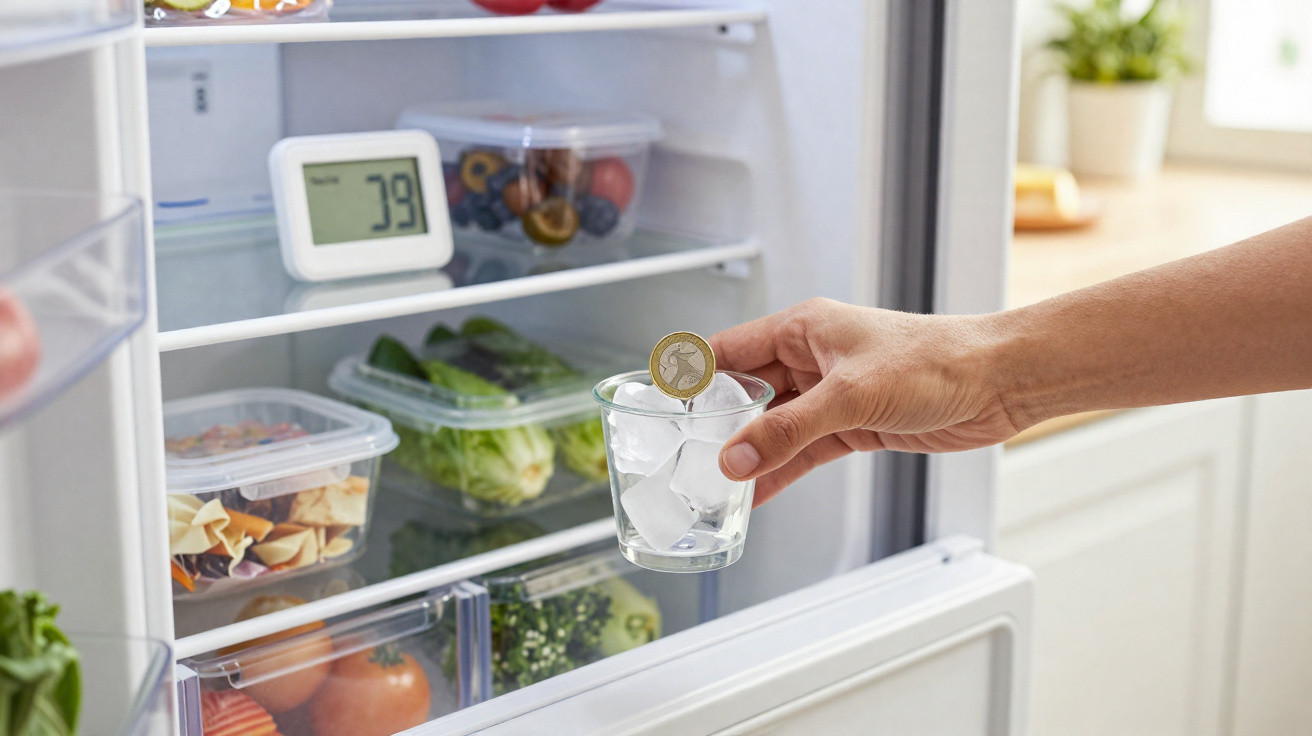
A straightforward home method has been doing the rounds on social media and in food safety messaging: put a coin in the freezer on top of a block of ice in a small bowl.
A single coin, sitting on frozen water, can act as a crude flight recorder for your freezer, showing how far the temperature rose while you were away.
How to set it up step by step
- Fill a small bowl, mug, or ramekin with tap water.
- Put it in the freezer on a flat shelf you can easily see.
- Leave it until the water has frozen completely solid.
- Place a coin flat on the top of the ice.
- Return the bowl to the freezer and keep it there permanently.
After that, the coin serves as a quiet record keeper. If the ice never thaws, the coin stays on the surface. If the power is off long enough for the ice to melt and later refreeze, the coin will sink into the water and end up set lower in the ice once everything freezes again.
How to “read” the coin after a suspected power cut
Where the coin ends up gives you a clue about what happened inside the freezer when you weren’t there.
| Coin position | What likely happened | What to do |
|---|---|---|
| Coin still on top of the ice | Ice never melted; freezer stayed cold enough | Food likely safe; still check for odd smells, packaging damage and use‑by dates |
| Coin sunk slightly below the surface | Partial melting; temperature rose but probably not for very long | Be cautious with high‑risk foods (meat, fish, dairy); consider cooking soon or discarding |
| Coin at the bottom of the bowl | Ice fully melted then refroze; prolonged loss of freezing temperature | Treat contents as potentially unsafe; discard perishable items |
If the coin hasn’t moved, your freezer probably remained within a safe temperature range. That does not make old or badly stored food safe, so the usual checks still matter: watch out for swollen packs, signs of freezer burn (ice crystals and dried surfaces), and any unusual smells.
If the coin is clearly embedded low in the ice or sitting right at the bottom, you have a strong sign the freezer lost freezing temperature for a meaningful period. In that situation, it’s safest to assume that meat, fish, cooked foods, ready meals, seafood, ice cream and dairy-based puddings may no longer be safe.
When the coin has clearly dropped, the question is not “can I save this food?” but “do I want to risk days of vomiting for a few pounds’ worth of groceries?”
Why refreezing food can be so risky
A widespread misunderstanding is that refreezing somehow “fixes” any bacterial growth that happened during a warm spell. It doesn’t.
Freezing prevents most bacteria from multiplying, but it does not undo growth that has already occurred. If food warms and bacteria increase a thousandfold, freezing again simply locks a thousand times more bacteria into the food. When you later thaw and eat it, those microbes are still present.
Some bacteria can also generate toxins that remain harmful even if the bacteria themselves later die. That is one reason people can become ill from food that looks and smells normal: you may be dealing not only with microbes, but also with the toxins they produced.
Which foods are most vulnerable?
Some frozen items become much higher risk if there are lengthy or repeated power cuts. Food safety guidance repeatedly highlights:
- Raw meat, minced meat and poultry
- Fish and seafood, particularly shellfish
- Ready-to-eat meals and cooked dishes
- Dairy desserts, ice cream and frozen yoghurt
- Food intended for babies, toddlers, pregnant women, older people, or anyone immunocompromised
By contrast, frozen bread, plain fruit and some vegetables tend to be lower risk microbiologically, although repeated thaw–refreeze cycles can still harm texture and flavour.
Other simple checks alongside the coin trick
The coin-and-ice approach is useful, but it’s most effective when paired with a few routine habits. A handful of extra steps can reduce the chance of food poisoning after a blackout.
- Keep a fridge/freezer thermometer inside and check it regularly.
- During a power cut, keep the freezer shut; opening it speeds up thawing.
- Mark frozen items with both the freezing date and the use‑by date.
- Group higher‑risk foods (meat, fish, leftovers) together so they’re easier to assess.
- Thaw food in the fridge rather than on the worktop.
If you live somewhere that often sees storms or unreliable supply, a small battery-powered temperature logger can give clearer data than a coin. For most homes, though, the coin is a low-cost, no-maintenance sign that something may have gone wrong.
What happens in your body during food poisoning
Food poisoning is often dismissed as a “dodgy tummy”, but the consequences can vary widely. Minor cases may mean a few hours of nausea, stomach cramps and diarrhoea. More severe infections can involve a high temperature, ongoing vomiting, dehydration and - for people at higher risk - hospital care.
Bacteria including Salmonella, Listeria, Campylobacter and certain strains of E. coli can be spread through frozen food that has been mishandled. Symptoms may start within hours or take several days to show up, which makes it easy to miss the link with that doubtful lasagne taken from a freezer of uncertain history.
Throwing away a freezer drawer of food is frustrating; spending three days in the bathroom or an A&E ward is worse.
Practical scenarios: when to be strict, when to be pragmatic
Consider two examples. First: you return from a ten‑day holiday. The oven clock is blinking, and the coin is right at the bottom of the bowl, frozen into the ice. That suggests the freezer fully warmed and then refroze before you got home. In that case, discarding high‑risk foods is a sensible choice, even if it feels like a painful waste of money.
Second: you pop out for an afternoon, a storm hits, and later you notice the coin has slipped only a few millimetres. The ice remains largely solid, and when the power is restored your thermometer reads just below zero. Here you may decide to keep certain items, use them soon and cook them thoroughly - while still throwing away anything intended for children, pregnant women, or anyone with a weakened immune system.
Being strict where the consequences are highest, and more flexible with lower-risk foods, can help balance reducing waste with protecting health.
Words you may see on labels and what they really mean
When power cuts and frozen storage are involved, a few label terms come up again and again:
- “Use by” date: a safety limit. After this point, food may be unsafe, even if it has been frozen and then thawed.
- “Best before” date: a quality marker. After this, taste and texture may decline, but it doesn’t automatically mean the food is unsafe.
- “Do not refreeze once thawed”: manufacturers assume domestic kitchens may expose food to temperature swings. Ignoring this guidance increases risk.
These details become even more important when you can’t be sure what your freezer has done recently. A coin in a bowl won’t change the biology - but it can give you a clear visual warning that the line between “probably fine” and “definitely risky” may already have been crossed.




Comments
No comments yet. Be the first to comment!
Leave a Comment