
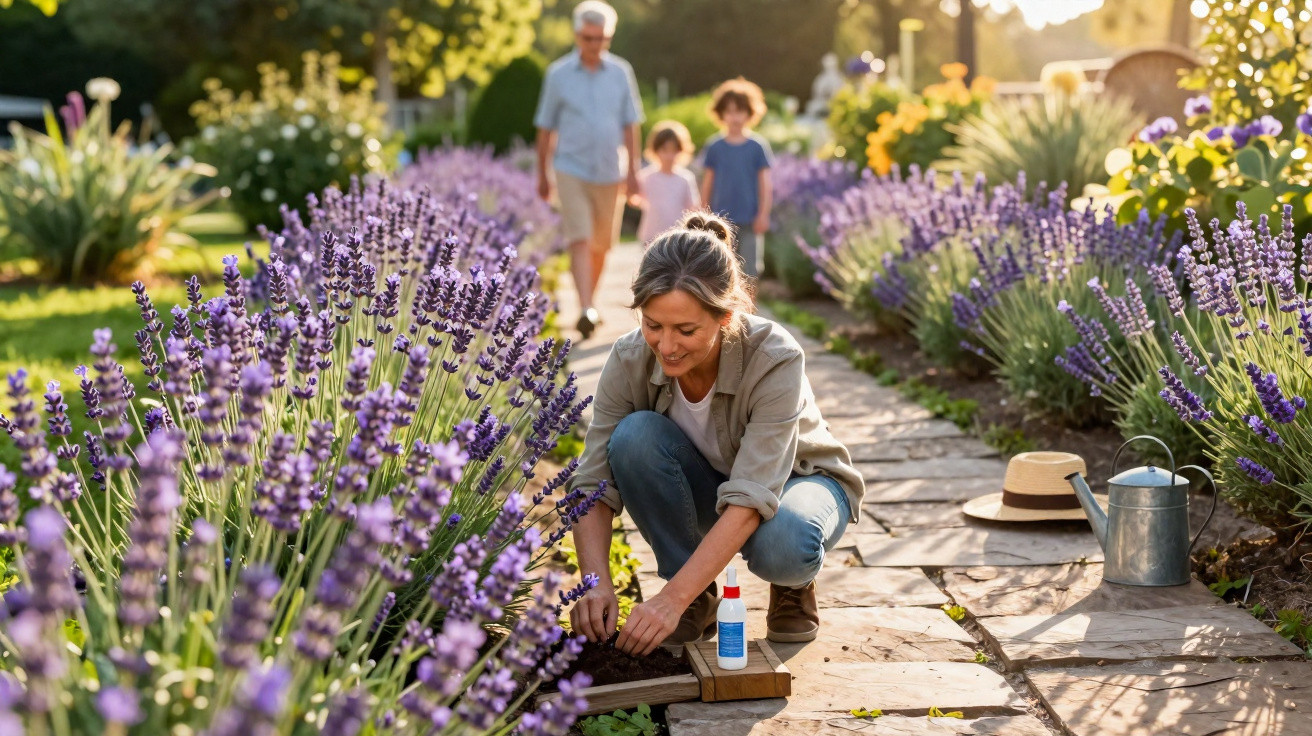
Sprays can reek, candles gutter out, and once you step beyond the door, screens are no use. A gentler solution is right under your nose: the very edge of the garden path.
Twilight was settling when a gardener let me in on his quiet trick. The gravel still radiated the day’s warmth as he walked ahead, secateurs tucked into his back pocket. He brushed past a low fringe of lavender and, with each graze of fabric, it breathed out tiny violet puffs of scent. Midges hovered over the lawn, but the walkway itself felt like a perfumed passageway-somewhere mosquitoes seemed to bypass, as though a doorman were turning them away.
He asked me to pause and listen. The garden buzzed, but there was no whining around our shins. Then he grinned and told me to walk the edge again, slowly. The difference was immediate.
The path that fights back
Lavender works beside a walkway because it sits exactly where your movement creates a little swirl of air. A shoulder brushing past, or a bag catching the tips, nudges the plant and releases the fragrant oils that make lavender smell so soothing-and those same aromatic compounds are among the scents mosquitoes tend to avoid. In effect, the border becomes a living diffuser, refreshed not by electricity but by ordinary passing footfall.
On one side he’d planted a ribbon of ‘Hidcote’; on the other, a shorter run of ‘Munstead’. He placed them far enough in that the foliage would skim your calves in shorts. In the first week, after watering late one evening, he counted six bites; the following week, with the lavender flowering and clipped into a low cushion, he had one. A neighbour copied the idea along a brick path and later noticed guests stayed outside after supper without the usual absent-minded slapping at their wrists.
The appeal has straightforward biology behind it. Lavender is rich in linalool and linalyl acetate-volatile compounds that lift into the air when warmed by sunshine or stirred by someone walking past, forming a light, near-ground haze. Mosquitoes home in on carbon dioxide and the chemistry of skin; that lavender layer helps muddle those cues while adding a scent they’d rather avoid. Add in the way stone and gravel hold warmth into the evening and the release stays steady-more a persistent whisper than a sudden burst.
How to line your path with lavender
Begin with robust types that cope well with trimming and the knock-and-bash of a busy border: Lavandula angustifolia ‘Hidcote’ for deep purple, ‘Munstead’ for a neat, compact edge, and lavandin ‘Grosso’ if you’d like taller, more dramatic flower spikes. Plant them about 35–46 cm apart (14–18 inches) so the line fills in, and angle each root ball slightly towards the path so the plants naturally lean into the space. Water them in well once, then let the top 2.5 cm (1 inch) dry out between drinks, and choose a spot with around six to eight hours of sun.
Position matters: this only works when the plants actually get brushed. Set the lavender too far back and you lose the effect; set it too close and boots will batter the stems. Free-draining, sandy or stony ground is ideal. If you’re dealing with heavy clay, build a slightly raised strip and work in coarse grit with compost, or plant lavender in long troughs that run along the pavers. We’ve all had that moment where a garden idea sounds romantic until it meets real life and stubborn soil-let’s be honest, nobody keeps up heroic fixes every single day.
To keep the border low and soft, like a lavender wave along the walkway, give it a light trim after the first flush of flowers. Snip off the spent heads easily and stop short of cutting into old wood, which rarely reshoots well. And try not to force perfect balls: this is scent planting, not a parade of topiary recruits.
“Paths are where you live,” the gardener told me. “So put the scent where you’ll brush it, and the bugs where they’d rather not follow.”
- Plant it where you walk: keep it about 15–20 cm (6–8 inches) from the edge so the fragrance stays close and the plants are brushed often.
- Prioritise sun and drainage: open sky, lean soil, and good airflow beat soggy roots every time.
- Keep a trimming rhythm: a gentle clip after flowering, then a light tidy in late summer-avoid hard cuts in autumn.
- Combine heights: use compact plants on tight bends, and taller ones by gates for a lavender “hello”.
- Choose smart edging: gravel, brick, or pavers reflect warmth and help encourage scent release.
The ripple effect of a scented edge
A lavender border won’t eliminate every mosquito, and it’s no substitute for screens or basic common sense about standing water. What it can do is change how the garden feels. The air seems fresher, evenings stretch out, and chat carries further from the back door. It’s a boundary that earns its keep twice over-one job for your nose, one for your ankles-delivered by a plant that mainly asks for sunshine and a little care.
| Key point | Detail | Why it matters to you |
|---|---|---|
| Lavender by the path reduces bites | Brushing releases volatile oils that help mask the cues mosquitoes track | Fewer interruptions outdoors and more comfort at dusk |
| Right variety and spacing matter | ‘Hidcote’/‘Munstead’ set 35–46 cm apart (14–18 inches), about 15–20 cm from the edge (6–8 inches) | A dense, touchable ribbon that perfumes the air as you pass |
| Care is light but precise | Sun, drainage, a gentle post-bloom trim, and avoiding cuts into old wood | A long-lived border that looks good and earns its place |
FAQ:
- Which lavender works best to deter mosquitoes? English lavender (Lavandula angustifolia) such as ‘Hidcote’ and ‘Munstead’ is ideal for edging, while lavandin ‘Grosso’ suits larger spaces where you want stronger scent and taller spikes.
- Will this replace bug spray entirely? No. It can ease the problem along the path and cut down bites for many people, but you’ll still need the basics-remove standing water and use protection on high-mosquito nights.
- How close should I plant it to the walkway? Aim for roughly 15–20 cm (6–8 inches) from the edge so knees, hems, and bags lightly brush the plants-this contact is what keeps the scented “cloud” refreshed.
- What if my soil is heavy clay? Improve drainage by making a raised strip with coarse grit and compost, or use long planters that run along the path; the essential thing is preventing roots from sitting wet.
- Will lavender harm bees or pets? Bees adore the flowers during the day, which is part of the appeal. In the garden, lavender is generally safe around pets; discourage chewing and avoid using concentrated oils near cats and small dogs.



Comments
No comments yet. Be the first to comment!
Leave a Comment