
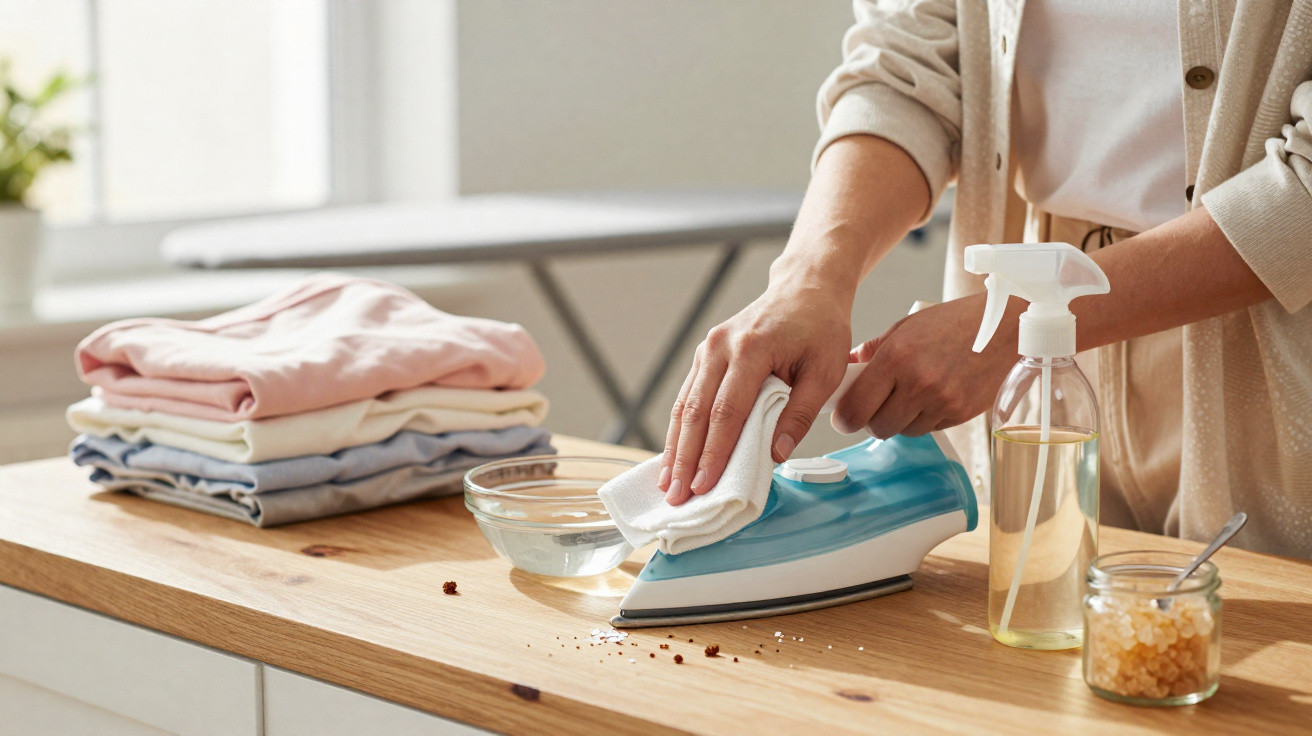
A freshly ironed shirt, then brown splashes suddenly emerge from the iron – every household’s nightmare.
A straightforward trick can stop it happening.
Many people only realise their iron is close to failing when rust marks or white flakes end up on a favourite blouse. Usually, the cause is not a fault but ordinary limescale. Recognising a few warning signs and knowing one simple household remedy can avoid an expensive replacement – and protect clothing from stains that cannot be repaired.
When your iron sends an SOS: spot the warning signs early
Each time you fill an iron with tap water, limescale deposits build up inside it. You may not notice at first, but the appliance will begin to give increasingly obvious signals.
Weak steam instead of a powerful burst
A properly functioning steam iron produces a steady, strong jet of steam. If this becomes feeble, erratic or merely “spits” intermittently, limescale is often responsible. Unusual noises frequently appear as well:
- whistling or hissing sounds
- crackling or “crunching” noises
- interrupted bursts of steam with pauses between them
The appliance can seem as though it is really struggling. Thicker materials, including denim or linen, become harder to smooth, so you have to pass over the same area for longer – and electricity use rises in the process.
White flakes and brown drops on clothing
Another common warning sign is pale, crumbly residue on dark fabrics. These particles are hardened minerals that break away inside the steam chamber and escape with the steam.
It is even more unpleasant when rusty brown water comes through the jets. At this stage, limescale, metal residue and burnt fibres have combined. Once these marks land on a blouse, shirt or silk dress, they are often extremely difficult to remove.
“Anyone who notices brown drops or white flakes coming from their iron should act immediately – otherwise, the only option is usually the electrical waste bin.”
In addition, a scaled soleplate does not glide as well, can catch easily and may discolour synthetic fibres. Shiny patches on suit trousers or synthetic tops are often caused by uneven heat distribution resulting from limescale.
The easiest kitchen helper: a vinegar and water mixture for your iron
For most appliances, one classic cleaner found in almost every home is enough: household vinegar. Used correctly, it dissolves limescale without scrubbing or specialist products.
Mixing the descaling solution
The standard method requires only a simple mixture:
- 1 part water
- 1 part clear household vinegar (for example, 10–14%)
This 50/50 solution is sufficiently strong to break down limescale, while remaining mild enough not to immediately damage plastic components and seals.
Important rule: never descale while hot
The most common mistake is to pour vinegar into the iron, switch it on and run the acid through while the appliance is hot. Not only does this produce a harsh smell, but it can also harm the internal components.
A gentler approach is as follows:
- Unplug the appliance and allow it to cool down completely.
- Empty any remaining water from the tank.
- Fill the tank with the vinegar-and-water mixture.
- Stand the iron upright and leave it for at least 30 minutes.
During this time, the acid loosens limescale crusts from the tank, channels and steam chamber. There is no need to shake or move the iron.
Rinse thoroughly to prevent lingering smells
After the waiting period, the most important stage comes next: rinsing. Skimp on this step and your home may quickly smell of vinegar the next time you iron.
Continue as follows:
- Empty the tank completely.
- Add fresh water, swirl it around vigorously and pour it out again.
- Repeat this rinsing process at least two or three times.
Then carry out a steam rinse: fill the iron with clean water, set it to its highest temperature and activate the steam function for an extended period over a sink or an old towel. This releases the final pieces of limescale and dirt from the steam holes.
“Many people are surprised by how much dark sludge and how many white lumps come out of a ‘perfectly ordinary’ iron during its first thorough descaling.”
A smell-free alternative: descaling with citric acid
Anyone who dislikes the familiar smell of vinegar can use citric acid instead. It is similarly effective but almost odourless.
How to measure citric acid correctly
Citric acid is generally sold as a powder. A simple mix is enough for the tank:
- 1 tablespoon of citric acid powder to around 250 millilitres of water
- for larger tanks, around 2 tablespoons to 1 litre of water
Dissolve the powder fully in the water before pouring the liquid into the tank. The rest of the process follows the vinegar method: leave it to work while cold, empty it, rinse several times with clean water and finally blow it through with hot steam over a cloth.
One benefit is that this method is especially suitable for areas with very hard water, as it can be used more frequently without making the whole home smell of vinegar.
How often does an iron really need descaling?
Even the best descaling method is of little use if you use it only once during the appliance’s lifetime. Regularity is what matters.
The right schedule for different households
The following broad guide has proved useful:
- soft water, infrequent ironing: every 3 months
- standard tap water, ironing weekly: every 1–2 months
- very hard water or daily ironing: roughly every 4–6 weeks
Anyone who irons frequently or lives in an area with heavily limescale-containing tap water can also mix in a little distilled water to reduce the amount of limescale from the outset.
For everyday use, it helps to keep a small “iron kit” close at hand:
- household vinegar or citric acid
- a measuring jug or old glass for mixing
- a small funnel (optional, to prevent spills)
- an old cotton cloth for steam rinsing
What limescale really does inside an iron – and why prevention costs less
Limescale is not just a cosmetic concern. The deposited layers act as insulation around the heating element. The iron takes longer to heat up and uses more energy to deliver the same performance. Meanwhile, the pump has to work against channels that are becoming increasingly narrow, until it overheats or fails completely.
There are also safety considerations: overheated components, blocked valves or leaking tanks can, in extreme cases, lead to faults that go far beyond a few marks on a blouse. A half-hour descaling session every few weeks costs almost nothing, whereas a new branded appliance can quickly cost a three-figure sum.
Practical everyday tips and common mistakes
Adapting a few small habits can significantly reduce limescale problems:
- Empty the tank after ironing whenever possible, rather than leaving water sitting in it for days.
- Store the appliance upright so that water cannot run into areas not designed to hold it.
- Rinse heavily soiled textiles or items carrying detergent residue before ironing them.
- Never use vinegar essence or undiluted citric acid – your seals and metal parts will thank you.
Anyone who often irons performance clothing, synthetic materials or delicate fabrics will benefit from a particularly well-maintained appliance: even heat and clean steam jets prevent shiny patches, scorch marks and unpleasant odours in the fabric.
Limescale, vinegar and citric acid may sound technical at first, but they have long been household essentials in many homes. Ultimately, the calculation is simple: a few minutes of care every few weeks can substantially extend an iron’s lifespan and save favourite clothes from damage that no wash cycle can undo.


Comments
No comments yet. Be the first to comment!
Leave a Comment