
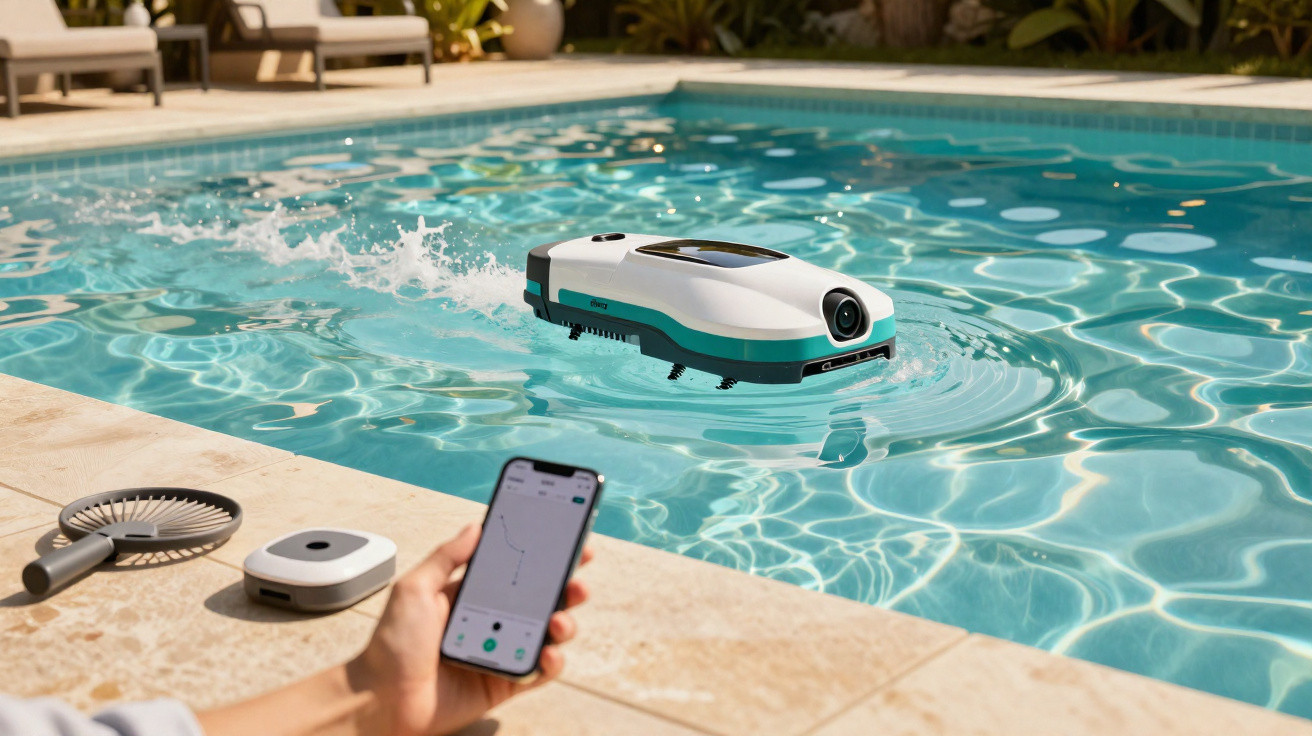
For the first time at Aiper, a pool robot features a front-facing camera supported by artificial intelligence that takes previous cleaning sessions into account. With the Scuba V3, the brand is pursuing a fairly unusual ambition: a robot able to refine the way it cleans your pool throughout the season.
Weighing almost 15 kg, with nine motors and a launch price of €2,499, the highly premium Aiper Scuba X1 Pro Max impressed us in 2025 with its ability to handle almost everything. It cleaned the floor, walls, waterline and even the surface in a consistent, efficient manner. Yet it managed to find its way without a lens in sight, relying entirely on a set of 40 sensors.
As surprising as it may sound, cameras remain uncommon in pool robots. In 2025, the Beatbot AquaSense 2 Ultra was among the first consumer models to use one, while WYBOT launched its S2 Solar Vision, S2 Vision and C2 Vision in the same year. The group has expanded this year with the Beatbot AquaSense X (€4,250) and the Mova Rover X10 (€2,499), among others. Even so, this feature is still reserved for a small number of products, and above all it remains expensive.
For 2026, Aiper is joining them with the Aiper Scuba V3. Less showy than its larger sibling and priced at €1,099, it notably drops surface cleaning. In return, it introduces a front camera that can identify debris and direct its movements. The brand goes further by pairing it with its AI Navium artificial intelligence, which is designed to use earlier cleaning sessions to refine its behaviour over time.
We therefore let the Aiper Scuba V3 clean the same 40 m² pool for three months, to see whether all those dips genuinely made it smarter.
Aiper Scuba V3 at the best price
Base price: €999
| Retailer | Discount | Price | Offer |
|---|---|---|---|
| Amazon | -15% | €849 | View offer |
| Rakuten | -15% | €849 | View offer |
See more offers.
A well-built robot that does without mapping
Measuring a reasonable 44.4 x 38 x 21.8 cm and weighing 8.25 kg when dry, the Aiper Scuba V3 almost looks lightweight beside some of the sector's heavyweights. By comparison, the Mova Rover X10, which measures 54 x 46 x 32 cm, tips the scales at 15.8 kg-nearly twice as much to lift from the water once it has finished its job.
That does not make the V3 a pool toy, however. Its rectangular body, generously rounded at each corner, gives it the appearance of a compact all-terrain machine. Gloss black covers the top, while anthracite sides frame the body. At the rear of the cover, a turquoise disc marks the water outlet. The plastics are thick and the various panels fit together perfectly. It consequently feels reassuringly solid from the first time you handle it.
Turned upside down like a turtle, the robot reveals a more conventional layout. Two wide toothed tracks run over large rollers, while two powered brushes scrub the pool lining as the pumps draw in dirt.
A single button on the top is enough to wake the robot, begin Bluetooth pairing with a long press, or reset it. Everything else is controlled through the Aiper app. Bluetooth handles the initial connection to the smartphone, before Wi-Fi takes over for changing settings and receiving notifications. Once submerged, however, the V3 loses this link because radio signals do not travel through water. Changing the programme mid-clean is therefore impossible.
It is best to decide precisely what you want it to clean before putting it in the water. This connectivity does not create a map of your pool either. Unlike the Dreame Z1 Pro, which displays a map of the pool in its app after an initial run, the Aiper Scuba V3 does not retain a layout that you can view. Aiper's latest model relies on something else to understand its surroundings.
A camera that moves navigation beyond a simple grid
There is no viewable map in the app, but the Aiper Scuba V3 is not navigating blind. Its front camera works alongside distance sensors within the in-house VisionPath system. This set of hardware assesses the environment and adapts its route in real time.
Aiper claims a detection range of 2 metres and recognition of more than 20 types of debris. Two LEDs, positioned on either side of the lens, illuminate the area when light is limited. This useful addition comes into its own with cleaning cycles scheduled late in the day, or where part of your pool is heavily shaded.
In Auto mode, the robot keeps a methodical approach. In our 40 m² pool, it first covered much of the floor before taking on the walls, without needlessly repeating the same areas. It occasionally made detours around steps or return jets, but its overall coverage remained consistent.
The app also lets you clean the floor or walls independently, while Auto mode deals with both in sequence. To make proper use of the camera, though, you need to select “AI Patrol”. The V3 then abandons its initial grid pattern to focus on the areas of the floor carrying the most dirt.
We tested this in a fairly straightforward way. We placed four pebbles in the four corners of the pool before returning the robot to the water. Rather than simply following its route until it happened upon them, the Aiper Scuba V3 first diverted towards the first pebble and sucked it up, then set off to collect the others in the same way. Only afterwards did it begin its wider cleaning work.
It is an option worth choosing when your pool is particularly dirty, after a windy night or when reopening it after winter. You may then want to follow it with an Auto cycle, so the walls are not left unattended.
AI Navium, the dormant brain of the Aiper Scuba V3
Essential for getting the most from the robot, the Aiper app is intuitive and easy to use. Its home screen brings together the robot's status, battery level and the cleaning modes already mentioned.
A closer look through the menus reveals several more compelling settings. Scheduling, for instance, enables regular pool maintenance provided the robot is left in the water. Three schedules are available: 45 minutes for four cleans a week, 60 minutes for three, or 90 minutes for two. Because the programme is stored directly on the V3, it can start work at the planned time without needing a Wi-Fi connection.
Notifications work differently. Since the robot cannot communicate while operating on the pool floor, the V3 waits until it returns to the waterline and regains Wi-Fi before sending its information. Five alert types can be enabled independently, with an adjustable time window to avoid being woken in the middle of the night.
The most distinctive feature is undoubtedly AI Navium. Curiously, it is disabled out of the box despite accounting for a substantial part of the robot's promise. To use it, you must allow analysis of local weather, usage habits and adaptive automatic cleaning.
Once enabled, these settings work over the longer term, whereas the camera responds immediately. Here, Aiper says it combines pool size, weather conditions and cleaning history to build future cycles automatically and adjust their frequency. This ability to learn from previous cleaning sessions was exactly what we wanted to assess throughout our three-month test.
Movements that become more refined over time
The more challenging parts of our pool provided the best test of the Scuba V3. Our corner staircase, for example, has four 28 cm steps and caused it difficulties during the first few cleans. Its attempts often ended at the foot of the steps because it could not gain the right purchase.
After repeated attempts, and once AI Navium had been enabled, its method changed.
Rather than repeatedly trying to force its way up, the V3 travelled along the wall beside the staircase to position itself against the second step. From there, it used the water movement created by its brushes to dislodge debris from that step and the first one, causing it to fall to the floor. It then only had to descend and vacuum it up.
This was a somewhat unexpected and rather clever workaround, although the uppermost step, which was half submerged, remained beyond its reach. Even so, in pools with numerous levels and changes in height, the V3 appears to have enough intelligence to try to find a solution.
The return jets were another revealing test. During the first weeks, their protrusion was enough to knock the robot off course. With successive runs, the Scuba V3 eventually adapted its route to avoid them.
A pool robot with sufficient power, but poorly arranged filters
With a suction flow rate of 18.2 m³/h, the Scuba V3 is not relying on raw muscle. The Ecovacs Ultramarine P1, launched at €549, claims precisely the same flow rate. That is half the price for the same stated suction. Aiper therefore appears to be betting on accurate coverage rather than brute force.
In water, we never really found this power difference lacking. Leaves, petals, insects, small pebbles and soil carried in underfoot generally disappear after one pass. The pool's four corners can sometimes resist it, though. Its rounded casing stops it from reaching debris right into them.
On walls, the V3 climbs readily and travels straight up to the top. It then moves directly onto the waterline. In the dedicated mode, it grips the surface and moves sideways from one wall to the other, never returning to the floor between sections. This approach prevents unnecessary back-and-forth journeys.
The Scuba V3 stores its haul in a 3.5-litre basket. That is not especially large compared with the 4.5 to 6 litres offered by some competitors. Its filtration uses two stages: a 180-micron mesh is intended to catch larger debris, followed by a 3-micron MicroMesh filter for pollen and suspended particles.
It is chiefly their arrangement that leaves us puzzled. Aiper places the MicroMesh at the front, before the main mesh. In other words, the finest filter receives leaves and pebbles before the filter intended to stop them. In a very dirty pool, it therefore clogs unnecessarily quickly. We got into the habit of running the first major clean without it, then fitting it again for a second pass dedicated to finer particles.
A useful charging base, and battery life that needs perspective
There is a pleasant surprise when it is time to put the Scuba V3 away: Aiper supplies a genuine charging station. Simply place the robot on it and two metal contacts take over. There is no connector to handle with wet hands, nor a flap to open after every swim.
The base also fits easily into a garage and is convenient for storing the robot in winter. The only minor disappointment is that a full charge takes around five hours, which is towards the upper end of the range.
When fully charged, its battery provides up to 180 minutes of operation. In our 40 m² pool, this proved sufficient for everyday use, with cycles generally lasting between 160 and 200 minutes when both the floor and walls needed cleaning. Depending on the pool's condition, the V3 may also decide that its task is complete before it has used all of its battery.
The claimed 150 m² should therefore be treated with some caution. This figure refers to the maximum pool size for which the Scuba V3 is intended; it does not mean it will necessarily clean that area on a single charge. In a large pool, maintenance will logically need to be spread across several cycles, depending on the state of the pool.
At the end of its work, if you have enabled the option in the app, the robot heads for the waterline and waits there for ten minutes to be retrieved by hand. If nobody collects it, it eventually sinks. The supplied hook, which screws onto your own pole, then becomes essential to avoid having to play lifeguard.
Aiper Scuba V3 price and competition
Launched at €1,099, the Scuba V3 sits in the market's most fiercely contested price bracket, where cameras remain uncommon. Above it, the Beatbot Sora 70 (€1,499) adds water-surface cleaning and a 6-litre basket. The Dreame Z1 Pro, launched at €1,299 in 2025, offers 30 m³/h of power and pool mapping.
Below it, the Ecovacs Ultramarine P1 (€549) was announced last spring, while the Mammotion Spino E1 (€599) arrived in summer 2025. Both robots clean the floor, walls and waterline, but neither has a front-facing camera.
Within Aiper's own range, the Scuba S1 costs €599. The brand presents it as a simpler alternative to the V3, without its camera or AI functions. The €500 difference gives a clear indication of the premium charged for these additions.
Aiper Scuba V3 at the best price
Base price: €999
| Retailer | Discount | Price | Offer |
|---|---|---|---|
| Amazon | -15% | €849 | View offer |
| Rakuten | -15% | €849 | View offer |
See more offers.
Our verdict on the Aiper Scuba V3 pool robot
At €1,099, the Scuba V3 cannot really get away with merely cleaning a pool well. Several cheaper models already handle the floor, walls and waterline. Aiper justifies its extra cost elsewhere, and these long weeks of testing are precisely what make it possible to judge that claim.
Still unusual at this price point, the camera provides the clearest proof of its value. In AI Patrol mode, the robot can leave its route to collect debris directly. AI Navium is far harder to assess, because Aiper promises a robot capable of building its own schedule from the pool dimensions, cycle history and local weather.
It is nevertheless difficult to credit every improvement to it. No two runs are ever exactly alike, and it would be rash to see AI behind every route change. After three months, though, the finding remains fairly clear: the Scuba V3 coped better with the particularities of our pool than it did at the start of the test. “Learning” may be a slightly strong term, but the promise of behaviour that becomes more refined is not misleading.
That does not erase its slightly undersized basket, filters fitted in an order we cannot understand, five-hour charging time or lack of surface cleaning. Taken together, the V3 makes most sense for regular use: a family pool that is not necessarily straightforward to navigate, a slightly intricate staircase, and a desire to let the robot get on with its work underwater through scheduled cleaning cycles.
You do need patience to get the full benefit, however. The V3 will need several dips before it finds its routine. It is only then that its price begins to make sense.
Aiper Scuba V3
€1,099
8.8
| Category | Score |
|---|---|
| Installation and build quality | 9.0/10 |
| Navigation and obstacles | 9.5/10 |
| App and features | 9.5/10 |
| Cleaning performance | 8.0/10 |
| Battery life and charging | 8.0/10 |
What we like
- Effective camera for spotting debris
- Navigation that becomes more refined across cleaning sessions
- Efficient cleaning of the floor, walls and waterline
- Comprehensive scheduling and AI Navium that becomes interesting over time
- Practical charging station
What we like less
- Poorly arranged filters
- Slightly undersized 3.5-litre basket
- Long five-hour recharge time
- Corner cleaning and high-step cleaning could be improved

Comments
No comments yet. Be the first to comment!
Leave a Comment