
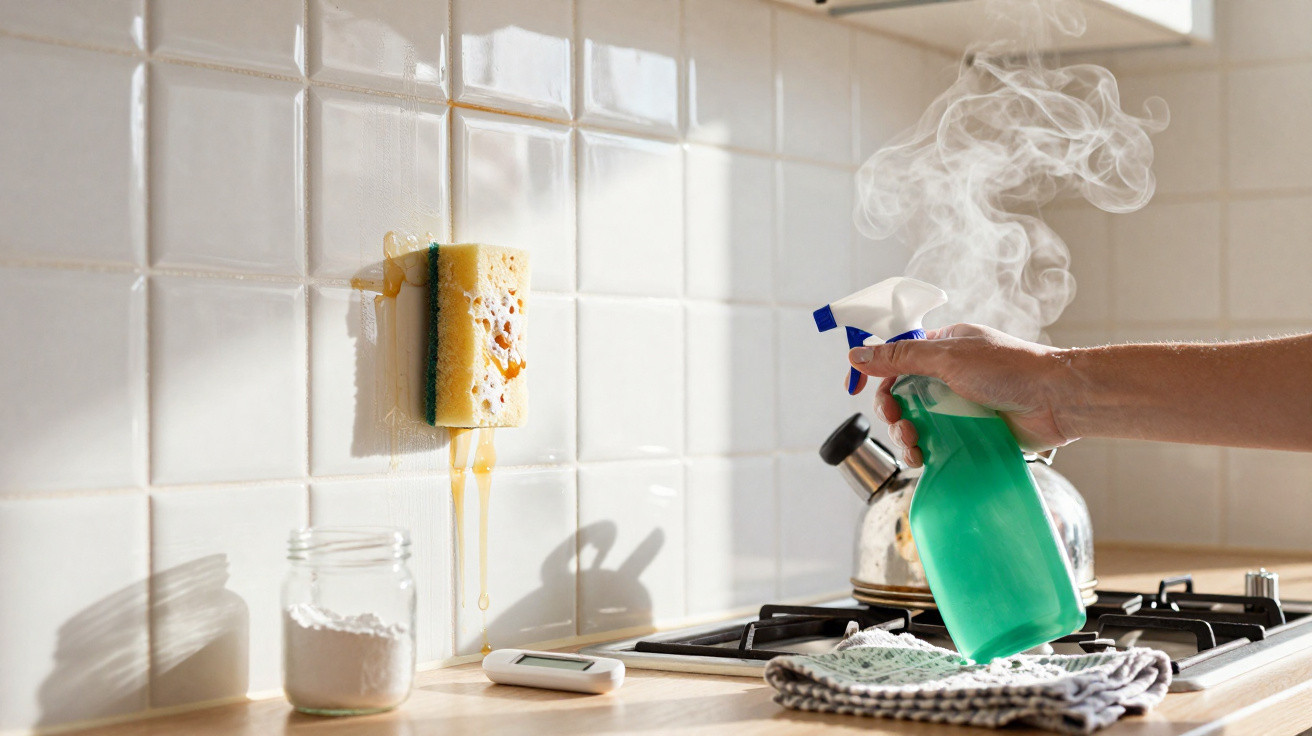
Baked-on grease on cooker tiles becomes harder to shift each time it picks up another layer of oil, dust and heat. When the grime is old, a quick wipe with washing-up liquid or a rub with alcohol can take a lot of elbow grease. The most effective approach is usually to soften the build-up first with heat or steam, then lift it with a suitable product and a non-abrasive cloth or sponge.
Why is old grease so difficult to remove?
Fresh oil splashes are easier to clean because they are still fairly fluid. After repeated heating and cooling cycles behind the cooker, however, the residue spreads into a sticky film that traps other particles and bonds more firmly to the tile surface.
Washing-up liquid is not pointless here. Its surfactants are designed to loosen and emulsify grease so it can be carried away with water. The issue is expecting a fast pass with cold detergent to dissolve immediately a layer that has built up over weeks or months. Hot water and sufficient contact time help soften greasy deposits before you start scrubbing.
- Recent grease usually lifts more easily;
- Older layers need time to soften;
- Warm or hot water makes it easier to remove greasy residue;
- Surfactants help keep grease dispersed in the water;
- Scrubbing with highly abrasive materials can scratch glossy finishes.
Is steam the best first step for baked-on grease?
On heat-resistant tiles, steam can be especially helpful because it delivers heat and moisture straight into the hardened layer, making it easier to remove mechanically. Steam cleaners are commonly used to loosen grease on kitchen surfaces and grout lines, but the jet should be used carefully around silicone, electrical sockets, cupboards and other sensitive materials.
Bicarbonate of soda or an enzymatic degreaser: which should you choose?
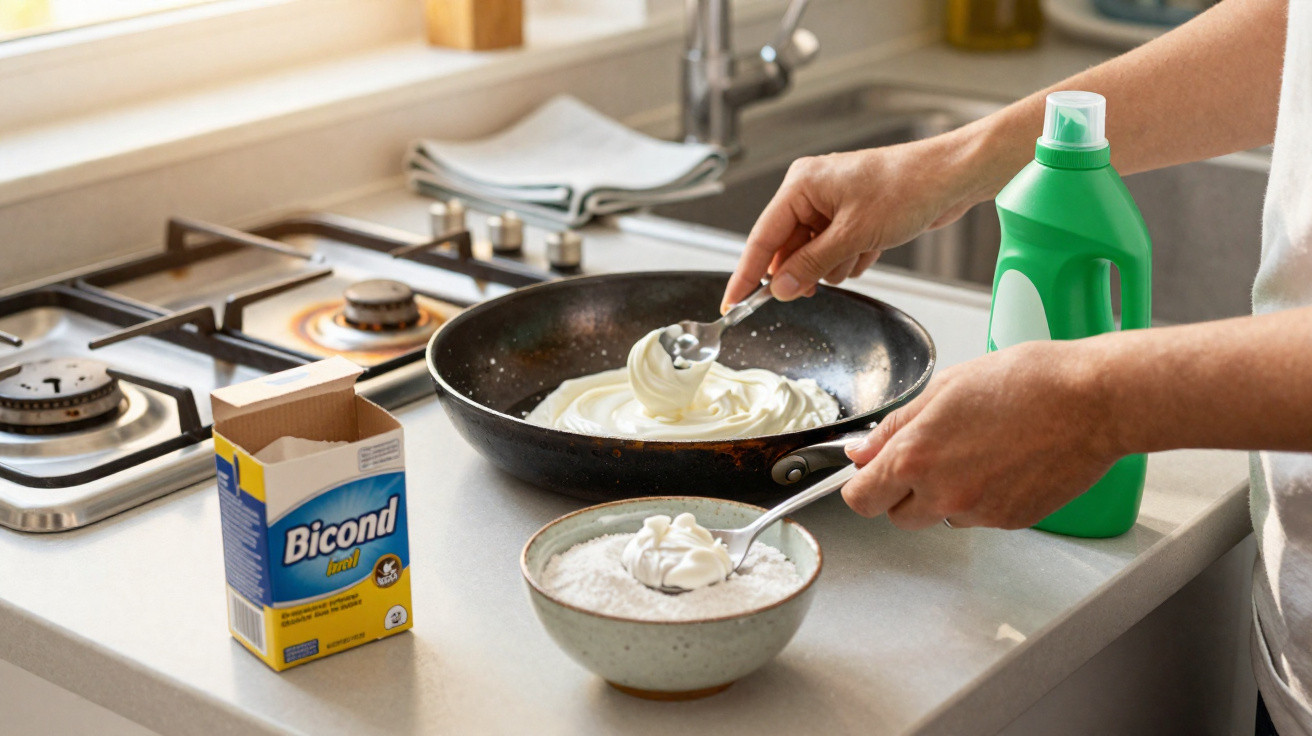
A paste made from bicarbonate of soda and water can be useful when there are stuck-on spots that benefit from a mild abrasive action. Apply it and rub gently, particularly on grout and any tile finish that could scratch. Cleaning guidance often recommends a bicarbonate paste for stubborn dirt, followed by rinsing with water.
Enzymatic degreasers work differently: certain enzymes help break down fats and organic residues over time. In that case, more heat does not necessarily mean a better outcome, because the product needs to remain on the surface for the time and at the temperature stated on the label. Ideally, pick a formula that is explicitly suitable for tile and grout, rather than repurposing products designed for floors or drains.
- Steam: helps soften old deposits quickly;
- Bicarbonate of soda paste: provides mild abrasive action on persistent spots;
- Degreaser: helps disperse or break down grease depending on the formula;
- Enzymatic product: mainly needs adequate contact time;
- Microfibre cloth or soft sponge: lifts away what has already loosened.
Why isn’t alcohol the best choice near the cooker?
Alcohol can dissolve certain residues and is widely used for other cleaning tasks, but it is not the most practical option for a thick crust of grease. Ethanol and isopropyl alcohol are also flammable liquids, so they should not be used near a flame, lit burners or surfaces that are still hot. The cooker should be switched off and completely cool before any cleaning.
Does temperature matter more than the product?
Heat can make a huge difference because it softens greasy deposits and reduces how much force you need to dislodge them. This is why hot water or steam often makes cleaning an old layer far easier than starting with a cold cloth. Even so, there is no fixed rule that temperature is always more important: heat, the product’s chemistry, contact time and friction all work together.
In practice, for the tiles behind the cooker, it is worth starting by softening the dirt with steam or warm water (as appropriate for the surface), wiping away the excess, and only then treating any stubborn areas with a bicarbonate of soda paste or a degreaser recommended for that material. Regularly wiping up splashes helps prevent new layers from being repeatedly heated during cooking and turning into that sticky film that is much more time-consuming to remove.


Comments
No comments yet. Be the first to comment!
Leave a Comment