
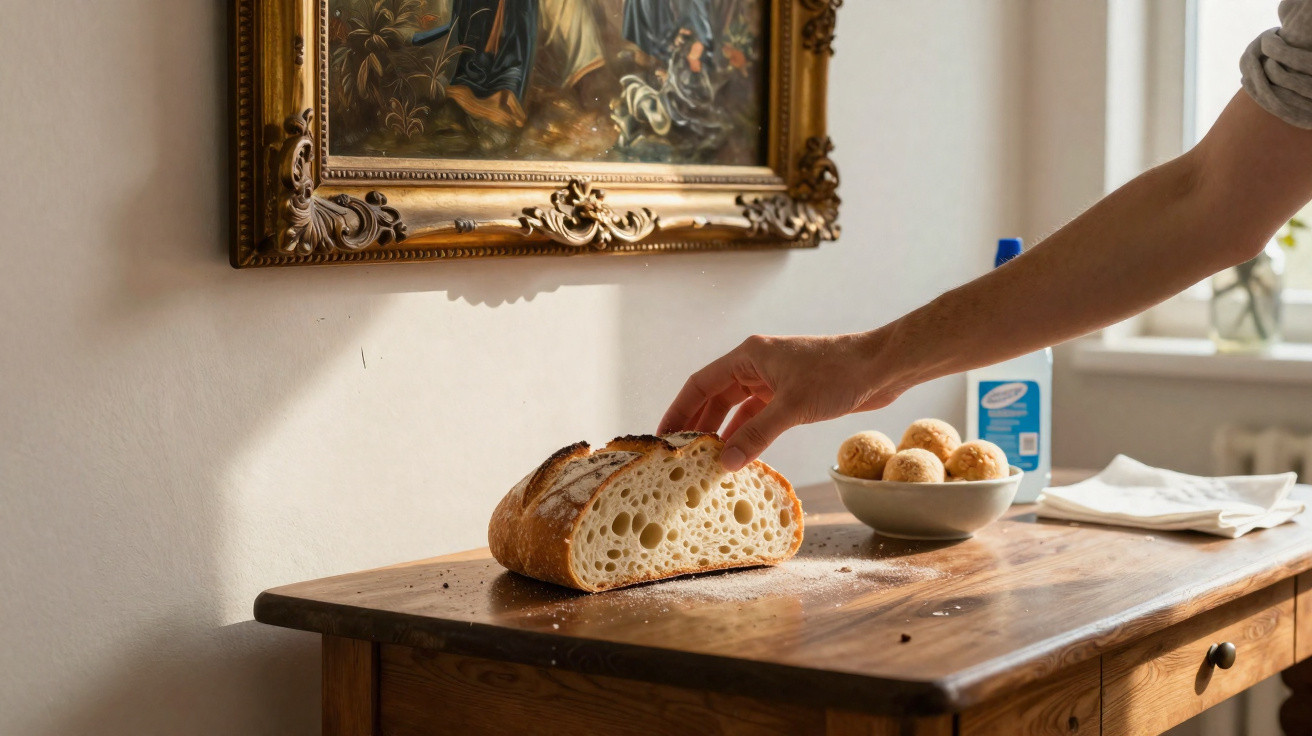
Most people reach for specialist cleaners when they need to deal with broken glass, fragile artwork or stained wallpaper. Those products are often chemical-heavy, strongly scented and far from cheap. Yet an ordinary staple from the kitchen can handle many of these jobs more quietly, more safely and surprisingly well - especially on tricky surfaces that many people avoid cleaning for fear of damage.
The unobtrusive cleaning miracle from the lunchbox
The key to this tip isn’t the slice itself, but the soft bread crumb - the inner part of the bread. The best choice is fresh, pale toast or sandwich bread with no hard crust. Its crumb behaves like an ultra-fine sponge that lifts particles away rather than smearing them around.
"Fresh bread crumb works like a natural micro-sponge: soft, elastic, absorbent - and completely free of chemicals."
Unlike glass sprays, methylated spirits or abrasive cleaners, bread crumb doesn’t attack the surface. It leaves no streaks, no scratches and no harsh residue. That’s exactly why it suits materials that people often leave untouched because they worry they’ll make things worse.
Why bread crumb grips dirt better than many cleaning products
How the porous structure traps tiny shards of glass
When a glass or light bulb shatters, the obvious pieces are easy to pick up. The real hazard is what’s left behind: minuscule splinters you can barely see but will definitely feel under bare feet. Sweeping with a brush often just spreads them.
Soft crumb has a fine, porous texture. Between its tiny air pockets, anything sharp-edged or dust-like gets caught. Pressing a piece of crumb onto the floor lifts those invisible fragments and holds them in place.
- Gently press the crumb onto the affected area
- Repeat in several spots until you can no longer see or hear any crunching
- Dispose of the bread immediately in the general waste bin
That way the glass ends up in the bin, not embedded in the carpet or stuck in someone’s soles. A quick wipe afterwards with a damp cloth is usually enough for extra reassurance.
Elasticity instead of friction: dirt is lifted, not dragged
A dry cloth frequently pushes dust and grit back and forth. A brush can rub some of that grime into the surface. Bread crumb works differently: it conforms to the area, yields slightly and effectively “encloses” the particles.
That’s why bread crumb is useful on surfaces where even microfibre can feel too harsh - such as matt paint or delicate paper wallpaper. The dirt transfers into the crumb and stays there, rather than becoming a cloud of dust in the room.
Delicate surfaces where bread crumb excels
Dust and grime on old oil paintings
If you inherit an older painting, it’s common to feel you shouldn’t touch it. Water, alcohol and glass cleaner are off limits, and typical cloths can be too rough. This is where bread crumb can help.
Shape a small piece of fresh crumb gently between your fingers, then lightly press it onto the painted surface. Don’t rub or wipe. Simply dab repeatedly. Loose dust lifts away without harming the paint layer or varnish.
"Many restorers have used soft crumb for decades to gently clean dusty paintings - an old trick that’s barely known."
Important: use this only on surfaces that are dry and appear stable. If the painting looks heavily cracked or extremely fragile, it’s best left to a professional.
Pencil marks and small scribbles on pale walls
In family homes, walls rarely stay pristine for long. Pencil or coloured-pencil lines on a light wall can smear with standard erasers, while stronger cleaners can quickly leave shiny patches or uneven colour.
A piece of crumb can make targeted corrections: carefully dab along the pencil line. Gradually the crumb absorbs the graphite without attacking the wall. This is particularly helpful with matt paints, which can show blotches very easily.
Cleaning mirrors, glasses and fine vases without scratches
Sensitive glass surfaces don’t forgive mistakes. Newspaper can dull the finish, and rough cloths can leave micro-scratches. If you first remove loose dust with a soft, dry cloth and then follow up with bread crumb, you can pick up remaining grit that might otherwise cause scratching.
To do this, press the crumb lightly onto the glass, lift it, and place it again elsewhere. Avoid rubbing so you don’t leave a trail of crumbs. Afterwards, mirrors or vases can be polished streak-free with a lightly damp microfibre cloth.
How bread crumb becomes a versatile household helper
Which type of bread actually works
Not every slice performs the same. What matters most is softness and structure.
| Bread type | Suitability as a cleaner |
|---|---|
| Fresh white toast bread without crust | Very good: soft, fine-porous, hardly any crumbs |
| White bread with a thin crust | Good: remove the crust first |
| Wholemeal or seeded bread | Not very suitable: too coarse, lots of crumbs |
| Stale bread | Only limited: less elastic, crumbles quickly |
Ideally, use a piece that still feels slightly moist and springy, but not sticky. Once bread goes stale, it loses elasticity - and with it, much of its cleaning effect.
The right technique: dab, don’t scrub
The motion is the most important part. If you rub with the crumb, it may break apart and scatter crumbs over the surface. Instead:
- Roll the crumb into a small, compact ball
- Press it lightly but firmly onto the area you want to clean
- Hold for a moment, then lift straight up
- Turn the piece and dab again using a clean side
- Replace it with a fresh piece once it becomes noticeably dirty
Used this way, the dirt transfers into the crumb bit by bit. It takes a little patience, but it gives a highly controlled result - especially for small marks and spot cleaning.
Cleaning more sustainably with kitchen leftovers
Using bread crumb protects delicate surfaces and helps cut cleaning costs. Rather than throwing away older slices of toast straight away, you can give them a final purpose as a small cleaning aid. Afterwards, dispose of them in the general waste bin or the food waste caddy, depending on what they’ve picked up.
If you adjust your cleaning habits, you quickly notice that many tasks don’t need harsh products. Broken glass, dusty pictures, marks on the wall - all of these can be dealt with using bread crumb, a microfibre cloth and a bit of patience. Chemicals are best saved for situations where they genuinely add value, such as descaling or disinfecting.
There’s also an interesting learning effect: children quickly understand that a soft piece of bread can remove marks from a wall - and, with supervision, they also gain confidence in handling fragile items with care. In this way, a simple household trick becomes a small everyday ritual that saves money, reduces waste and brings old cleaning wisdom into the present.

Comments
No comments yet. Be the first to comment!
Leave a Comment