
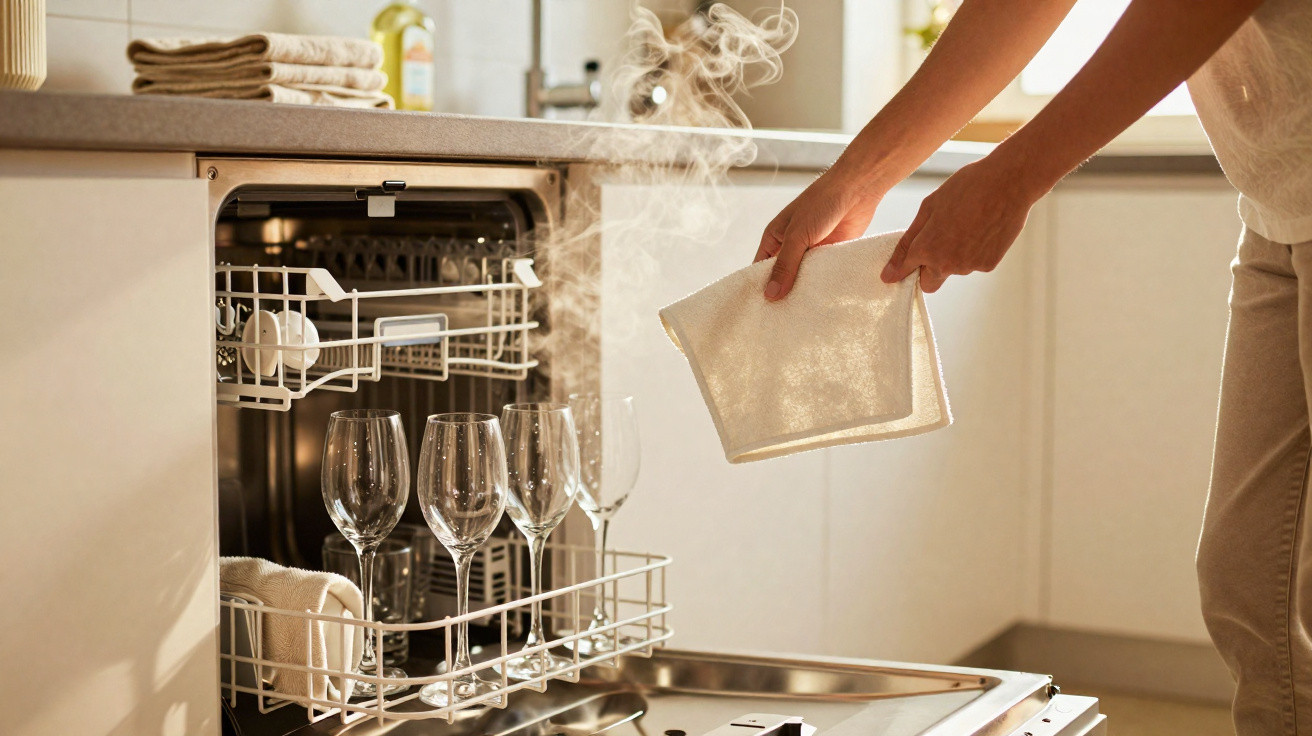
Still unloading damp glasses after every wash?
A straightforward, low-tech change to your routine can quietly improve how your dishwasher dries everything - and you can do it tonight.
Dishwashers may promise gleaming plates and clear glassware, but plenty of homes still end up with dripping mugs and wet cutlery. The good news is that you can often reduce that leftover moisture with a small adjustment, without replacing the appliance or buying specialist add-ons.
Why your dishes keep coming out wet
A dishwasher doesn’t only clean; it also creates a sealed, steamy environment. Near the end of a cycle, very hot water is sprayed around the tub to help shift grease and stubborn food. As the temperature drops, that hot moisture becomes steam and then turns back into condensation, settling on cooler surfaces - plates, glasses, plastic tubs, and even the interior walls.
On machines that depend mostly on residual heat for drying, the door generally stays closed until the programme finishes. With nowhere obvious for the steam to escape, it clings to the first cool surface it meets. Glassware and plastics are often the most affected because they retain heat poorly.
Condensation is not a malfunction. It’s a normal side-effect of hot water and a closed, sealed cabinet.
A few everyday habits can make the problem more noticeable:
- Choosing eco or low-temperature cycles that generate less heat for drying
- Loading the racks too tightly, restricting airflow
- Not using rinse aid, which helps water run off instead of beading
- Leaving the door closed for ages after the programme ends, once steam has already settled
The outcome is familiar: the cycle is “done”, but you still reach for a tea towel to dry each glass before it goes back in the cupboard. That turns an automatic task back into hands-on work.
The towel trick that changes everything
The tip doing the rounds online doesn’t require a gadget at all. It relies on a clean, dry kitchen towel acting as a moisture catcher at exactly the right moment - immediately after the cycle finishes.
How to do it step by step
It’s quick and takes under ten seconds to set up:
- Let the dishwasher finish its cycle (you’ll usually hear a beep or see the end-of-programme light).
- Crack the door open slightly - just enough to break the seal so a burst of steam can escape.
- Drape a clean, dry towel over the top edge of the open door so that:
- part of the towel sits inside the tub near the upper rack
- the rest hangs outside over the front of the door
- Ease the door back towards closed until it’s almost shut, holding the towel in place without slamming it.
- Leave it like that for about 15–30 minutes.
In that short pause, lingering steam and fine droplets are more likely to end up in the towel rather than on glass and plastic.
The towel creates a simple, absorbent bridge between the humid interior and the drier air in your kitchen.
When you open the door again, plates and glasses will typically be noticeably drier, with fewer droplets stuck on rims or pooled in the bottoms of cups. For many households, that’s enough to stop hand-drying each item.
Why this hack works so well
The viral trick is basically physics applied with common sense. Warm, damp air naturally heads towards cooler, drier surfaces. A cotton towel contains thousands of tiny fibres where moisture can condense and be held. Instead of forming beads on a wine glass, the water shifts towards the towel.
Leaving the door nearly shut matters too. The tub is no longer fully sealed, so humidity can escape gradually, but the towel accelerates the process by providing a better place for the moisture to go. That small change nudges the environment from “steam clinging everywhere” to “steam being captured and released”.
| Drying approach | What it uses | Typical result |
|---|---|---|
| Standard cycle only | Residual heat, closed door | Clean but often wet dishes |
| Door opened at end | Room air circulation | Better drying, some droplets |
| Towel trick | Absorbent fabric + ventilation | Noticeably drier, fewer spots |
Which households benefit the most
This method is particularly handy in common situations where drying tends to disappoint:
- Older dishwashers without active drying fans
- Budget models that are usually run on eco programmes
- Families washing lots of plastic lunch boxes and children’s cups
- Open-plan kitchens where you’d rather not release a big cloud of steam into the room
If you have a premium model that opens its door automatically, the improvement may be smaller. Even so, the towel can still help after a very full load or with quick cycles that finish before a thorough dry.
For people who run one big load in the evening, the towel step can replace the morning ritual of wiping every wine glass by hand.
Safety, hygiene and small precautions
As with any household shortcut, it works best with a few sensible checks. Choose a towel that is:
- clean and completely dry
- free of loose threads that could catch on racks or hinges
- cotton or another highly absorbent fabric
Don’t let the towel sit directly on any heating elements or cover any obvious vent openings inside the door. If your dishwasher has a powerful fan system, or the manufacturer warns against blocking the door area, leave the door slightly ajar rather than pushing it closed over thick fabric.
Afterwards, dry the towel out fully. Swap to a fresh one regularly so you don’t bring stale odours back into the machine.
Other tweaks that boost drying performance
You’ll usually get the best results by combining the towel trick with a few small changes to day-to-day use. Minor adjustments can make a visible difference.
Loading patterns that help water escape
The way items are arranged affects both airflow and drainage. To help things dry faster:
- Position glasses at an angle so water runs off rather than collecting on flat bases.
- Lean bowls slightly instead of sitting them perfectly upright.
- Avoid overlapping plates, which blocks warm air from reaching surfaces.
- Put plastic items on the top rack, where they get less direct heat but better circulation.
It’s worth checking the manual at least once, as many brands show layouts aimed at drying performance, not only cleaning.
Rinse aid, salt and the right programme
Rinse aid isn’t just about preventing spotting; it reduces the surface tension of water so it sheets off dishes rather than forming droplets. If you stopped using it to cut costs, you may simply have swapped money saved for time spent drying glasses by hand.
On dishwashers that need it, salt supports water softening. Hard water clings more readily and tends to dry more slowly, increasing streaks and a cloudy haze on glassware.
When dryness matters more than efficiency, selecting a hotter “intensive” or “auto” programme can leave you with a drier load - especially if you also use the towel at the end.
Energy, cost and environmental angles
Many households now rely on eco cycles to reduce energy use and keep bills down, but those programmes often shorten or weaken the drying stage. The towel trick restores some of that drying performance without consuming additional electricity or relying on powered accessories.
A cotton towel absorbs moisture for free; your electricity meter doesn’t move while it does its job.
That may sound minor, but over the course of a year, avoiding the extra “heat dry” option - or an additional short cycle purely to dry - can lower costs and reduce your kitchen’s carbon footprint. For anyone watching spending closely or dealing with variable energy tariffs, this simple approach fits neatly into a money-saving routine.
When the towel isn’t enough: signs your machine needs attention
If everything is coming out soaked rather than lightly damp, the cause may be more than normal condensation. Keep an eye out for these signs:
- A white film on glasses even when you use rinse aid
- Standing water pooled in the bottom after a cycle
- Steam continuing to pour out for a long time when you open the door
- Programmes running much longer than usual for no clear reason
These can indicate a clogged filter, blocked spray arms, or a heating problem. Cleaning the filter basket and the spray arm jets often improves both washing and drying. If the water doesn’t seem to get properly hot, a faulty heating element may need a technician. In that situation, the towel trick might reduce droplets, but it won’t fully make up for a mechanical fault.
Going further: turning dishwashing into a smarter routine
This small habit raises a wider question: how much of your dishwashing routine is just repetition rather than what actually works best? Trying the towel method for a week can reveal patterns. You may find that running the machine straight after dinner and emptying it before bed leads to better drying than starting it overnight and opening it in the morning, when condensation has already cooled and settled.
Some families also use the towel as a simple signal for children or teenagers: if the towel is hanging over the dishwasher door, the load is ready to unload. That tiny visual cue can help share the job and reduce how long clean items sit in a warm, humid, closed tub.
As energy prices change and more people balance cost with convenience, small changes like this towel trick show how low-tech habits can sit alongside modern appliances - no app, no subscription, just a strip of fabric that captures steam and leaves glasses ready for the cupboard instead of the draining board.

Comments
No comments yet. Be the first to comment!
Leave a Comment