
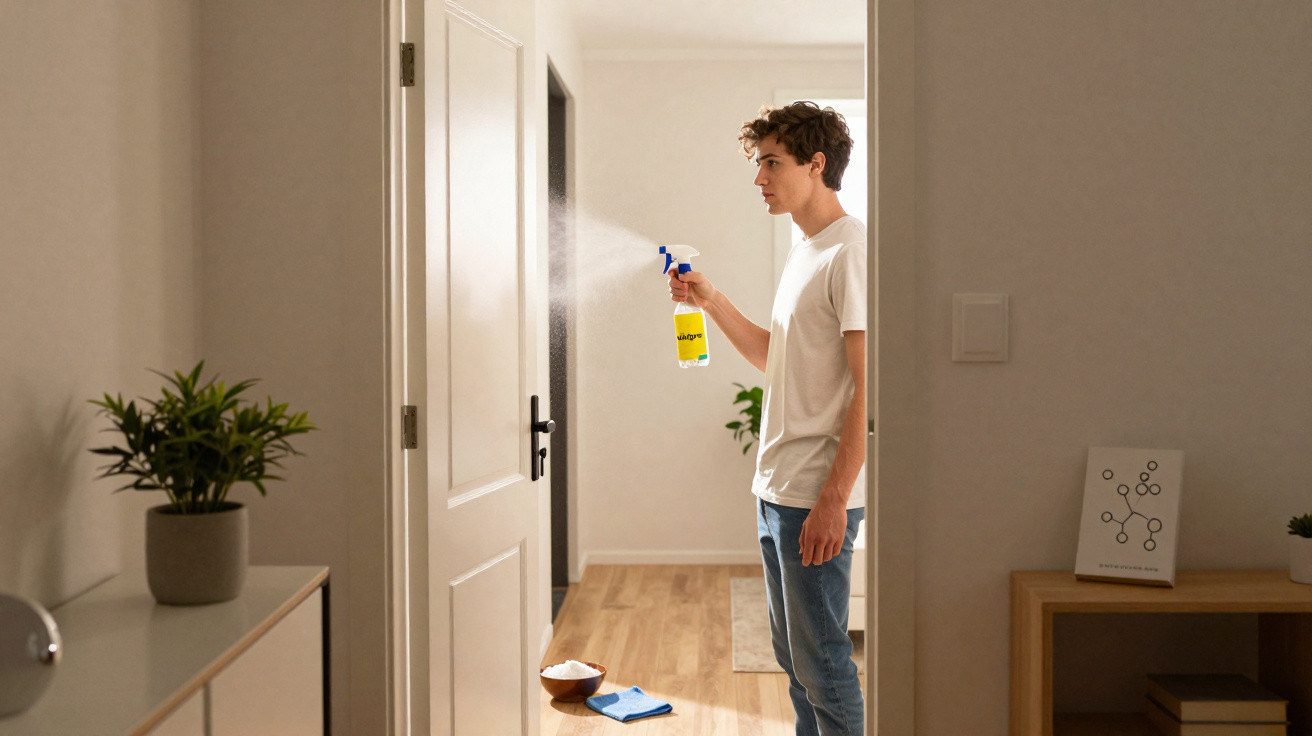
Late on a quiet suburban street, a woman in leggings and slippers stands at her front door holding a plastic spray bottle. Her neighbour, arms folded, looks on with the familiar blend of curiosity and mild judgement people reserve for someone else’s cleaning habits. The bottle gives off a sharp vinegar tang - the sort that normally sits under the sink beside abandoned sponges. Today, though, she’s misting it carefully along the doorframe, over the handle, and even across the doormat.
“"I saw it on TikTok,"” she laughs, slightly sheepish, as though she’s been caught doing something a bit superstitious. The claim is tempting: fewer insects, better energy, and a cleaner, “protected” entrance.
Online, thousands of people are doing the same thing.
And nobody seems to agree on whether it truly works.
Why are people suddenly spraying vinegar on their front doors?
If you scroll through short clips late at night, you’ll see the same thing repeated: the satisfying “psssht-psssht” of vinegar being sprayed over doorframes, from Florida to Frankfurt. Fans say it drives off ants, discourages spiders, shifts built-up grime, and even “resets” the energy of a home. It sits somewhere between old wives’ tales, a DIY cleaning trick, and a mass experiment.
A tip that once lived in the world of niche cleaning advice has travelled through lifestyle influencers and into the comment sections of spiritual, “good vibes only” accounts. What used to be a habit associated with meticulous grandmothers is now framed as a fashionable little rite. And, as with most rituals, it draws power from two places at once: chemistry and belief.
In one viral video, a young couple in a small flat giggles as they spray their front door as though they’re sprinkling holy water. The on-screen text promises, “No more ants since I started this”, and the clip has passed 3 million views. Underneath, one commenter says, “My grandma did this in Mexico, it’s not new.” Another insists it “changed the whole feel of the house”, while someone else complains it lifted paint from their wooden door.
That blend of success stories and cautionary tales is exactly what keeps an online trend alive. The more the results seem to clash, the more viewers want to try it themselves “just to see”. Curiosity spreads far faster than nuance.
Set the hype aside and vinegar is simply a mild acid - mostly acetic acid mixed with water. Used on suitable surfaces, it can be an effective cleaner: it helps break down mineral build-up, loosens dirt, and can take the edge off light odours. Ants, in particular, dislike strong smells, and some homeowners do report fewer trails after wiping entry points with vinegar.
But the same acidity that helps with cleaning can also cause problems. Over time, it can be harsh on unsealed stone, certain metals, and more delicate paint finishes. The idea of a “magic barrier” at the front door runs up against the basic reality of what a cheap acidic liquid can and cannot do. There’s a big difference between the myth of an invisible shield and what’s actually happening in a spray bottle.
How people are actually doing it (and what goes wrong)
Among enthusiasts, an informal “method” has taken shape. Many people pour distilled white vinegar into a spray bottle and dilute it - typically one part vinegar to one part water - sometimes adding a few drops of essential oil to make the smell less harsh. They spray the outside frame of the front door, the step, the threshold, and the handle, then wipe everything down with a cloth. Some give it a symbolic flourish, beginning at the top of the frame and working downwards, as if they’re rinsing away stale energy.
Others don’t bother wiping at all and allow it to air-dry, particularly on metal or uPVC doors. A handful of videos show people using kitchen roll, although more experienced commenters warn that lint and streaks can spoil the look of darker-coloured doors. The concept remains the same: a quick mist, a wipe (or not), and a feeling that the line between outdoors and indoors is fresher.
This is where the trend can become messy. Plenty of people copy the routine without first checking what their own door and threshold are made of. Painted timber, stained hardwood, and natural stone sills don’t always respond well to acid. One reader told us their deep-blue front door developed pale, patchy marks after “just a few weeks” of daily vinegar spraying.
Most of us recognise how these “quick hacks” can quietly turn into a daily fixation. Realistically, almost nobody keeps up a door-spray routine every single day - but some people try, pushed along by pest anxiety, pressure from “clean-tok”, and a nagging fear of having a “dirty” home. When chips, stains, or rust spots show up, that regret rarely goes viral in the same way the original video did.
The people who seem most satisfied with the habit tend to follow a few consistent rules: they dilute the vinegar, they patch-test a discreet area first, and they keep it to once a week at most. One cleaning expert we spoke to put it plainly:
“Vinegar is not a protective forcefield,” says London-based housekeeper Elena P. “It’s a cleaner with limits. On the right surfaces and with moderation, it helps. On the wrong ones, it eats away quietly.”
They also treat it as one part of general upkeep rather than a miracle fix.
People who say they get the best results often pair the door-spray routine with:
- Regular sweeping of the step and entrance mat
- Sealing gaps beneath and around the door to stop pests getting in
- Occasional use of targeted insect treatments outdoors
- Gentle soap-and-water cleaning for more delicate surfaces
- Opening windows to clear the vinegar smell more quickly
Vinegar on its own rarely addresses an underlying issue such as an infestation or flaking paint.
Between superstition, science, and the small daily rituals we need
There’s something undeniably human about taking a basic kitchen staple and turning it into a front-door ritual. A front door isn’t only timber and metal; it represents the boundary between our private lives and the wider world. Spraying vinegar there can feel like a small act of control at a time when much else feels uncertain. Some people laugh it off, others scoff, and some swear they sleep better after they’ve “cleaned the energy” at their entrance.
In reality, the answer likely sits somewhere in the middle. Practically speaking, a light vinegar-and-water mix can remove fingerprints and mild grime and may even disrupt the occasional ant trail - provided your door and threshold materials can tolerate acid. Emotionally, the routine can become a brief moment of care: a pause between work messages and washing-up. A quiet way of saying, without words, that this is your space and you’re looking after it.
The more useful question may not be “Does it fix everything?”, but “What am I hoping to get from doing this?” Is it fewer insects, less mess, a calmer head, a sense of control, or a link to family habits? If it’s some combination of these, then the story is bigger than vinegar. This trend shows how much people want small, repeatable actions that make home feel safer, cleaner, and more intentional - whether or not they ever pick up a spray bottle.
| Key point | Detail | Value for the reader |
|---|---|---|
| Know your door material | Vinegar can damage wood, stone, and some paints over time | Avoid costly repairs and faded finishes |
| Use dilution and moderation | One part vinegar, one part water, once a week at most | Get cleaning benefits while limiting long-term damage |
| Combine ritual with real fixes | Seal gaps, clean regularly, tackle pests at the source | Move beyond trends to lasting comfort and protection |
FAQ:
- Does spraying vinegar on the door really repel insects? It may interrupt scent trails for ants and irritate some insects, but it isn’t a guaranteed barrier. Treat it as a gentle deterrent, not a substitute for proper pest control.
- Can vinegar ruin my front door finish? With painted wood, natural timber, and stone thresholds, repeated use can dull the finish, cause discolouration, or gradually damage the surface. Test a small hidden spot first and stick to diluted solutions.
- What type of vinegar is best for this? Most people choose plain distilled white vinegar. It’s inexpensive, clear, and less likely to stain than darker vinegars such as balsamic or red wine vinegar.
- How often is it safe to spray the door? For many door materials, once a week using a 50/50 vinegar–water mix is a sensible upper limit. If the surface is delicate, use mild soap and water instead.
- Is there any real “energy clearing” effect? Scientifically, no. What can change is how you feel: cleaning and setting an intention may make your home seem fresher and more manageable, which can be a genuine psychological benefit.




Comments
No comments yet. Be the first to comment!
Leave a Comment