
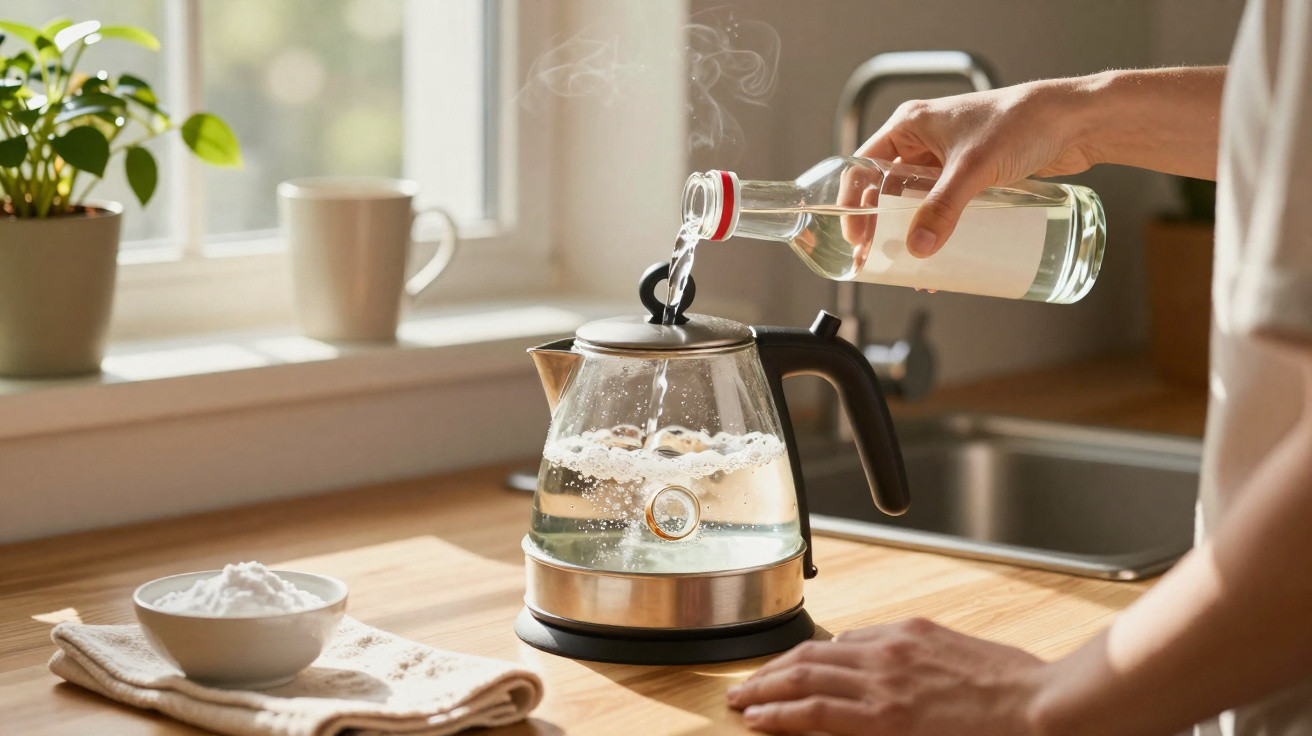
Limescale build-up inside an electric kettle often shows up as spots or a whitish film on the base and along the inner walls. To remove these deposits, some manufacturers suggest using white vinegar or purpose-made descaling products. The right method, however, depends on the model and should follow the manufacturer’s instructions.
Why does vinegar help clean the kettle?
Limescale is made up mainly of mineral deposits left behind by water. The harder the water you use, the more likely these residues are to collect inside the appliance.
Vinegar contains acetic acid, which can react with mineral deposits and make them easier to lift away. Brands such as Tefal, De’Longhi and Philips describe white vinegar as an option for descaling certain models.
How to use white vinegar in the kettle?
There isn’t one universal formula that suits every kettle. De’Longhi, for instance, recommends a mix of one part white vinegar to two parts water in its descaling guidance. Other manufacturers specify different strengths and contact times.
On some Philips models, the instructions are to add white vinegar to water and let the mixture work after heating, whereas Tefal outlines a process that uses vinegar without heating the solution. That’s why the kettle’s manual should take priority over recipes found online.
Do you need to boil vinegar inside the kettle?
Not always. This is one of the areas where extra care is needed. Some manufacturers advise not to heat the vinegar solution directly, instead leaving it in place for a set period, while other models use different procedures.
Tefal, for example, recommends leaving the vinegar to work for one hour without heating on certain appliances. De’Longhi also advises heating the solution and switching off before it reaches boiling point, while Smeg sets out another model-specific method.
For that reason, it isn’t recommended to simply pour neat vinegar into the kettle and boil it. The manufacturer’s specific guidance should determine the concentration, whether heating is required, and the contact time.
What to do after descaling?
Once the solution has had time to work, it should be poured away completely. The kettle then needs to be rinsed thoroughly to remove vinegar and any loosened residue.
Some manufacturers also recommend boiling fresh water and discarding it more than once before using the appliance again. Tefal, for instance, advises rinsing five or six times on certain models, while De’Longhi recommends boiling and discarding clean water twice.
Can vinegar extend the kettle’s lifespan?
Descaling regularly can help the appliance continue to operate properly. Philips states that periodic limescale removal extends the kettle’s lifespan, while Tefal explains that build-up on the heating element can reduce how effectively heat is transferred to the water.
How often you should descale depends mainly on water hardness and how frequently the kettle is used. Some manufacturers suggest monthly descaling in hard-water areas, while kettles used with softer water may need longer intervals.
So, adding white vinegar to a kettle is not just a household tip: it is a descaling method recognised by several manufacturers. The key is not to treat a single recipe as universal, because the concentration, how long the solution should act, and whether heating is required can vary from one model to another.


Comments
No comments yet. Be the first to comment!
Leave a Comment