
The frying pan is blisteringly hot, the bacon is spitting, and you’re clutching a wooden spoon as if it’s a miniature riot shield. Hot fat flicks at your wrist, the smoke alarm decides to join in, and in the middle of the chaos you remember you only wanted “a quick breakfast”.
By the time you’re finished, the kitchen looks as though it’s survived a small blast. The hob is dotted with grease, the pan has a tacky brown layer fused to it, and the sink is already piled up from last night. You eat the bacon standing at the worktop, already anxious about what comes next.
There’s a brief, odd pause-fork mid-air-when you catch yourself thinking: is bacon really worth this much hassle?
Why parchment paper quietly changes the bacon game
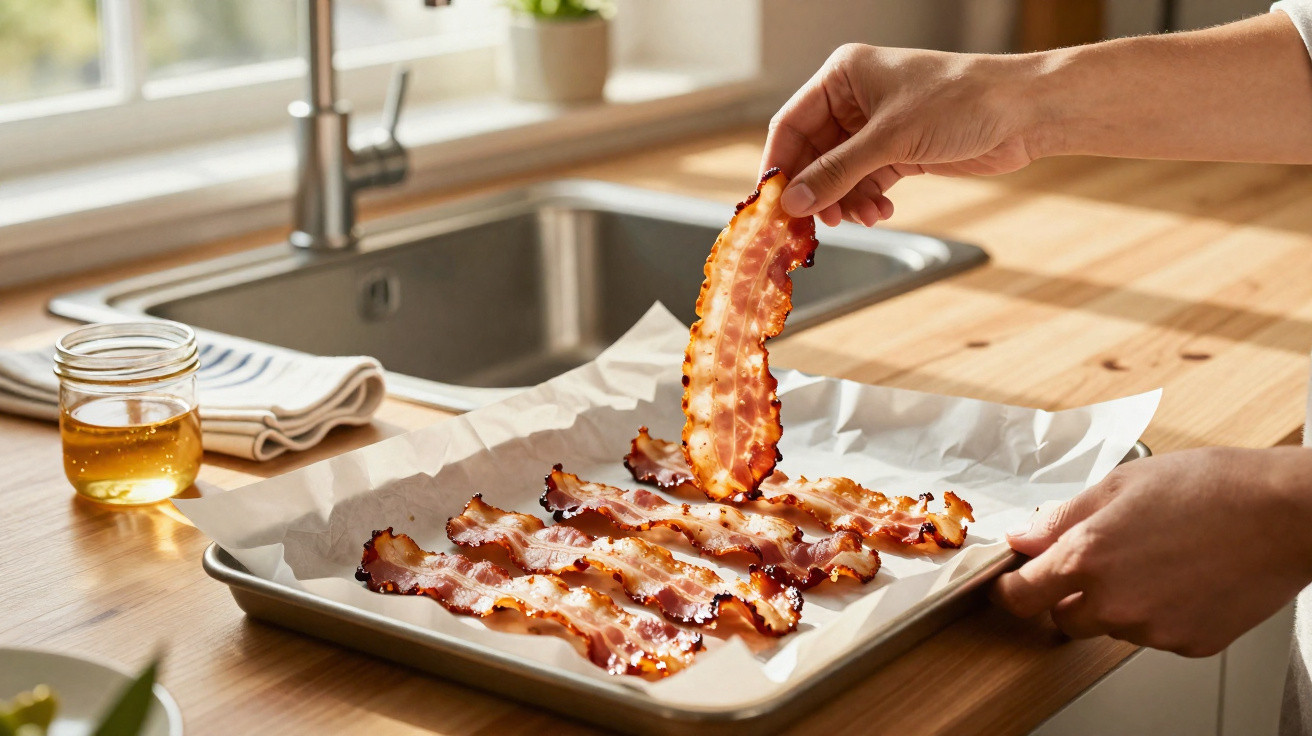
The first time you put bacon on parchment paper instead of directly on the tray, it feels almost anticlimactic. No cinematic sizzle, no celebrity-chef flourish. You simply pull off a crinkly sheet, lay it on a cold baking tray, and arrange the rashers like you’re assembling a collage.
Then the small differences start to show. The bacon browns more uniformly. The rendered fat gathers calmly instead of burning itself onto the metal. And when it’s ready, you lift the parchment by the corners and… you’re nearly done. The tray beneath is barely marked, as if it watched everything happen from the back row.
Imagine a Sunday morning: oven set to about 200°C (roughly 400°F), you’re half awake, and the coffee is taking its time. You line a rimmed baking sheet with parchment, place a dozen strips in a single layer, and slide it into the oven. No grease popping across the hob, no constant turning with tongs-just a soft hiss behind the oven door.
Around fifteen minutes later, you pull out crisp, evenly cooked bacon. The parchment is shiny with fat, the edges browned, acting like a disposable cooking surface. You lift the strips onto a plate with tongs, then pick up the whole parchment sheet-crumbs, grease and all-and throw it away. Instead of a 20-minute soak, the tray usually just needs a quick rinse.
What’s happening is down to how parchment behaves with heat and fat. It has a coating that resists grease rather than soaking it up, which stops the bacon sticking and the fat bonding to the metal. It also forms a thin layer between the meat and the hot tray, so the fat renders more gently and spreads instead of scorching in one spot.
And because the fat isn’t baked onto the pan, you avoid the dreaded scrub-scrub-scrub later. Less caramelised residue clinging to metal means less elbow grease-literally. It’s not “easy clean-up” as a slogan; it’s simple physics taking work away from your sponge.
The simple parchment method that saves your sink
Begin with a rimmed baking sheet and parchment paper rated for at least 220°C (about 425°F). Tear off a piece slightly larger than the tray so it curls up around the edges. That little lip helps trap any wandering grease.
Lay the bacon in a single layer on top. The strips can touch a bit, but don’t overlap too much or they’ll steam and stay soft. Put the tray into a cold oven, then set the temperature to around 200°C. Letting everything warm up together encourages gentler, more even cooking.
Once the bacon looks a deep golden colour and is just short of your preferred crispness, take it out. It will continue to cook for a moment on the hot tray.
This is where many of us used to trip up: turning the heat up too high, crowding the pan, then wondering why some pieces were burnt while others stayed chewy. With parchment, the new temptation is to pile the tray high “to save time”. That’s the trap.
Give each strip a little breathing room, and if your oven has hot spots, rotate the tray halfway through. If you like extra-crisp bacon, you can blot the top briefly with kitchen paper right at the end, though you rarely need to-the parchment has already encouraged the fat to pool and separate.
Worried the paper will smoke or blacken? If you keep it below its stated temperature limit and away from the grill, it generally just turns a warm, toasted beige.
“Switching to parchment was the first time I cooked bacon and didn’t dread the sink afterwards,” said one home cook I talked to. “I used to soak pans overnight. Now I rinse and walk away.”
- Line first, always
Cut the parchment so it covers the base of the tray and climbs slightly up the sides. That edge catches sneaky splatters. - Let the fat cool before tossing
Leave the tray on the hob or worktop for a few minutes so the grease thickens. Then lift the whole sheet and bin it, or scrape the fat into a jar if you like cooking with it. - Rinse, don’t scrub
With most of the mess contained on the parchment, a hot-water rinse and a gentle sponge is usually enough. No steel wool. No epic soaking session. - Use parchment, not wax paper
Wax paper melts and smokes in the oven. Parchment is designed for this.
Why this tiny switch changes more than your pan
When one small kitchen job stops being irritating, it sets off a quiet chain reaction. Bacon shifts from “special occasion, expect carnage” to “I can do this on a weekday and not regret it later”. You no longer have to bargain with the mess in your head before you even crack an egg.
Everyone knows that feeling where the thought of clearing up is enough to cancel breakfast entirely. Then suddenly the mental maths changes. Lining a tray with parchment takes seconds; scrubbing baked-on grease can swallow half an hour-plus your patience.
That small exchange can change how often you choose to cook, rather than defaulting to something joyless but tidy, like a dry cereal bar on the way out of the door.
| Key point | Detail | Value for the reader |
|---|---|---|
| Use parchment on a rimmed baking sheet | Creates a non-stick, grease-catching barrier under the bacon | Much less scrubbing; the tray often needs only a quick rinse |
| Bake at moderate heat (around 200°C / 400°F) | Even rendering, less splatter, less burnt-on fat | More consistent bacon with less mess and less monitoring |
| Cool, lift, and toss the sheet | Let fat thicken, then remove everything in one motion | Quick, low-effort clean-up and a cleaner sink |
FAQ:
- Question 1 Can I reuse parchment paper for multiple bacon batches?
You can often reuse it once if it isn’t too dark or brittle, especially if you’re doing a second batch straight away. After that it tends to brown too much and tear, so it’s best to use a fresh sheet.- Question 2 Does bacon still get crispy on parchment, or does it steam?
It still crisps up. The fat renders and pools a little, but the oven heat dries the surface. For very crisp edges, cook for an extra minute or two and don’t crowd the strips.- Question 3 Is parchment paper safe at high oven temperatures?
Most parchment is rated to around 220°C (about 425°F). Check the packaging, stay below the limit, and keep it away from the grill element so it doesn’t scorch.- Question 4 Can I save the bacon fat when I cook on parchment?
Yes. Let the tray cool slightly, tip it, and pour the rendered fat from a corner of the parchment into a heatproof jar. Then discard the sheet and keep the liquid gold.- Question 5 Is this really better than using a non-stick pan on the hob?
For many people, yes. Oven bacon on parchment needs less attention, creates less splatter, and leaves almost nothing baked onto the tray. Let’s be honest: nobody scrubs those hob pans with joy every single day.
Comments
No comments yet. Be the first to comment!
Leave a Comment