
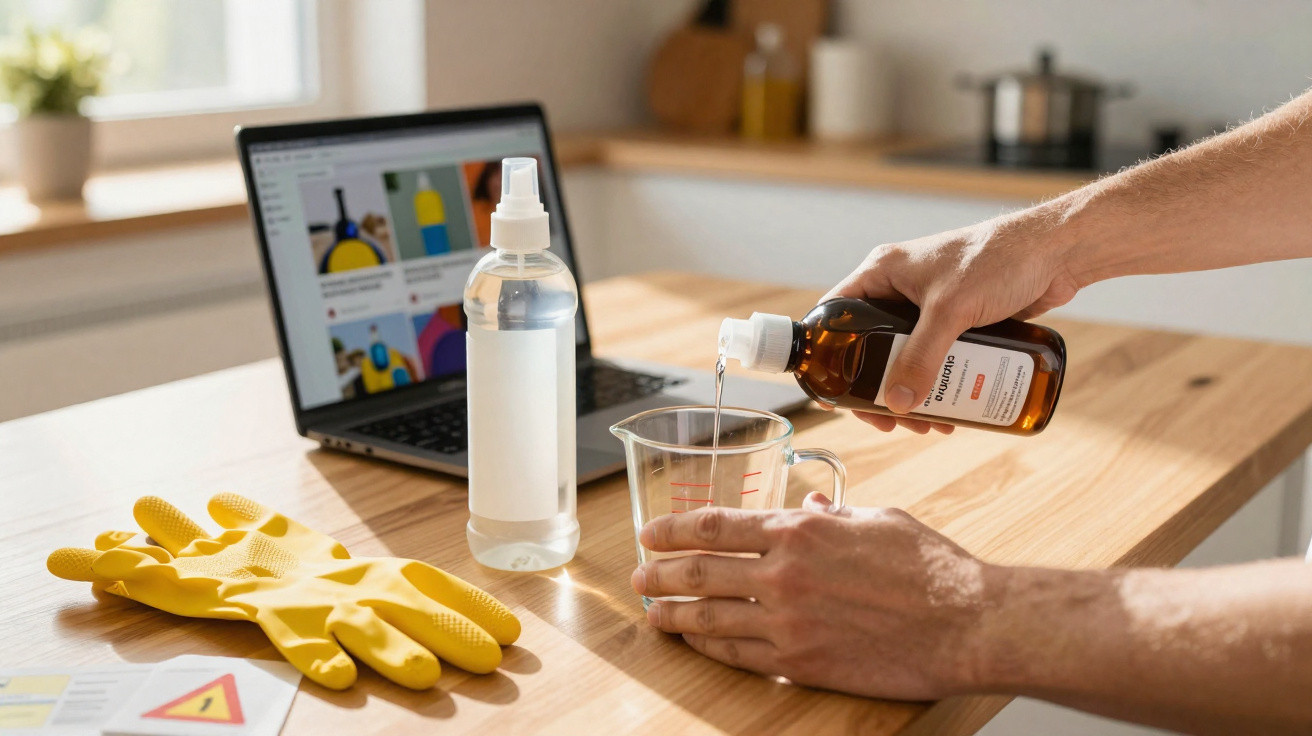
The smell arrives before anything else does - sharp, sour and strangely clinical all at once. In some small, tiled bathroom, an exhausted parent is hunched over darkened grout: vinegar in one hand, hydrogen peroxide in the other. A TikTok clip had promised “the ultimate DIY disinfectant.” The comments insisted it was a miracle combo.
They rarely include the moment your eyes begin to burn.
On a different screen, a chemist calmly lays out why combining acids and peroxides can turn nasty in seconds. Same two bottles. Completely different tone.
Somewhere between those realities sits the truth.
Why everyone’s suddenly obsessed with this “magic” mix
Spend a few minutes scrolling through cleaning hacks and you’ll notice the same pair appearing on repeat: white vinegar and hydrogen peroxide. They’re inexpensive, familiar, and already tucked away beneath countless sinks. Both are marketed as mild, everyday household basics.
Placed next to each other, they seem almost innocent - like the set-up for a classroom science demo.
What’s easy to miss is that, once combined, they can slip into territory most people can’t see coming - and can’t reliably smell in time.
Consider Emma, a 32‑year‑old teacher who decided to “deep-clean” her kitchen after a winter of colds. She’d seen a blog claim that if peroxide kills germs and vinegar breaks down mineral build-up, blending them must create a turbocharged disinfectant. So she tipped both liquids into one spray bottle, gave it a shake, and sprayed her worktops liberally.
A few minutes later, her throat felt scraped and sore. Around the sink, the stainless steel developed odd cloudy marks. The odour in the room wasn’t simply vinegary and it wasn’t bleach-like either - it was sharper than both. She opened a window, coughed for ages, and only afterwards learned that she hadn’t made a super-cleaner at all.
What Emma produced was peracetic acid: a far stronger, highly reactive disinfectant used in food processing facilities and hospitals - and only under strict protocols. When vinegar (acetic acid) meets hydrogen peroxide, the mixture doesn’t just sit there. It reacts. That reaction can create irritating vapours and a solution that’s more corrosive to skin, lungs and household surfaces than either product by itself.
That’s the point where the DIY narrative gets muddled. The very chemistry that makes the combination so effective in professional settings is exactly what makes it a poor bet in a home with children, pets and no protective kit.
How to use vinegar and hydrogen peroxide safely (without playing chemist)
Here’s the part that surprises people: specialists aren’t telling you to bin both products. They’re saying use them wisely. The safest way to “pair” vinegar and hydrogen peroxide is not to blend them into one bottle, but to use them separately, one after the other, on the same area.
For instance, if you want to sanitise a chopping board, you can spray it with hydrogen peroxide (3%), leave it for a few minutes, wipe it, and then apply vinegar - or do the steps the other way around. The crucial detail is that they meet the surface, not each other inside a sealed container.
You still get a practical one‑two hit against bacteria, without turning the cupboard under your sink into a tiny chemistry lab.
Where things go wrong is when people try to turn that two-step approach into one “ultimate” spray. They’re worn out, they want fewer bottles, and they want quick results. So they pour both into the same container, assuming it’s a clever, efficient upgrade. Most of us know that feeling - a shortcut that seems smarter than reading a dull label.
Those labels exist for a reason. Hydrogen peroxide decomposes and gives off oxygen. Introduce an acid such as vinegar and you can accelerate that breakdown in ways that aren’t straightforward to predict. You might not get dramatic fizzing or obvious fumes. Instead, you can end up with quiet, ongoing corrosion - on grout, on metal fittings, and in your own airways over time.
“From a chemistry standpoint, vinegar and hydrogen peroxide are both useful, low‑toxicity tools,” explains Dr. Laura Campos, an environmental health researcher. “But once you deliberately combine them, you’re no longer cleaning. You’re doing chemistry you can’t easily control, and that’s where domestic accidents begin.”
- Never mix them in the same bottle – Keep them in separate sprays and use them one after the other.
- Ventilate the room – Open a window or use a fan whenever you’re using stronger cleaning products.
- Test a hidden area – Especially on grout, metals or stone before you commit to regular use.
- Wear basic protection – Gloves and, if you’re sensitive, a simple mask.
- Label everything – Don’t keep unmarked bottles “for later”; that’s where mix-ups start.
The quiet line between smart DIY and risky home chemistry
The bigger issue behind the “dangerous hack or powerful solution” argument is trust. Many people feel disappointed by harsh commercial cleaners with ingredient lists that run on for pages. Vinegar and hydrogen peroxide sound straightforward, “natural”, and easy to control. Then the algorithm nudges things further: mix them, strengthen them, hack them.
There’s also the comfort of action. When flu season ramps up, or when a virus dominates the headlines, spraying a homemade disinfectant can feel like taking control back. And, realistically, hardly anyone keeps up intense disinfecting every day - it tends to happen in anxious bursts: after a scare, after a child is ill, after an alert on the news.
So what should you do when you’re in the kitchen holding two bottles and hearing completely different advice? The most sensible route is often the least dramatic. Use hydrogen peroxide on its own to disinfect chopping boards, fridge handles and bathroom areas that see lots of hands. Use vinegar on its own for limescale, soap scum and dull, cloudy glass. If you do apply them in layers, build in a pause - a wipe-down, a moment to breathe.
That small gap is where the danger drops quickly. No mysterious bubbling cocktail, no invisible acidic haze - just two everyday products doing separate, predictable jobs.
In professional settings, peracetic acid (created from that same vinegar–peroxide reaction) is used because it can sanitise medical instruments and food equipment effectively, including against a wide range of microbes that weaker cleaners may not handle well. The difference is, they’re trained, protected, and measuring concentrations with care.
At home, the genuinely effective approach may be less about inventing a secret formula and more about returning to simple routines you can repeat: ventilate the bathroom, wipe down high‑touch spots, wash your hands, and use what you already own - while respecting what you can’t readily see or smell. A random mixed spray bottle won’t transform your home into an operating room. It can, however, turn a routine chore into an avoidable health risk.
| Key point | Detail | Value for the reader |
|---|---|---|
| Don’t mix in the same container | Vinegar + hydrogen peroxide together create peracetic acid and irritating vapours | Protects lungs, skin, and surfaces from hidden damage |
| Use sequentially, not simultaneously | Apply one product, let it act, wipe, then apply the other | Gets stronger hygiene benefits without risky reactions |
| Choose the right job for each | Peroxide for disinfecting, vinegar for descaling and shine | Makes cleaning more effective, cheaper, and safer |
FAQ:
- Can I ever safely mix vinegar and hydrogen peroxide? You can use them on the same surface in sequence, but you shouldn’t combine them in the same bottle or container. Mixing them in a closed space encourages the formation of peracetic acid, which is far too harsh for casual household use.
- Is breathing the fumes from my “mixed” spray really dangerous? A short, one-off exposure may only cause irritation, but repeated use in rooms with poor ventilation can aggravate eyes, throat and lungs - especially for people with asthma or allergies. If you’ve already mixed them, get rid of the contents and ventilate the area thoroughly.
- Does the combo actually disinfect better than peroxide alone? In industrial settings, peracetic acid is a very powerful disinfectant. In a home, uncontrolled mixtures can behave unpredictably, while plain 3% hydrogen peroxide already provides dependable disinfection on clean, pre‑washed surfaces.
- Can I use the mix on grout, tiles, or stainless steel? The reaction can etch some metals, harm sealants and gradually discolour grout. Use them separately instead: vinegar for soap scum or limescale, hydrogen peroxide for mould staining and disinfection - and test a small, hidden patch first.
- What should I do if I already used a mixed bottle for months? Stop using it, pour it away down the drain with plenty of water, then rinse the container well. If you’ve had coughing, burning eyes or skin irritation, speak to a healthcare professional and mention that you were using mixed vinegar and peroxide.
Comments
No comments yet. Be the first to comment!
Leave a Comment