
At the back of many linen cupboards, neglected sheets sit for years, slowly yellowing and weakening, while homes continue to buy fresh yardage.
Yet those tired linen sheets are far from worthless. With nothing more than scissors, a little thread and ten minutes of attention, they can be repurposed into useful, attractive kitchen essentials that genuinely make everyday routines easier.
From “ruined” sheet to textile gold
Linen has a habit of outlasting shifting tastes. Even when a sheet looks past its best, the fibres are often still in excellent condition. Unlike low-cost cotton mixes, quality flax yarn commonly stays resilient after decades of washing and drying.
Textile experts put linen at roughly 30% more hard-wearing than cotton. In other words, once the weakest sections are cut away, an old linen sheet can outperform some modern fabrics sold by the metre. Over time the weave also becomes softer and more absorbent-exactly the combination you want for kitchen use.
Old linen is domestic “textile gold”: tough, breathable, already pre-washed and usually far too good to throw away.
This is the point where circular thinking becomes practical. Rather than sending worn sheets to landfill or dropping them at a clothing bank, households can upcycle them into long-lasting items. No new fabric, no extra packaging-just straightforward cutting and stitching.
Step one: check, sort and brighten the sheet
Before you reach for the scissors, give the sheet a quick but careful check. Hold it up near a window or under a lamp so the light exposes thin spots. The middle of the sheet is often the first area to wear through, and creases from storage can also become fragile.
- Mark thin patches, holes and splits along creases.
- Save the sturdy, tightly woven sections from the sides and corners.
- Keep original hems wherever you can; they dramatically reduce sewing time.
If the sheet includes embroidery or a monogram, cut it out neatly and set it aside. These decorative fragments can later be used as appliqués on bags, napkins or tea towels, giving a personal, slightly vintage finish.
A quick whitening bath
Linen often develops a yellow cast over time, particularly when it has sat in a damp or dark cupboard. This usually doesn’t weaken the cloth, but a brighter fabric looks and feels more hygienic in the kitchen.
For most robust linens, this simple brightening method is effective:
- Leave the sheet to soak for about 24 hours in warm water with two tablespoons of sodium percarbonate.
- Rinse well, then hang it to dry outdoors if possible.
- If the fabric is resilient and you prefer a more natural option, hot water with the juice of two lemons can help reduce the yellow tinge.
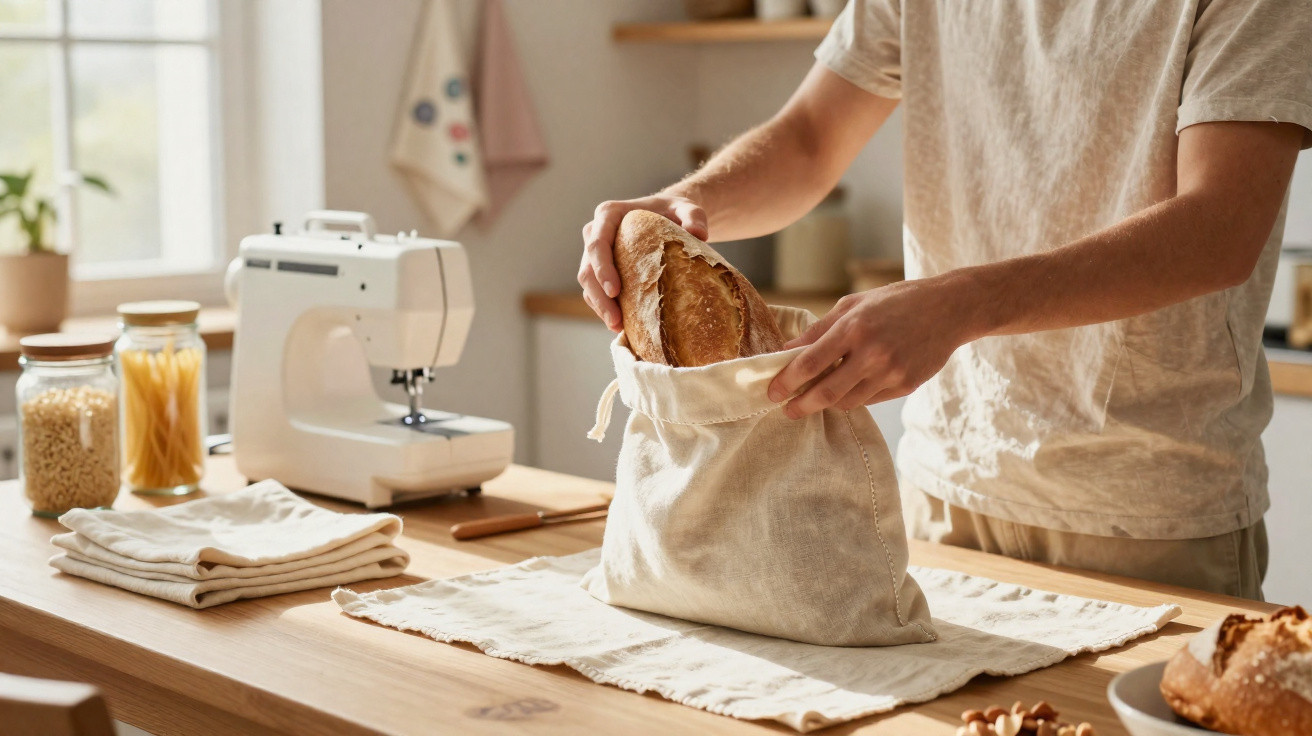
When it is dry, pick a pristine section and cut a rectangle of roughly 30 x 70 cm. This will be used for the main quick make: a reusable linen bread bag.
The 10‑minute DIY bread bag
The concept couldn’t be much simpler: sew a long pouch and add a drawstring at the top. Linen handles the rest.
A single 30 x 70 cm strip of sound linen can turn into a breathable bread bag that helps keep loaves crusty for longer.
What you need
- One 30 x 70 cm rectangle of solid, clean linen
- Strong sewing thread
- Fabric scissors
- Pins
- A cotton cord, ribbon or spare shoelace
- A sewing machine, or a little extra time to sew by hand
How to sew it, step by step
- Fold the rectangle in half to make a 30 x 35 cm piece, with right sides together.
- Pin the long edge and the bottom edge.
- Sew along those two sides, leaving the top open. If an original hem runs along one side, keep it and use it as the future opening.
- At the top, turn the edge in by 2 to 3 cm to create a channel for the cord, then stitch around, leaving a small gap unsewn.
- Feed the cord through the channel, tie the ends, and pull to close.
Older, heavier linen can be a little resistant under the needle. Using a jeans needle (size 90/100) and a 3 mm stitch length helps the fabric move evenly and reduces puckering.
Why linen works so well for bread
Linen is breathable. Its fibres let air move through while still protecting the loaf from draughts and dust. This balance limits condensation, which is what usually makes crusts turn soft inside plastic or tightly sealed bags.
In day-to-day use, many home bakers find a loaf stored in a linen bag stays enjoyable for around two days longer than when kept in a supermarket paper bag. The crumb remains soft, the crust stays respectable, and there’s no plastic waste.
| Container | Air circulation | Typical effect on bread |
|---|---|---|
| Plastic bag | Almost none | Soft, damp crust, faster mould growth |
| Paper bag | Moderate | Crust hardens, bread dries out quickly |
| Linen bag | Good, controlled | Balanced texture, slower drying |
What to do with the remaining pieces
After cutting out the main rectangle, you’ll usually have plenty of usable fabric left around the worn sections. That’s where smaller, speedy makes are ideal.
Bulk bags for rice, pasta and nuts
Using the same drawstring pattern as the bread bag, shorter rectangles can be sewn into smaller pouches. They’re useful for shopping in bulk sections or for keeping dry foods tidy at home.
- Choose untreated, uncoated linen for anything that will touch food.
- Take advantage of intact hems so you don’t have to finish every edge from scratch.
- Standardise sizes-one for flour, another for nuts or lentils-so cupboards stay organised.
For anyone reducing packaging, a batch of these quickly becomes part of the weekly shop: fill them at the supermarket, weigh once, then wash as needed.
Napkins, tea towels and cleaning cloths
Clean, wide strips make excellent table napkins. Cut generous squares, then stitch a narrow hem on all sides or simply overlock the edges. With each wash the cloth softens further and feels pleasant against the skin.
Squares or rectangles also work well as tea towels. Linen is highly absorbent, dries fast and tends to leave fewer lint marks than many microfibre cloths. For a more rustic look, stitch the original monogram onto a corner.
Even the most worn areas can be useful. Thin, threadbare sections are ideal as cleaning rags. If you cut them with pinking shears, fraying is reduced and they hold up longer during household jobs.
Tiny offcuts that seem beyond use can be gathered into a bag and later used as stuffing for a cushion insert or a door draught excluder. Larger, worn panels can be laid over delicate plants during a light frost or used as a simple outdoor play mat.
When every piece of fabric is given a role, even the most tired sheet avoids the bin and stretches its life by several more years.
Why this quick hack fits today’s habits
Turning an old sheet into a bread bag may sound old-fashioned, but it matches modern sustainability aims. Using what you already own lowers demand for new textiles, which are often resource-intensive in both energy and water.
From a household budget perspective, it is equally clear-cut. High‑end linen bread bags can be expensive to buy. Making one from a sheet you already have costs almost nothing beyond a little thread and ten minutes of focus.
It is also a friendly first step into sewing. The seams are short and forgiving, the shapes are straightforward, and there is little risk. Even if the first version comes out slightly wonky, the loaf still fits-and the project still cuts waste.
Practical tips, risks and small precautions
Not every old sheet is suitable for food-related projects. If the linen has been heavily exposed to fragrance, fabric conditioner or unknown treatments, it may need several hot washes to remove lingering residues. Some older linens were stored with mothballs or scented oils, and those smells can persist.
If you are unsure, use questionable fabric for non-food purposes such as cushion stuffing, plant covers or cleaning rags. Save fresh, neutral-smelling sections for bread bags and bulk-storage bags.
Two linen-related terms are often mentioned and are worth clarifying:
- Thermoregulation: Linen naturally responds to temperature and humidity, which helps stored bread avoid sweating or drying out too quickly.
- Grammage: This means the weight of fabric per square metre. Higher-grammage linen is stronger and well suited to bags; lighter linen is better for napkins or delicate covers.
If you like to think in practical terms, it helps to “map” a sheet in your head. A standard double linen sheet-even with a worn centre-typically contains enough sound fabric for one or two bread bags, several bulk bags, a handful of napkins, a couple of tea towels and a stack of rags. That is effectively a small set of homewares created from a textile many households would otherwise throw away.
Once you complete a first project successfully, it often becomes contagious. Old pillowcases get turned into produce bags, stained tablecloths become aprons, and the linen cupboard starts to feel less like storage and more like a quiet, useful workshop.
Comments
No comments yet. Be the first to comment!
Leave a Comment