
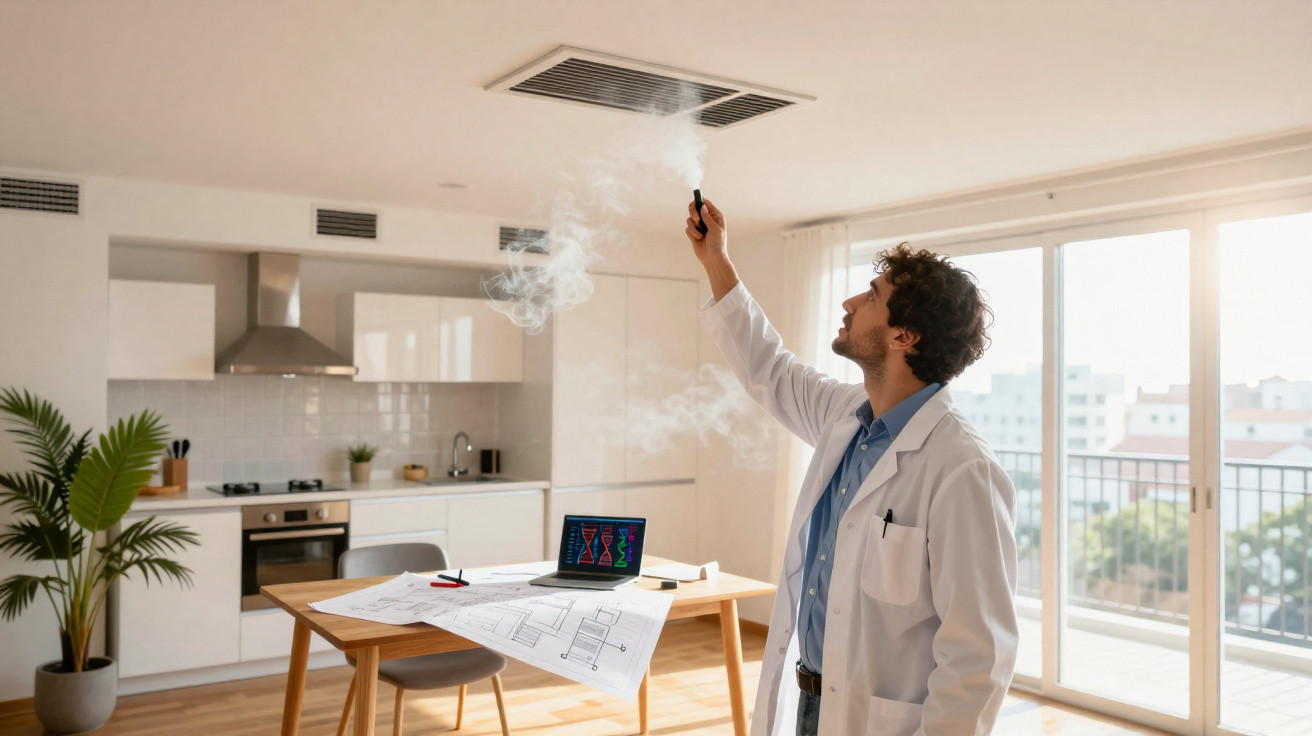
The belief that home equals safety shaped much of the public response to COVID-19: shut the front door, steer clear of crowds, and the danger falls.
Yet an unusual outbreak in Spain undermined that assumption and pushed researchers to pay attention to something most people never think about - the air moving through a building’s hidden spaces.
In the summer of 2020, Santander had almost stamped out COVID-19. Day-to-day life was beginning to resemble normality again.
Then cases surfaced abruptly in a seven-storey block of flats. Within a matter of days, 15 residents from four separate apartments returned positive tests.
At first glance, the cluster was puzzling. The affected homes were not side by side. Instead, they were stacked one above another - each infected flat sitting directly over or under another.
That vertical alignment suggested a concealed link. The driver was not social contact; it was the building itself.
A precise pattern of COVID cases
David Higuera, an engineer living in the building, was among the first to spot the logic in the pattern. He and his wife tested positive.
Soon, neighbours positioned along the same vertical line of flats also became cases. The infections appeared above and below in what looked like a tidy column.
“I knew that if what my wife and I suspected was happening, it could have significant scientific implications for public health,” said Higuera.
This was not a scattered, chance spread. The path looked less like person-to-person mixing and more like air moving through a system.
Old design meets a new virus
The block had been built in 1969, predating Spain’s modern ventilation expectations. Each apartment had a small bathroom vent feeding into a shared vertical shaft.
The shaft ran from the lowest floor up to the roof and relied on natural draught. As warm air rises, the idea was that air would travel upwards and be discharged outside.
On paper it was straightforward and functional. In practice, it also meant flats were linked by a common route for air.
Air movement inside buildings is rarely steady. Temperature, weather and day-to-day behaviour all affect pressures. Something as ordinary as opening a window or switching on a fan can alter the balance inside a room.
If pressure falls, the flow can flip direction. Rather than being extracted, air can be drawn back in.
In this building, that reversal meant air from one flat could be pulled into another through the bathroom vent.
Clues in an empty apartment
To understand what was happening, researchers examined the airflow closely, tracking pressure, air speed and carbon dioxide concentrations. Carbon dioxide is commonly used as an indicator of exhaled breath.
In one experiment they monitored an unoccupied apartment, which should have shown very low carbon dioxide. Instead, readings climbed as the day went on.
“It was like there was a ghost in the room,” Higuera said.
The source of the air was not outdoors - it was neighbouring flats.
The virus spread through vents
Under particular conditions, the reversal became pronounced. When a kitchen extractor fan was run at full power, air surged into the bathroom vent rather than leaving through it.
The backwards flow reached roughly 42 litres per second. With that air came particles from other homes, including aerosolised droplets capable of carrying the virus.
Because the design allowed air to travel in both directions, it created a route for infection to move vertically through the building.
Researchers then used computer simulations to check what they were measuring. One model reproduced airflow between two bathrooms stacked one above the other. Another represented the whole building.
The simulations agreed with the real-world data: air from a lower apartment could rise through the shaft and enter a flat above, and the same mechanism could also run the other way.
They also applied infection-risk models. In multiple scenarios, the predicted probability of infection rose beyond levels considered safe.
The role of kitchen fans
One of the more unexpected results involved kitchen extractor fans. While they remove indoor air, they also create negative pressure.
When a cooker hood was switched on, it could draw air from the shared shaft. If that air contained virus-laden aerosols, it would be pulled into the apartment.
Bathroom extractor fans could contribute as well, potentially driving contaminated air towards other levels.
Everyday routines - cooking a meal or ventilating a bathroom - could, unintentionally, help infection spread.
Apartments that were safe
Not every household in the block reported cases. Those flats were connected to the same ventilation shaft, but had made small changes.
Three apartments had extractor fans fitted with one-way flaps, which let air out but prevented air from coming back in.
Another flat had fully sealed its vent. None of these homes recorded COVID-19 infections.
That difference strongly supported the conclusion that airflow was behind the outbreak.
Genetic proof of spread
Scientists also examined the virus genetically. Samples taken from infected residents were almost identical.
They did not match other cases circulating in the city at that time, reinforcing that transmission happened within the building rather than being repeatedly introduced from outside.
The cluster followed a single chain of transmission across connected apartments.
Broader implications of the study
This was not an isolated phenomenon. Comparable events have been documented in earlier outbreaks.
In 2003, SARS spread through a housing complex in Hong Kong. During COVID-19, signs of vertical transmission were reported again in Seoul and elsewhere.
Many older buildings still depend on shared ventilation shafts. Such systems were designed for practicality and efficiency - not for controlling infection.
“While this is a special building design more common in Spain, it illustrates a broader concern, that even if you are far from the source, if your air is connected, you can still get sick,” said Shelly Miller, first author of the study from the University of Colorado Boulder.
“This can happen in a multifamily apartment building through the ducts, in a hotel between the hallway and rooms off the hallway, in office buildings between offices or on a cruise ship.”
A simple engineering fix
The remedy is relatively straightforward. A small extractor fan fitted with a one-way flap can prevent reverse flow.
When the fan is off, the flap stops incoming air; when it is running, it expels air safely.
It also helps to provide make-up air when using kitchen extractors. Opening a window can stabilise pressure and lower the chance of pulling air from other flats.
Rethinking building safety
This outbreak forces a rethink of what “safe indoors” really means. Doors and walls do not necessarily isolate air, and unseen routes can connect spaces in ways people do not expect.
Building checks should pay closer attention to airflow systems. Shared ducts, pipes and cavities can all act as corridors for airborne particles.
In Santander, an ordinary ventilation shaft became the bridge between households - a reminder that infection can travel through buildings along pathways few residents ever consider.




Comments
No comments yet. Be the first to comment!
Leave a Comment