
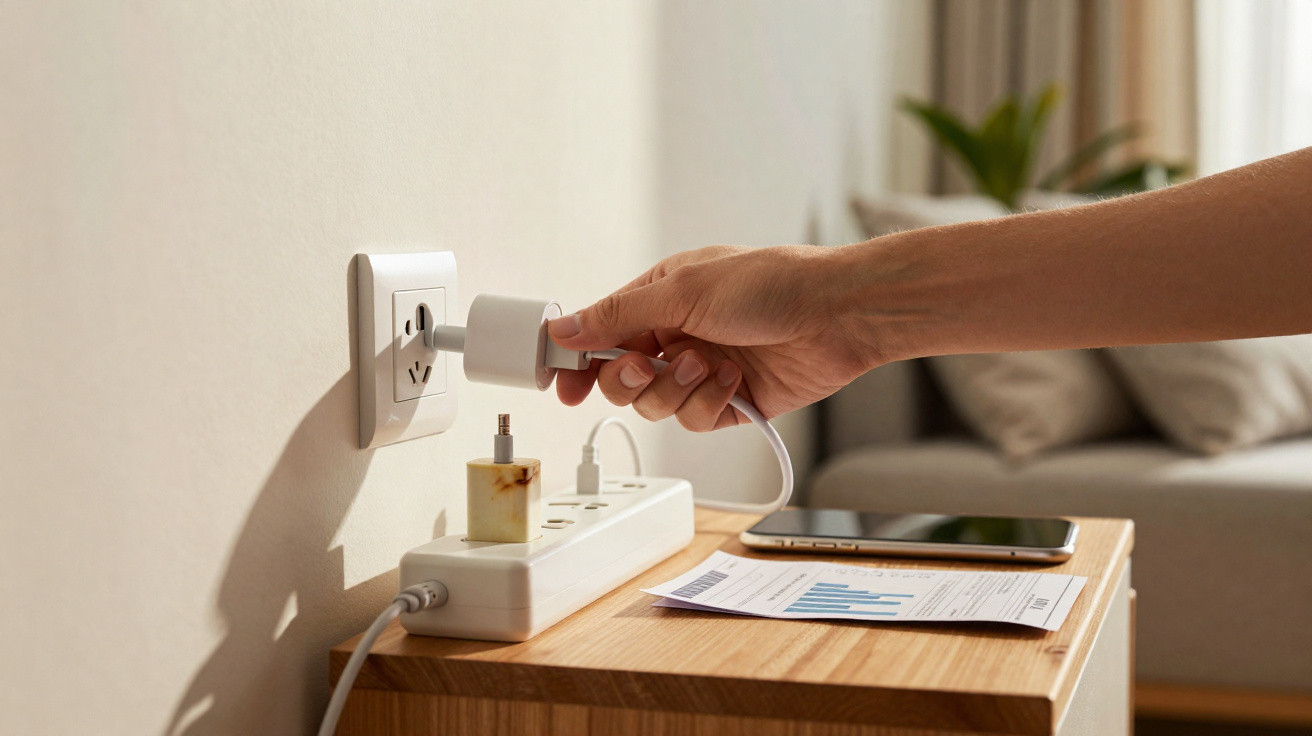
A small everyday habit that can have serious consequences.
Whether it’s in the bedroom, by the sofa or in the kitchen, countless homes leave chargers permanently plugged into the wall, ready for the next top-up. Most people barely notice it. Yet that convenient always-there cable comes with two downsides: it carries a (rare) fire risk and, at the same time, quietly pushes up electricity use.
Why a charger stays active even without a phone
A modern phone or laptop charger is a compact switched-mode power supply. Its job is to convert mains electricity from the socket into a lower voltage that your device can use. That circuitry does not simply switch “off” because nothing is connected.
As long as the plug is in the wall, voltage is present across internal components. The transformer, capacitors and other parts remain energised in a ready state. In effect, the charger sits in standby mode - and that’s the crucial point.
"A plugged-in charger with no device connected still uses electricity, warms up slightly and, if it’s poor quality, can become a real hazard."
With high-quality, certified branded chargers, the risk is generally manageable. They are designed for continuous connection and must pass strict testing. Trouble tends to start with bargain units picked up from online marketplaces or a holiday shop by the till.
Cheap chargers: when saving becomes a fire hazard
Many ultra-low-cost models cut corners precisely where you do not want them to: insulation, component quality and safe clearances. As a result, they can age faster, run hotter and react more badly to voltage fluctuations.
In day-to-day work, electricians repeatedly come across:
- scorch-marked extension leads caused by overheated chargers
- sockets where the plastic housing has melted
- a smell of burning in the bedroom triggered by a cheap power adaptor left permanently plugged in
In most cases it ends with melted plastic and a lot of frustration. Even so, the jump from a scorched plug to a smouldering fire is smaller than many assume - particularly when several risk factors overlap, such as multi-socket adapters, dust build-up, flammable materials nearby or ageing electrical installations.
"The simple rule from electrical professionals: use only certified chargers - and unplug them from the socket after charging."
How to spot a safe charger
Not every inexpensive charger is automatically dangerous, but certain warning signs are worth taking seriously:
- missing approval marks such as CE or GS
- extremely low weight (often a sign of fewer or cheaper components)
- an unpleasant chemical smell when you open the packaging
- noticeable heat after a short time during normal use
- loose-fitting plugs, wobbly ports, or visible gaps in the casing
If you notice one or more of these, the charger should not be left plugged in permanently - and if in doubt, it should be disposed of.
The hidden electricity trap: everyday “phantom power”
Even if nothing catches fire, leaving chargers plugged in has another, often underestimated effect: so-called phantom power. This refers to small amounts of energy drawn by electrical items in standby, even when you are not actively using them.
On paper, a single charger typically has only a tiny no-load power draw - often around 0.1 to 0.3 watt for newer, efficient models, and sometimes significantly more for older or poor-quality units. That sounds trivial, but it runs 24 hours a day, seven days a week.
A rough calculation:
| Situation | Power draw (example) | Electricity use per year |
|---|---|---|
| 1 charger permanently plugged in | 0.3 W | around 2.6 kWh |
| 5 chargers permanently plugged in | each 0.3 W | around 13 kWh |
In a single household, this still seems fairly minor. It becomes more striking when you scale it up to millions of homes: tiny amounts turn into vast quantities of wasted energy - and the associated CO₂ emissions.
How big the impact can be at home
Studies by energy agencies indicate that standby devices and unused power supplies can account for up to ten percent of a household’s total electricity consumption. Chargers are only one part of that, but they are woven into everyday life: almost everyone has several - for a smartphone, tablet, laptop, smartwatch, headphones and more.
"Each power adaptor left plugged in is like a tap left ever so slightly open on your electricity supply - barely noticeable on its own, but a clearly measurable loss in total."
Three simple habits that help immediately
Using chargers a bit more thoughtfully reduces the risk of damage and also saves electricity. The most effective steps are surprisingly straightforward:
- Unplug after charging - phone off the cable, charger out of the wall.
- Use only tested and certified power adaptors, ideally from the device manufacturer or well-known brands.
- Choose extension leads with a switch, so you can disconnect several chargers completely at the press of a button.
Once you get into the habit of pulling the plug straight after charging, you barely think about it after a few days. It becomes routine - much like turning off the light when you leave a room.
Where chargers can become dangerous particularly quickly
Certain locations and situations raise the risk if chargers are left in the socket all the time:
- under pillows or duvets: heat cannot escape, so warmth builds up
- wedged behind furniture: cables can be crushed, plugs can sit crooked, and dust accumulates
- old or damaged sockets: higher contact resistance means contact points can heat up
- children’s rooms: children may play with cables and plugs, pulling, bending or overloading them
In these settings, it is especially sensible to limit the number of devices plugged in and to pay close attention to both the quality and condition of the hardware.
What terms like phantom power and standby actually mean
Many people hear these terms but find them hard to place. Phantom power is electricity use that remains “invisible” because nothing appears to be running: no screen is lit and no motor is turning. Yet power supplies, routers, set-top boxes or televisions in standby can still draw energy continuously.
Standby usually describes a mode where a device is meant to start up quickly again - for example, a TV that can be switched on at any time with a remote control. A smartphone charger behaves in a similar way: it stays ready for the next charging session even when no phone is connected.
The underlying physical reason is simple: electronics need a basic amount of energy to remain “on standby”. Reduce that baseline load and you cut energy demand without giving up convenience - one click on a switched extension lead is enough.
Practical examples from everyday life
If you take a careful look around your home, you will often find more constantly powered adaptors than you realised. Common culprits include:
- chargers for old smartphones that have long since been retired
- power supplies for unused routers, speakers or games consoles
- USB charging stations that stay on all the time even though they are only used occasionally
A quick walk-through is often enough to spot several “electricity leaks”. If you identify them and unplug, you not only reduce fire risk, but also bring your energy use back to a far more sensible level.
Ultimately, not leaving chargers permanently plugged in helps on multiple fronts: it reduces unnecessary hazards in your home, protects your wallet and eases demand on the electricity network. The effort is only a few seconds a day - while the benefit adds up over the years.






Comments
No comments yet. Be the first to comment!
Leave a Comment