
French households are heading into yet another costly winter, and a curious cleaning trick involving a plastic bag is suddenly all over social media.
As radiators start clattering and humming back into service across France, a simple tip shared by a home influencer has shifted from niche housekeeping advice to something closer to a nationwide routine. Initially pitched as an easy way to lift out dust, it has quietly been adopted as a practical response to rising heating costs - and it is now travelling well beyond the audience it began with.
The hidden problem sitting inside your radiators
After spending months switched off, many radiators become storage spaces for dust, dead skin, and pet hair. The debris works its way into the narrow channels between fins and along tight metal seams where a cloth, brush, or duster can’t properly reach. When the heating comes on again, that trapped build-up warms up too - and fine particles end up circulating into the room.
The wellbeing effects can be easy to miss. People with sensitivities may begin winter with irritated eyes, a dry or scratchy throat, or fatigue that seems to come from nowhere. Children can see eczema flare-ups or asthma-like symptoms right around the time radiators start running again. Older adults often mention headaches and a “heavy” feel to the air, particularly in bedrooms and compact sitting rooms.
The financial side is just as real, even if it is less obvious. A radiator coated with dust effectively has an insulating layer on its surface. Heat has a harder time passing from the metal into the room, so a boiler or electric system has to run longer to achieve the same comfort. That extra runtime increases energy consumption and can reduce equipment lifespan. During a cold snap, a system that’s partly clogged can even tip into an expensive failure when you least need it.
A dusty radiator doesn’t just look neglected; it can pollute your indoor air and add unexpected pounds or euros to your heating bill.
The plastic bag and hairdryer hack everyone is trying
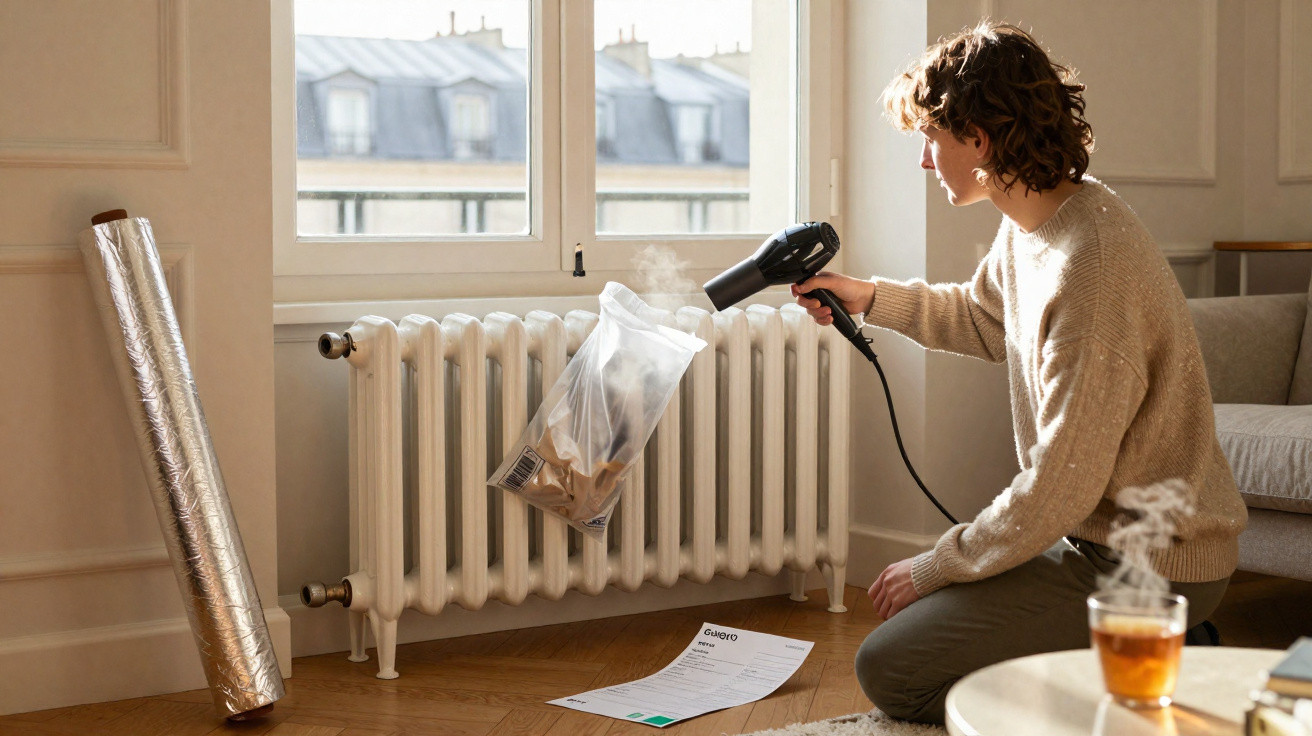
The technique gaining traction was popularised by Polish-born creator Agnieszka Radzikowska, known online as @sprytna_radzikowska. Her video spread quickly across languages and borders. The premise is disarmingly straightforward: use a plastic bag and a hairdryer to shift dust out of a radiator without dismantling anything.
In practice, you slide a large bag beneath the radiator, covering as much of the floor as you can. Next, you direct hot air from a hairdryer down from the top and along the fins. The airflow drives dust and fluff downward, and gravity takes over, dropping the mess neatly into the bag. No panels come off, no specialist attachments are needed, and there’s no awkward wrestling with a vacuum hose.
| Step | Action | Typical time |
|---|---|---|
| Preparation | Turn off heating, place a large plastic bag or bin liner under the radiator | 30 seconds |
| Cleaning | Blow hot air from the top and along the fins with a hairdryer | 5–8 minutes |
| Finishing | Seal and throw away the bag, wipe nearby surfaces | 1 minute |
Compared with the usual approach - brushing, poking between panels, vacuuming half-blind, and then inhaling the resulting dust cloud - the big advantage here is containment. Most of the debris ends up in the bag rather than floating through the room. And the only “tool” required is something most people already have in the bathroom.
Instead of chasing dust around the room with a duster, the plastic bag method traps it in one controlled shot.
How a cleaner radiator can shrink your heating bill
Once dust is cleared from the fins and interior surfaces, heat transfers more freely from metal to air. Rooms reach temperature faster and the warmth feels more even. Those persistent cool spots - by windows or at the far end of a room - can reduce as circulation improves. If each heating cycle becomes even ten minutes shorter, repeated hour after hour, the cumulative effect over a winter can be noticeable.
Energy specialists commonly suggest that maintaining heating systems properly can reduce annual consumption by several per cent. That may sound small, but for a flat relying on electric radiators or a house heated by gas, a three-to-five percent reduction across the season can equate to a month of bills - or at least soften the impact of the latest price rises.
To build on that benefit, technicians often advise pairing the bag method with a few straightforward habits:
- Bleed hot-water radiators before winter to release trapped air that blocks circulation.
- Vacuum carpets and skirting boards near radiators so dust doesn’t simply drift back inside.
- Open windows wide for a few minutes each day to refresh stale air and remove humidity that can make rooms feel colder.
- Keep furniture, curtains, and laundry at least a few inches away from the radiator front and top.
Together, these actions reinforce one another. Clean fins improve heat transfer, clear water circuits support better flow, and drier, fresher air feels more comfortable at the same temperature. The combined effect can make it easier to nudge the thermostat down slightly without losing comfort.
Why this simple hack resonates in 2026
The bag-on-radiator trick has gone viral partly because it matches the pressures households feel right now. Across Europe, energy prices are still unpredictable, and many people are actively looking for fixes that don’t demand major spending. A solution that uses a supermarket bag and a hairdryer feels accessible - almost democratic - compared with pricey insulation work or installing new smart thermostats.
Social platforms amplify it too. Short, vertical cleaning videos are made for this kind of content, and the payoff is immediate: grey streams of fluff dropping into the bag within seconds. Comment threads fill with disbelief as viewers realise just how much dust has been lurking out of sight in their own homes.
In an age of high-tech thermostats and connected boilers, one of the season’s most talked-about energy hacks comes down to a plastic bag and hot air.
There’s a mental element as well. Many families feel they have little control over global energy markets. A practical, repeatable task restores a sense of agency. You can’t bargain down wholesale gas prices, but you can ensure each kilowatt of heat actually leaves the radiator rather than disappearing into the electricity meter.
A few precautions before you try it
Although it looks straightforward, the usual safety basics still apply. Make sure radiators and pipework are fully cold before starting. Hot metal can soften thin plastic and a hairdryer held too close can be damaged. In older homes, take care not to cover any safety vents or block sensors while you work.
If you have electric convector heaters, panel heaters, or storage heaters, the same general idea applies, but the appliance shape alters the airflow. In those cases, a vacuum cleaner with a narrow nozzle can sometimes be more effective. The bag trick tends to suit traditional wall-mounted radiators with open fins particularly well.
Where someone in the household has significant allergies, it may be sensible to wear a mask and protective glasses during cleaning, even if most dust drops straight into the bag. Finishing by wiping nearby skirting boards with a damp cloth helps capture any particles that escape.
From French flats to global households: what this trend reveals
A small domestic tip like this points to bigger issues: energy affordability, indoor air quality, and the ways people adapt when costs rise faster than wages. French families may simply be early adopters of a routine that could easily take hold anywhere with cold winters and ageing radiator systems.
Heating professionals have discussed “thermal efficiency” for years in technical language. Viral videos now turn that idea into something you can see. When the dust comes out, it feels like money stops draining away quite so quickly. That human logic helps explain why the clip continues to circulate well beyond home-cleaning circles.
For anyone who wants to take the idea further, the same principle applies elsewhere: cleaning a fridge coil at the back, removing dust from a heat pump unit, or ensuring a boiler is serviced regularly can all improve how efficiently electricity or fuel is converted into comfort. The bag-on-radiator trick is simply a quick, visible entry point into that wider habit.
There is also a waste angle. Some people replace single-use bags with reusable fabric sheets or large cardboard boxes lined with newspaper, then empty them outdoors. That keeps the satisfying, visual “reveal” while reducing plastic use.
As winter sets in, more households will probably try this five-minute approach before turning the thermostat up. The savings will be modest for some and more dramatic for others, depending on how much the radiators have been neglected. What is consistent is the shift in behaviour: the heating season starts not just with a switch and a shrug, but with a quick clean that ties comfort, health, and the household budget together in one simple action.


Comments
No comments yet. Be the first to comment!
Leave a Comment