
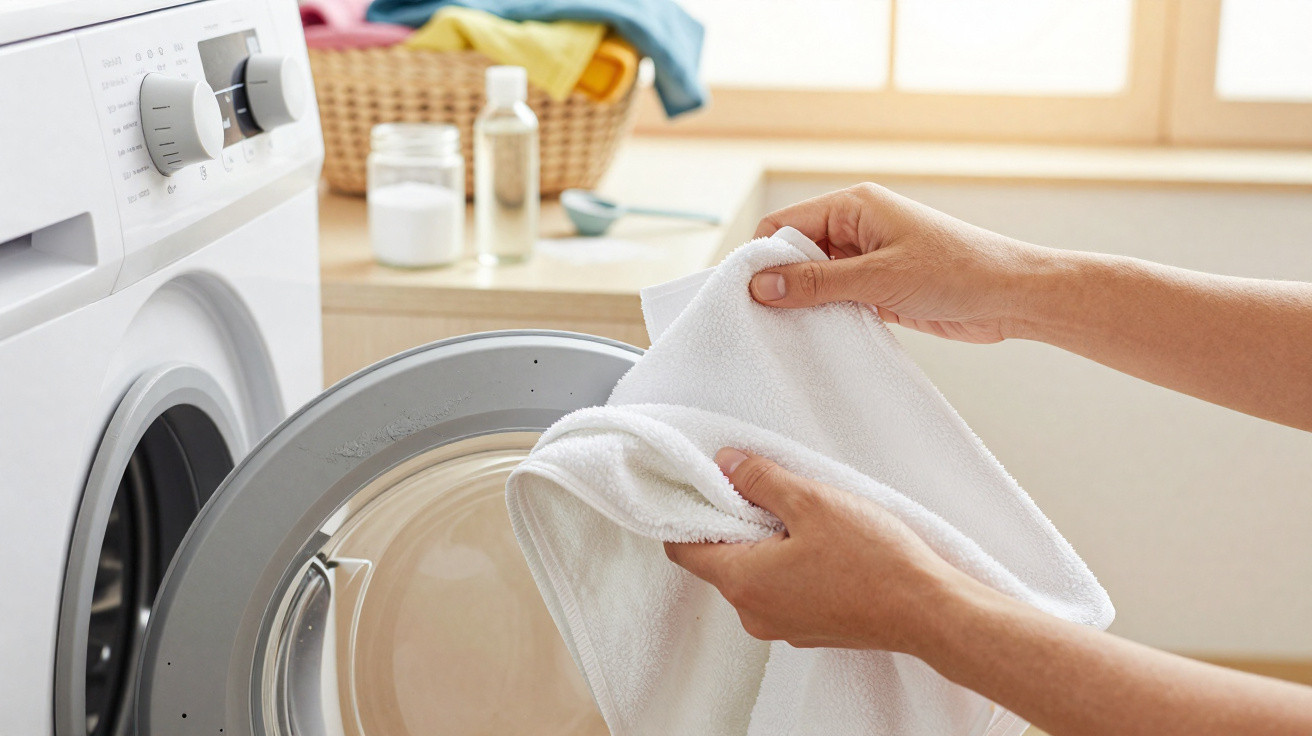
The washing machine let out a bright little beep - the sort of upbeat electronic chirp that’s supposed to say, “Job done.”
You opened the door, lifted out the washing and got that blast of “fresh” scent brands love to bottle. Yet your favourite T-shirt felt… oddly rigid. The towels almost crackled as you handled them, like they’d been dried on a radiator in a student flat rather than in a modern machine with a whole rainbow of programmes.
You rubbed a sleeve between your fingers and heard the faint rasp. It smelled like a spring meadow, but it moved like cardboard. The fabric didn’t drape - it kept its shape. That mismatch felt unsettling, like a smile that never reaches the eyes.
You told yourself it must be the weather, the washer, the detergent, the way you hung everything up. Still, as you folded each stiff towel, a quiet suspicion stayed with you: maybe “clean” isn’t as straightforward as it smells.
The “clean” laundry that doesn’t feel clean at all
There’s a peculiar moment when your nose says one thing and your hands say another. Your washing smells like a TV advert, yet your jeans bend rather than fall, and your pillowcases almost creak. Plenty of people brush that off, persuading themselves softness is a luxury - not a basic sign the rinse actually did its job.
What’s going on on the drying rack or inside the tumble dryer is more than a touch of “crunchiness”. Stiffness is a small flare from your laundry. It’s a hint that something has been left behind on the fibres - not grime in the obvious sense, but something you can’t see and that’s far more widespread than most people realise.
A London-based laundry service monitored complaints from thousands of customers over the course of a year. Smell was rarely the problem; most customers said their washing “smelled nice”. The most common, unspoken frustration was feel: scratchy towels, shirts that held themselves up, bedding that wasn’t inviting. When the company dug into it, they kept seeing the same pattern - heavy fragrance, weak rinsing, and a slow build-up of product coating every thread.
If your clothes come out smelling like a perfume counter but acting like cardboard, it’s unlikely to be hard water alone. What you’re detecting is residue: detergent that didn’t rinse away; fabric softener sticking around like clingfilm; tiny minerals in your water bonding with that tacky layer. It’s a mix that looks clean, smells clean, and misleads most of us day after day.
The reasoning is brutally simple. We love the reassuring hit of “fresh laundry” smell, so we add a bit more liquid, throw in an extra pod, pick the strongest softener. The more you add, the more the machine has to remove - and modern short cycles, overfilled drums and tired filters often can’t keep up. So the load comes out fragrant, yes, but the fibres underneath are effectively smothered.
Residue: the silent cause hiding in your washing machine
In most households, the main culprit isn’t the detergent brand as such - it’s the layer that can be left behind. High-efficiency machines use less water. Short eco programmes reduce energy use. Those are good for bills and the environment, but they also mean less rinsing power, so what you pour in is more likely to linger as an invisible film on the fabric.
Add liquid fabric softener and the effect can snowball. Those slippery drops don’t “relax” fibres out of generosity; they work by coating fabric with a fine, waxy layer to make everything feel smoother. Over time, that coating accumulates, especially on towels and cottons. It can feel luxurious at first - then, gradually, it passes an invisible tipping point and begins to set harder as it dries.
Water chemistry plays its part too. Across much of the UK, hard water contains calcium and magnesium. These minerals latch onto leftover detergent and softener and effectively cement them onto the fibres. The outcome is that stiff, slightly dull, “boardy” feel - even while the fragrance insists everything is spotless. That same residue can also trap tiny traces of sweat or skin cells, so your laundry may not be as genuinely clean as it seems.
There’s another knock-on effect most people don’t connect to stiffness. Once fibres are coated, they stop absorbing water properly. That’s why towels stop soaking up moisture and instead smear it over your skin. It’s also why sportswear can start hanging on to odours. Residue turns breathable fabric into something closer to plastic. The machine keeps going through the motions, you keep folding the same rigid items, and the loop continues quietly.
How to break the residue cycle and bring back real softness
One of the quickest, most effective ways to reset things is to strip everything back. Take a load of towels or everyday cottons and run a long, hot wash with no detergent and no softener. If you live in a hard water area, add about a cup of plain white vinegar directly into the drum. It won’t make anything smell like a “chippy” - it helps break down that sticky film.
When the cycle ends, check the feel. They might not be fluffy immediately, but the rigid, slightly greasy stiffness often starts to disappear. That’s the clue the build-up is dissolving. From the next load onwards, reduce your detergent by about a third, or stick to one pod even if the pack encourages two. Modern detergents are more concentrated than the marketing suggests, and you may be surprised how little you need for lightly soiled everyday items.
It also helps to support the machine itself. Run a monthly maintenance programme with an empty drum, using a cleaner or a decent dose of laundry sanitiser on a hot setting. Wash out the detergent drawer, wipe the rubber door seal, and clear the filter at the bottom. Let’s be honest: nobody really does this every day. But even once a month can remove the sludge that keeps redepositing onto your clothes.
If you feel a flicker of guilt reading that, you’re in good company. On a chaotic Tuesday evening, an extra capful of detergent feels like a shortcut to “properly clean” clothes. On a cold Sunday, a generous glug of softener feels like kindness for your towels. We tie strong fragrance to care, to effort, to looking after the people in our homes - it’s emotional, not purely practical.
That’s why turning everything down can feel strange at first, almost like you’re cutting corners. Your washing may smell less dramatic, less “Instagram laundry room”. Give it a week. Notice how your T-shirts begin to hang more naturally. See how towels slowly start drinking water again. Ask anyone with eczema or sensitive skin and they’ll often say the same thing: less product can mean less itching, less redness, and fewer unexplained rashes.
The biggest “mistake”, if that’s the right word, is trying to solve stiffness by adding more of what causes it: more softener, a hotter dryer, longer programmes. Most of the time what fabric needs isn’t extra pampering - it needs a clean slate, a chance to breathe without a chemical coat sitting between the fibres and the air.
As one professional cleaner said to me over a cup of tea,
“If your clothes smell of strong perfume, they’re not clean, they’re disguised. True clean doesn’t shout. It just feels right on your skin.”
That line stays with you, especially once you start separating fragrance from freshness. Real freshness is almost quiet - it smells of very little, perhaps just cotton and air. The drama is in the feel: how a pillowcase slides through your fingers, how a hoodie folds without “crunching”.
- Use less detergent than the label suggests for everyday loads.
- Skip fabric softener on towels and sportswear.
- Run an occasional hot “stripping” wash with no product, plus vinegar for hard water.
- Keep the machine clean: drawer, seal, filter, and a monthly maintenance cycle.
- Choose longer rinse cycles if your machine offers them, especially for bulky items.
When “fresh” stops meaning what you think it means
Once you’ve clocked the gap between smell and feel, you can’t really unnotice it. You start lifting towels in hotels and guest bathrooms and sensing the stiffness behind the scent. You notice how an old T-shirt - washed hundreds of times with a modest amount of product - can feel softer than a brand-new one loaded with finishing chemicals and shop fragrance.
On a bus or train, you can sometimes catch that heavy laundry perfume coming off someone’s jacket. It smells “nice”, sure - but it also hints at build-up, at modern machines expected to do too much with too little water, and at our cultural obsession with anything that shouts “fresh” from across the room. We’ve built an idea of cleanliness that lives in the nose rather than in the hands.
Once you start unpicking that, your routine shifts without much fuss. You might switch to fragrance-free detergent and realise you don’t miss the fake meadow smell at all. You might find yourself reaching for softener, then putting it back. You might even mention it to a friend - that odd moment when you realised stiff fabric was your first real clue that “clean” wasn’t quite what you’d been sold.
| Key point | Detail | What it means for you |
|---|---|---|
| Laundry residue | Overdosing + short cycles = an invisible film on fibres | Understand why washing feels stiff despite a good smell |
| Fabric softener and hard water | The softener’s wax combines with minerals and hardens as it dries | Spot how softener contributes to the loss of softness |
| “Reset” routine | Empty hot cycles, vinegar, less product, a cleaned machine | A practical plan to get soft-feeling laundry back |
FAQ:
- Why do my towels feel stiff even when I use fabric softener?
Fabric softener coats fibres with a waxy layer that builds up over time, particularly in hard water. As it dries, that coating can harden - so the more you add, the stiffer towels often become.- Will using less detergent really get my clothes clean?
For lightly soiled everyday washing, yes. Modern detergents are concentrated and machines are efficient. Using too much tends to leave residue rather than improving cleaning performance.- Does white vinegar damage washing machines or clothes?
In moderate amounts (around a cup in the drum), white vinegar is generally safe for most machines and fabrics. It helps dissolve mineral and product build-up without stripping fibres.- Should I stop using fabric softener entirely?
You don’t have to quit altogether, but avoiding it on towels, sportswear and baby clothes often improves softness, absorption and breathability. Many people keep it for specific items only.- How often should I clean my washing machine to avoid residue?
A monthly hot maintenance cycle, plus a quick wipe of the seal and a filter check, is usually enough for most households. Heavy use or very hard water may need a little more attention.





Comments
No comments yet. Be the first to comment!
Leave a Comment