
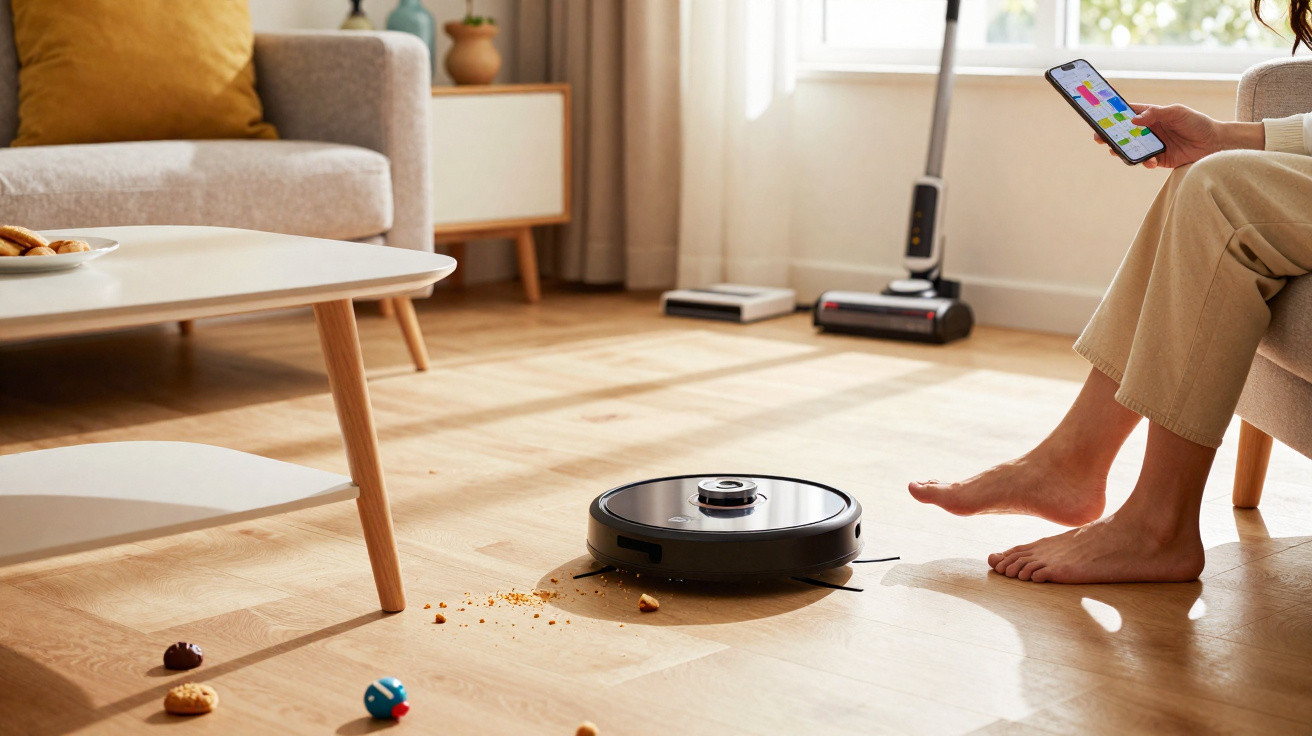
Created at the prestigious MIT in 1990, iRobot is the company that quite literally brought the mainstream robot vacuum cleaner into people’s homes. After a string of financial upheavals (a failed Amazon buy-out followed by bankruptcy proceedings in 2025), China’s Picea Robotics (the firm that was manufacturing the brand’s robots) took over the business. One of the first machines from this reborn iRobot, the Roomba Mini, aims to stand apart by going all-in on an ultra-compact design.
Who is it for? City-dwellers in smaller flats who want a sensible price tag. But does it actually deliver? To find out, we put it through its paces in about the toughest setting you can throw at an autonomous vacuum: a Parisian geek’s flat that’s crammed with stuff.
Smaller than the rest, and genuinely clever
The standout the moment you open the box is how small the unit is. The robot measures 24.5 cm across, whereas a typical model is easily around 10 cm wider. That lets it slip between chair legs, under a bedside table and, more broadly, into places many rivals simply cannot reach. Its dock follows the same compact logic, with dimensions of just 21.2 × 17.8 × 28.5 cm overall, so it’s straightforward to tuck into a cluttered office or a narrow hallway.
iRobot sells the Mini in four colours: pink, mint, white and black. Our test unit was mint, which looks pleasant enough that we left it in the living room where it almost disappears. That’s not something you can say about plenty of conventional robot vacuums.
Power comes from a 2,400 mAh battery rated for up to 90 minutes, with a full recharge taking 3 hours. That’s ample for a mid-sized home in a single run, but anything beyond roughly 60–70 m² may require a pit stop at the dock mid-clean-meaning a few extra hours waiting for the battery to refill.
Suction is quoted at 7,000 Pa, which feels appropriate for this class. Shrinking the robot has, however, forced a few trade-offs. The most frustrating, in our view, is the choice to use just one motorised main brush where many competitors fit two. That could become a limitation on thick rugs or in homes with lots of pet hair.
It can work in the dark and always knows where it is
Guidance and positioning are handled by a capable LiDAR module. Besides being dependable, LiDAR doesn’t need the lights on. You can therefore run the Mini with the shutters closed or overnight (earplugs may be wise, as it can get noisy on carpet). It also recognises rugs and carpets automatically so they stay dry when you switch to mopping mode.
On first use, the Mini quickly maps your home. It took it under ten minutes to complete the map of our flat. Once the mapping is done, a simple yet effective editor lets you name rooms, merge them, or split them into zones to make scheduled cleaning easier.
Control options include the mobile app and voice assistants such as Alexa or Google Assistant. Siri is trickier: because HomeKit still doesn’t support robot vacuums, you’ll need to use Shortcuts to trigger a clean. There’s also a traditional physical button on the robot, which means you can run it without Wi‑Fi-and without sending anything to any cloud service.
The app keeps things focused and avoids unnecessary extras. Alongside the map, it enables scheduled routines (once or several times per week) and provides usage statistics. If something goes wrong, a built-in helper walks you through the steps to resolve it.
It avoids (almost) every obstacle
In day-to-day use, automated cleaning runs smoothly overall. That’s despite the fact we deliberately littered the Mini’s route with a range of awkward items: shoes, balled-up socks, keys left in the hallway and, of course, several kinds of cables. It managed to steer clear of everything except one object: a 10 cm USB‑C lead, which it tried-unsuccessfully-to swallow. The app then sent us an alert saying it needed help. After we removed the cable and put the robot back in the room, it re-orientated itself correctly and continued from where it had stopped.
The Mini couldn’t finish our 85 m² flat on a single charge. It paused cleaning at 15% battery to return to the base, then set off again 120 minutes later and wrapped up in 15 minutes. The end result is more than convincing: the side brush funnels dust effectively into the suction path, and the small footprint helps it reach almost everywhere. Its low height allowed it to get under a very low sofa, and it also weaved between the legs of the coffee table and dining chairs. As a result, there’s no longer any need to lift chairs out of the way for a thorough clean.
The dock includes a self-emptying system that transfers debris into a 2.5-litre bag designed to trap fine particles and allergens. According to iRobot, that capacity can keep the Mini going for up to three months before you need to think about replacing the bag.
Mopping isn’t its strength, but it can help out
The mopping function isn’t automated. Instead, it uses disposable wet wipes that attach underneath the robot. iRobot supplies a removable plate where the wipe is fixed, which then clips under the base and disables the mechanical brush. There’s no water tank and no vibrating mechanism. iRobot sells a pack of wipes made for the Mini, but also states that any standard-brand wipes can be used. It’s worth noting when a manufacturer doesn’t try to force you into proprietary consumables.
With that in mind, we weren’t expecting miracles from wet cleaning-and that’s exactly what we got. The wipe picks up fine dust and light marks on hard floors, but it doesn’t scrub deeply. It’s a long way from the twin rotating mop systems found on certain competing models. That limitation clearly stems from the robot’s compact build. In short: the Roomba Mini passes over the floor, freshens it up, but doesn’t properly scour-simply the trade-off for such a discreet vacuum.
iRobot Roomba Mini: Presse-citron’s verdict
The Roomba Mini isn’t trying to take on the heavyweights from Roborock or Dreame when it comes to raw suction power or advanced mopping tech. Its pitch is different: compactness that makes it more accessible-and on that front it largely succeeds. The reduced footprint is a genuine advantage in tight spaces, and it will squeeze into just about anywhere. LiDAR navigation proves reliable, and the self-emptying dock is a welcome feature. The control app is straightforward while still covering the essentials. Mopping, meanwhile, is very basic, and you must fit a wipe each time you want to use it. It’s not designed to deep-clean a kitchen; it’s there to refresh the floor.
The remaining sticking point is price. At €399, the Roomba Mini includes advanced navigation, a mopping mode and an auto-empty station, yet it still feels expensive. Clearly iRobot has recognised that: at the time of writing this test, it’s listed at €299 on the iRobot website and on Amazon. At that level, it becomes far more compelling-because its compact design is a real asset.
iRobot Roomba Mini
Price: €399
Overall score: 8.5
| Category | Score |
|---|---|
| Design & maintenance | 9.0/10 |
| Vacuuming performance | 9.5/10 |
| Mopping performance | 7.0/10 |
| Battery life | 8.5/10 |
| Performance-to-price ratio | 8.5/10 |
What we like
- Compact size
- Reliable LiDAR navigation
- Well-designed self-emptying station
- Original colour options
What we like less
- Only one main brush
- Mopping without a water tank
- Official price is too high
Discover the iRobot Roomba Mini



Comments
No comments yet. Be the first to comment!
Leave a Comment