
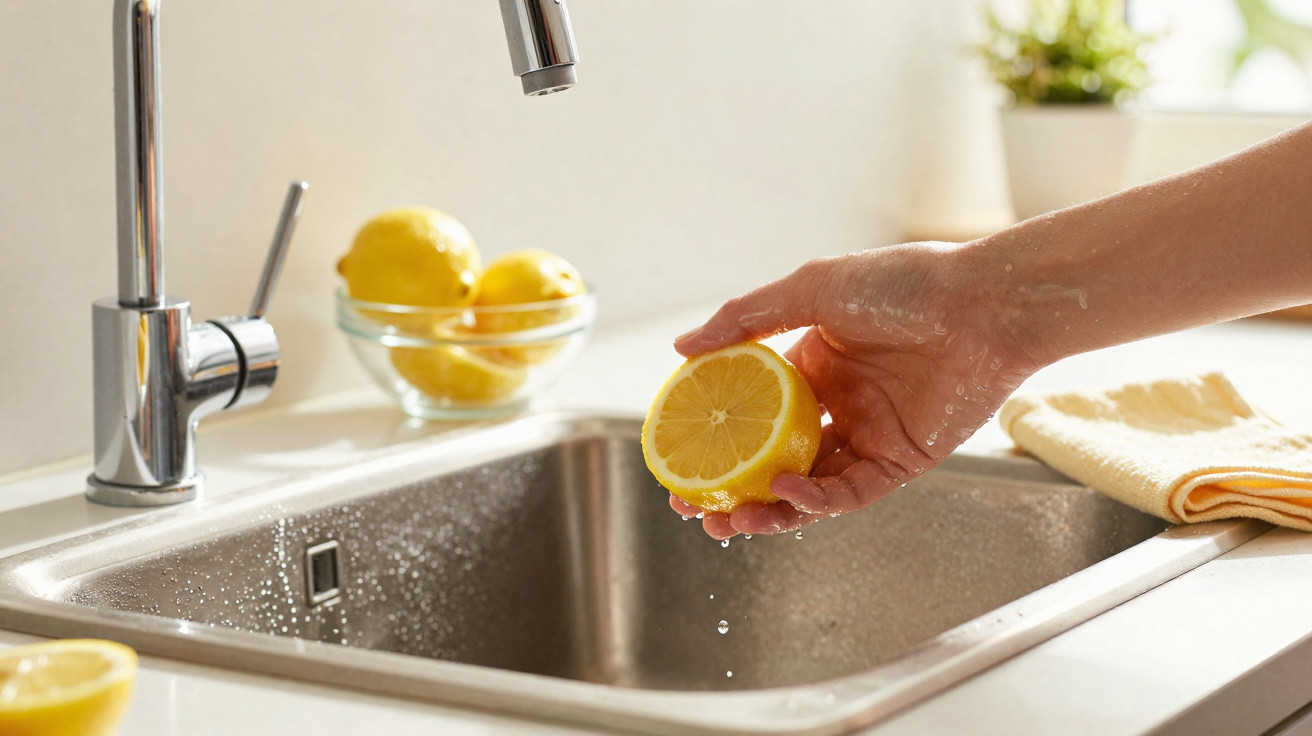
I still remember the first time I tried rubbing a cut lemon over my bathroom tap. I wasn’t hoping for much. I’d seen one of those online “grandma hacks”, gave it an eye-roll, and fished out a slightly pathetic leftover half-lemon from the fridge. The chrome was flat and lifeless, speckled with marks, and ringed with stubborn white crust that seemed to shrug off ordinary cleaning sprays.
As soon as I pressed the lemon against the metal, I heard a faint fizzing and watched the white deposits soften and disappear in seconds. The strangest bit came afterwards: once I’d rinsed and dried the tap, the water stopped clinging. Instead, it gathered into beads and slid away, like rain on a freshly waxed car.
Something you can’t see had shifted on that surface.
Why a simple lemon humiliates hard water stains
In a hard water area, a bathroom tap ends up on the front line in the battle between minerals and shine. With every shower and every handwash, tiny droplets land on the metal and dry into dull, chalky specks. Given enough time, those specks stack into limescale that feels like it needs endless scrubbing.
A lemon wedge doesn’t look like a serious tool-more like something you’d put on the rim of a glass. Yet the second the juice hits those pale crusts, they start fading almost instantly. Suddenly the tap is reflecting the room again, as if you’ve used some high-end product and spent ages polishing.
Think of a Sunday morning when the light hits the bathroom at just the right angle. That’s when you notice what’s really there. The tap you “cleaned” the day before is already sprinkled with tiny white freckles-around the base, on the spout, beneath the handle. Most of us grab whatever bottle is closest, often the one with a bright label and a hazard warning on the back.
A friend of mine binned that approach after her toddler kept reaching for the limescale remover. She cut a lemon in half, rubbed it over the tap, left it for a couple of minutes, then wiped it away and sent me a photo. The change was absurd: the tired, greyish chrome looked brand new, and the cloudy ring around the base had completely gone. She didn’t scrub once.
There’s straightforward chemistry behind the effect. Hard water stains are largely calcium carbonate and magnesium salts-minerals from the same family as chalk and limestone. They cling to metal and build up into stubborn layers. Lemon juice contains plenty of citric acid: it’s a mild organic acid, but still reactive enough to tackle those mineral deposits.
When you rub a cut lemon on the tap, the citric acid breaks down the chalky build-up into compounds that dissolve and rinse away. At the same time, the juice lightly degreases and gently etches the surface, lifting soap scum and skin oils that otherwise help limescale stick. That’s why the shine doesn’t simply return-it can look crisper than before.
The exact method that makes the shine last longer
Begin with a completely dry tap. It matters more than you’d expect, because the lemon needs to touch the metal directly rather than being diluted by water. Take half a fresh lemon and give it a light squeeze so the juice starts to bead. Then work it slowly over every part of the tap: the spout, the handle, the base, and the awkward little seams where the white crust likes to gather.
You may hear a gentle fizzing where the limescale is thickest-that’s the acid reacting. Let the juice sit on the metal for three to five minutes. If there are particularly stubborn patches, hold a small piece of lemon peel against them like a tiny compress. After that, rinse with warm water and polish with a soft microfibre cloth. That’s the moment the real mirror finish shows up.
This trick often fails because people rush it. They swipe a lemon over the tap as if it’s a blessing, rinse straight away, then wonder why the stains haven’t shifted. You need that brief waiting time so the acid can work through thicker layers.
Another easy way to undo the result is to follow the lemon with a grimy or abrasive sponge. That can scratch chrome and take the edge off the shine you’ve just created. A soft cloth is plenty, because the mineral build-up should already be dissolved by then. Realistically, hardly anyone does this daily-but a proper lemon “treatment” every week or two can slow the build-up dramatically and keep that bright, hotel-bathroom look going for much longer.
“People think the lemon is only cleaning,” explains a home-care chemist I interviewed, “but what really impresses me is the micro-film it leaves behind. It slightly changes how water spreads and dries on the metal.”
That’s the extra secret: once you rinse away the lemon and buff the tap dry, a very thin layer of natural lemon compounds remains-citric acid traces, essential oils, and tiny amounts of natural waxes from the peel.
- Cleans: Breaks down calcium and magnesium deposits on contact.
- Polishes: Cuts through grease and subtly smooths the metal for a stronger reflection.
- Protects: Leaves a delicate hydrophobic film that encourages water to bead and run off.
- Freshens: Helps neutralise bathroom odours with a light, natural citrus scent.
- Saves money: Can replace several specialised cleaners with one leftover half fruit.
The invisible “shield” that keeps water drops from sticking
After you’ve done the lemon rub properly, you’ll spot something odd the next time you turn the tap on. Instead of spreading into flat, clingy patches, the water forms round droplets that roll away. That’s a clue the surface has become less friendly to water. The faint lemon film behaves like a miniature raincoat for the tap.
This isn’t a promise that the tap will stay perfect forever. It simply means splashes leave less behind, because droplets are less likely to sit and dry in place. After a few days, you’ll notice fewer fresh marks, and the shine holds on longer than it does after a quick spray-and-wipe. Some people even catch themselves flicking on the bathroom light just to look at the tap. It’s a small, oddly satisfying win in an ordinary day.
| Key point | Detail | Value for the reader |
|---|---|---|
| Natural descaler | Citric acid dissolves hard water minerals and soap scum | Deep clean without harsh chemical fumes |
| Protective film | Light residue from juice and peel changes how water beads | Fewer new spots and longer-lasting shine |
| Everyday practicality | Uses leftover lemon halves from cooking or drinks | Low-cost, low-effort ritual that fits real life |
FAQ:
- Can lemon damage my tap finish? On real chrome or stainless steel, short contact times are fine as long as you rinse and dry after a few minutes. Avoid leaving lemon on for long periods and skip it on special finishes like brushed brass, gold, or black coatings unless the manufacturer says acids are safe.
- How often should I use lemon on my taps? For hard water, once a week is usually enough to keep stains away. If your water is extremely hard or your tap gets splashed constantly, you can do a quick rub every few days and a longer sit once a week.
- Can I use bottled lemon juice instead of fresh? Yes, the citric acid still works, but fresh lemon has the added bonus of essential oils and a nicer scent. If you use bottled juice, soak a cloth or cotton pad and press it onto the stains rather than just pouring it on.
- Is this safe around kids and pets? Lemon is food-grade, so it’s far gentler than many commercial descalers. That said, the acidity can still irritate eyes or small cuts, so rinse the surface well, dry it, and keep the lemon itself out of reach when you’re done.
- What if the limescale is really thick and old? For heavy build-up, you might need two or three rounds. Rub with lemon, let sit, wipe, then repeat. For cement-like deposits around the base, you can wrap a lemon-soaked cloth around the area for 10–15 minutes before rinsing and buffing.

Comments
No comments yet. Be the first to comment!
Leave a Comment