
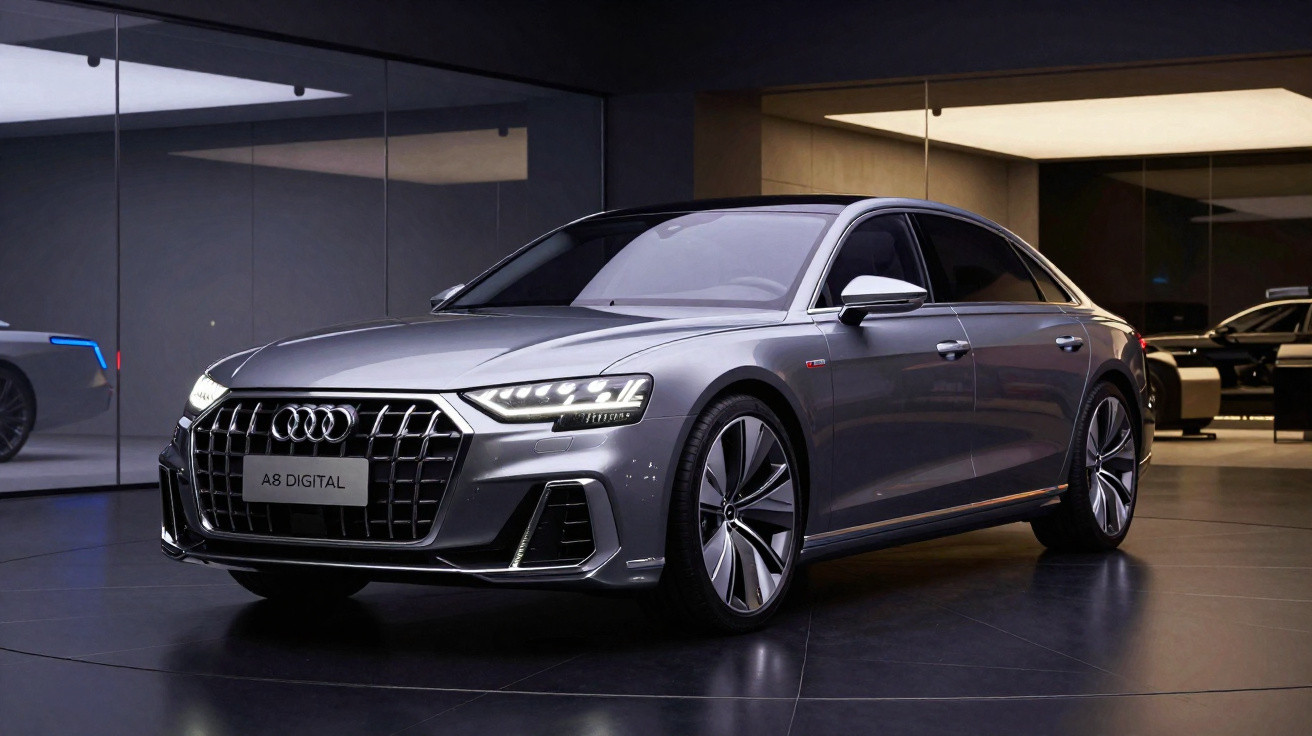
The refreshed Audi A8 is the first model in the brand’s line-up that can be fitted with a fully digital exterior lighting set-up, combining Digital Matrix LED technology for the front headlights with digital OLED rear lights.
From summer 2022, three extra functions using this technology will become available, as outlined by Stephan Berlitz, Audi’s Head of Lighting Development: “advanced traffic information; an illuminated lane with turn indicators on motorways; and an orientation light on secondary roads”.
Those are exactly the three new features we tested after dark in Ingolstadt-Audi’s home city to the north of Munich-where the company’s engineers also talked us through what is coming next.
A brief history
Audi’s digital lighting is another major step in a field that has evolved alongside the car itself since the very beginning.
The first “motor carriages” did not have headlights at all, and when lamps did arrive (towards the end of the 19th century) they were little more than small oil-fed points of light that required you to open a housing, open an acetylene supply valve and strike a match.
The first incandescent electric bulbs appeared shortly before 1920, and the next big leap was made by Hella with the introduction of halogen headlights. “After that we see that the pace of development accelerated, as it did across all industries,” Berlitz explains.
And the timeline backs him up: in 1972 Audi introduced its first twin-headlight applications; in 1994 came its first xenon headlights; in 2008 Full LED (Light Emitting Diode) units arrived; in 2013 the Matrix headlights appeared, followed by Laser lighting a year later; in 2016 it was time for OLED (Organic LED) rear lights; and in 2021 digital light (Digital Matrix LED) made its debut on the updated Audi A8.
Cesar Muntada-a Catalan designer who has lived in Germany for decades and led the system’s design-told me: “In the first Matrix HD systems (on the previous A8 and the Q8), it was only possible to dim a vertical light segment; then we improved this in the next generation by doing it horizontally as well; and now, with Digital Matrix LED, it’s possible to do it at each individual point of light, without having to work in segments. On top of that, it will be possible to see lighting-system updates remotely (over the air) in the near future”.
Let there be light!
After an overview of the developments expected in car lighting over the coming years (more on that later), I set off in an Audi A8 on a night route designed to show what this technological leap adds in terms of visibility.
For the first few kilometres I was slightly disappointed: I could not really sense any difference in the intensity or reach of the beams-let alone spot new functions. A quick call to Audi’s specialists explained why: “It’s still twilight-you need to wait a few more minutes until it’s properly dark”. Fair enough.
And that’s exactly what happened. Once we were on the motorway, the so-called orientation light appeared, shown as dark arrows alongside what Audi calls a “light carpet”, visible on the road surface between the lane markings.
This is particularly helpful when you are driving on a busy motorway or passing through roadworks (which Audi kindly made sure were included on our route), because it keeps the driver’s gaze anchored on the tarmac ahead-on the lane itself-where the light is focused.
Next came the second new function: with the right indicator engaged, I could see the flashing turn signal being projected onto the road surface, reinforcing the message the driver is sending to other road users nearby.
The third new function is designed to help the driver register a hazard ahead more quickly, by projecting an “other hazards” symbol onto the road. In practice, this means the person at the wheel does not even need to take their eyes off the asphalt (the alert can also appear in the instrument cluster or on the infotainment screen) to be made aware of the situation.
More functions
Beyond these new features arriving on the A8 now, Audi’s flagship also offers the rest of the Digital Matrix LED lighting system’s capabilities (an option costing around €1,900), which can be just as-if not more-impressive on secondary roads.
It not only helps you spot pedestrians near the roadside in unlit areas; the digital OLED rear lights (first introduced on the Audi TT RS) also increase their brightness by illuminating all segments when they detect a vehicle (a person or a bicycle) approaching the back of the A8.
What’s more, the owner can select a light signature-via the infotainment system-so the rear lights take on a personalised graphic that effectively becomes a kind of digital identifier.
Above all, night-time driving feels markedly safer thanks to the genuine “bath of light” thrown ahead of the A8 (and even into the forward side areas). This also highlights the much-improved ability to “mask” vehicles travelling towards you or in the same direction-without dazzling their drivers.
In fact, while following an older car with a dated lighting system, I am certain its driver was surprised by the bright illumination in front of their car, which allowed them to see far better (zebra crossings, road signs, and so on). That is because the strong, wide light was actually being emitted by the A8’s headlights behind them, but selectively dimmed around their vehicle and their eyes.
The progress is obvious, and it should translate into greater comfort, less fatigue and improved safety at night.
When I asked Muntada to pinpoint the main user benefits of the new technology, he did not hesitate: “The illuminated areas are much larger than before and, because we can dim pixels, there are many more sections that stay lit even when dimming is taking place. On the other hand, the light/dark transitions are much faster and smoother. And for the drivers of the cars we meet, the dazzling effect is much lower”.
What we can expect over the next few years
In the workshop showcasing what is being developed for the short to medium term, Audi highlighted the possibility of owners using the car’s lights to spend time with games projected onto the ground or onto a wall in front of the vehicle.
These games will be controlled via a personal mobile device working in conjunction with the car’s front headlights, which effectively become video-game projectors.
Less playful and more focused on safety, flexible OLED lights use a flexible substrate that allows them to form three-dimensional structures, sharpening shapes and also enabling them to project illuminated pictograms to the outside world.
That outside world would also benefit from information about different kinds of hazards that might be present a few metres ahead, via signals shown in the rear lights or the rear window.
In this area of communication through digital lighting, there is still a long road ahead: standardisation assumptions and legal frameworks will need to be created so that the messages transmitted can be perceived quickly and accurately.
But Muntada has no doubts that this will be the next big frontier in automotive lighting: “It all comes down to making the world a better place with light, using a human-centred approach and one that, inevitably, will have to be democratised because only then will it deliver global benefits. It will be a difficult task, as it will involve many car makers and legislators, so that pictograms and graphics become immediately recognisable and intuitive. People understand things differently, depending on cultural nuances.
A conversation with Stephan Berlitz, Head of Lighting Systems Development
Razão Automóvel (RA): During the night drive, there were a few drivers I passed who even flashed their lights at me. Does that happen because the colour temperature of Digital Matrix LED (DML) is stronger than normal LED?
Stephan Berlitz (SB): It may have happened because they noticed a different type of light or a larger lit area than usual in front of them, but I can assure you that DML brightness does not cause any dazzling.
RA: When I tried to activate DML on several occasions, I couldn’t, because it wasn’t available. Does the system’s availability depend on speed, the car’s location (if it’s in an urban area, for instance)… or both?
SB: Both, in fact. The navigation system informs the DML system that you are passing through an urban area and, therefore, the system is switched off. A sequence of traffic lights detected by the camera also tells the system that the vehicle is in an urban area. And, below 50 km/h, many functions are not active either (there is no maximum speed limit).
RA: On fast roads I could see the “light carpet” projected ahead and the extension of the stronger illuminated area in an intermittent way, but on secondary roads there’s no “light carpet” or flashing-light effect. Instead, there are 2+2 arrows projected onto the road, reminiscent of augmented-reality arrows… but they seem discreet and hard to distinguish from the asphalt. Is that intentional, or can the user adjust their brightness?
SB: The arrows are very discreet, because it is something that is always moving in front of the car. If it were stronger, its brightness would bother the driver. It is not a warning, it is an assistance light.
RA: On some occasions, I felt the DML light was very strong when it was being reflected by road signs (especially the blue-background ones), to the point that I felt dazzled…
SB: We have already reduced the light intensity by 30% when the system detects a road sign. If we reduce it even further, the camera or the driver (or both) may not see the sign. You have to consider that tonight’s test was done under very good weather conditions: clear sky, full moon…
If it were cloudy and/or rainy, you would probably consider the intensity appropriate. But I even admit you may be right: perhaps the reflection of light off road signs is still too strong, and it’s something we will need to keep assessing.
RA: How will it be possible to bring this technology to smaller, cheaper cars? What kinds of limitations should we expect in terms of packaging and costs?
SB: That is the normal path for any new technology: it appears in the more expensive cars first and then is passed down to lower market segments. We are already thinking about ways to reduce the size of the equipment in the next generations and also about some different functions for digital light-with many pixels, but not the millions of pixels we have in this system.
We do need to reduce the size, yes, but the main functions will be kept (such as the “light carpet”, the orientation, etc.), which means we will use the overall electronic architecture.




Comments
No comments yet. Be the first to comment!
Leave a Comment