
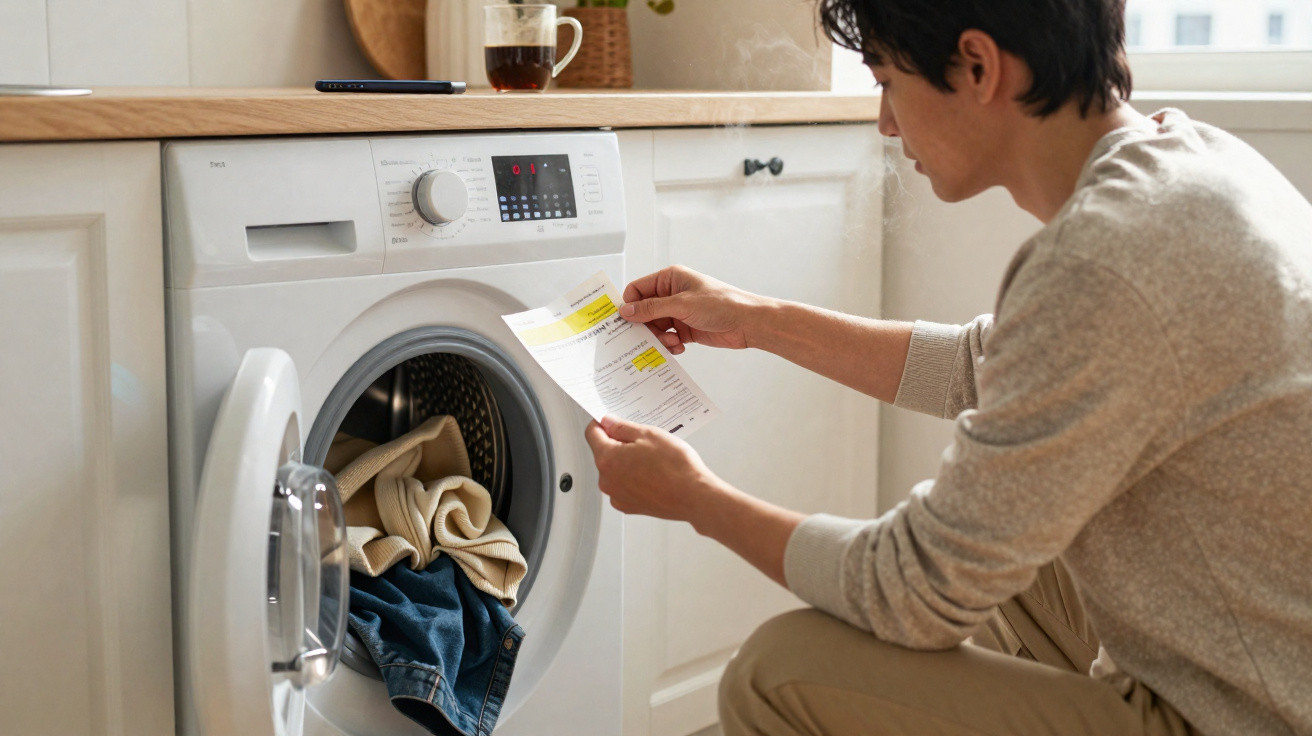
At 10.42pm, I was barefoot on freezing kitchen tiles, watching a blinking screen announce: “24 minutes remaining”… for the third time. Inside, the towels were making that miserable, weighty thud-thud sound: neither dry nor completely soaked, just defeated. I opened the door and squeezed one. It felt exactly like a wet dog that had lost the will to live. Back in it went, I stabbed at the controls and muttered something unsuitable for print.
If that feels even remotely familiar, you are far from the only one. Washing that seems incapable of drying has become one of those low-level modern annoyances, somewhere between rising energy bills and vanishing socks. We blame the weather, the appliance or the general unfairness of the universe. We decide that the dryer is “getting old”, or that this load is “particularly thick this time”, then get on with our evening.
Yet there is often a more modest, dust-covered and, frankly, fairly revolting explanation for why clothes take so long to dry. It is sitting in a filter you may not even realise is there.
The evening my tumble dryer went on strike
The breaking point in our house arrived with a load of school uniform: white shirts, grey trousers and mounting panic. Rain was forecast for the next three days, socks already covered the radiators like tiny distress signals, and the tumble dryer was my final option. I started it, made tea and returned an hour later… only to find every item still damp. Not mildly damp, either. Properly damp enough to cling to your hands.
I put it through a second cycle. Still damp. I switched programmes, selected “Cupboard Dry”, then even tried the baffling “Extra Dry” setting that nobody seems able to explain. By then, the machine sounded like a faraway train in the kitchen, rattling and rumbling as I paced about checking the clock. The energy meter on the wall glowed like an alarm.
Most of us know the feeling of taking out a hoodie that is hot yet somehow remains wet, then looking at it with confusion and a faint sense of betrayal. That was me, holding a partly dry school jumper and trying to understand how it could be warm and utterly unhelpful at once. Somewhere underneath it all, I knew this was not simply “one of those days”. There was a problem, and it was unlikely to sort itself out.
Tumble dryers do not simply “get worse with age”
Many of us cling to a reassuring theory: appliances become weary. They gradually slow down, start puffing and wheezing, and eventually we reluctantly replace them. It suits the broad feeling that nothing is made to last any more. So when drying starts taking longer, it is easy to dismiss it with, “Well, it’s about ten years old.”
But that explanation frequently conceals what is really happening. A properly functioning dryer with unrestricted airflow is essentially a large, carefully managed hairdryer. Air circulates, heat is controlled and moisture is taken away. Restrict that airflow, even a little, and the appliance becomes an inefficient, costly heater that lightly steams your laundry rather than drying it. The drum may turn flawlessly and the display may blink away happily, while inside it behaves like a warm, humid cave.
And honestly, nobody carries out every check every day. We do not religiously remove every bit of debris or inspect each filter and vent. We empty the obvious fluff when the visible screen is overflowing, feel quietly pleased with ourselves and move on. For a while, the dryer lets us get away with it. Then, one night, it stops doing so.
The main lint filter: the one you remember to clean
Most people are familiar with the primary lint filter. It is the approachable one: the small plastic flap inside the door that can be pulled out and swept with a thumb in a moment of modest satisfaction. That grey-blue layer of fluff can almost feel like evidence of a productive household, proof that people are living life, wearing socks and washing clothes.
Cleaning that filter genuinely matters. Once it becomes clogged, the dryer cannot move air as effectively, so it has to run harder and longer. The drum heats up and the clothes become warm, but the moisture hangs around. You can often hear the difference as well: a muted, strained noise rather than the lighter whoosh of freely moving air.
However, even if you are meticulous about the lint screen - removing fluff after every cycle and tapping it against the bin like a veteran - another, more concealed offender may be collecting dust out of view.
The forgotten filter that makes your dryer a sauna
The concealed area almost nobody cleans
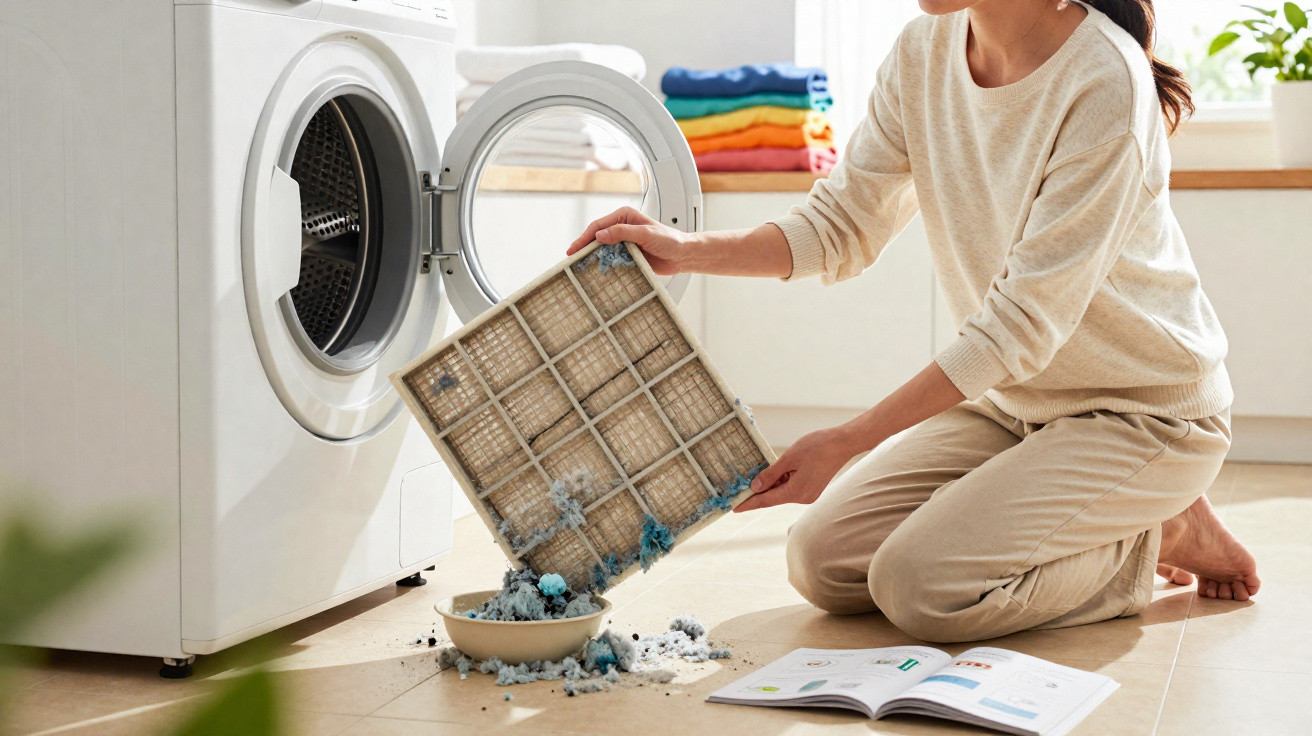
This is the part rarely mentioned when you purchase the appliance, yet it can quietly ruin your drying times: the secondary filter or heat exchanger section. Its precise label varies by model - condenser, pump filter, lower filter or heat exchanger filter - although its purpose is much the same. This is where warm, damp air is condensed into water before the water is sent to a tank or drained away.
In many condenser and heat pump dryers, this mysterious component sits behind a panel at the lower front of the appliance. There may be a small door you have never once opened. On some models, the water tank must be removed before you can even find it. In plenty of UK homes, that panel has remained untouched from installation day onwards, apart from perhaps when a toddler attempted to climb on it.
When I opened mine for the first time, it released a slight dusty puff, rather like the smell at the back of an old cupboard. The plastic grille was covered in a dense, stubborn mat of hair and fluff, speckled with the strange grey dust that every house somehow produces. It resembled lint lasagne far more than a technical component. Suddenly, my poor tumble dryer’s difficulties made perfect sense.
Why this filter makes such a difference
Once the lower filter or heat exchanger is blocked, the dryer cannot remove moisture effectively. It is like attempting to breathe through a scarf. The appliance continues heating, spinning and humming as though it is hard at work… but the steam has nowhere useful to escape. Instead, it remains inside, condenses in unexpected places and leaves your laundry rotating through warm, heavy air.
That is why a cycle that used to last 60 minutes gradually becomes 90, then 120. It also explains why some dryers stop halfway through and stubbornly declare everything dry while your jeans clearly disagree. It is why energy costs can rise without you quite noticing. You are paying to warm up the same trapped moisture repeatedly, rather like using a dehumidifier with every window open.
Cleaning that hidden filter can bring an oddly emotional response. There is a flicker of horror at realising how long it has been in that condition, followed by guilty relief when you see the sheer amount of fluff removed. The dryer was not “getting old”; it had been slowly starved of air.
The gradual arrival of permanently damp laundry
A blocked filter takes more than time and electricity. It can quietly alter the feel of the whole house. When the dryer is underperforming, clothes airers begin appearing everywhere like improvised installations - on a chair, across a door frame, with a towel draped over the stairs. The air becomes heavier and slightly damper, windows steam up more regularly, and bedding can develop a mildly musty smell if you are not careful.
There is an emotional burden, too, to laundry that never feels fully complete. You reach for a pair of jeans only to find the seams are still cold and damp. Towels emerge limp and weary instead of soft and fluffy. Bed linen feels as though it has been dried through a combination of radiators and optimism. Before long, you no longer trust the machine and begin adding “extra time” to every load just to be safe.
Eventually, you are standing where I was: looking at an appliance that used to be useful but now seems like a sulky teenager doing the absolute minimum. You begin entertaining dark thoughts about replacing it. You open a new tab to compare models, then close it as soon as you see the prices.
What genuinely makes clothes dry more quickly
The unglamorous maintenance habits
Here is the part nobody particularly enjoys hearing: dryers work properly only when we show them a little care now and again. This does not mean arranging a full service or calling out an engineer, merely adopting a few small rituals that prevent the machine from slipping into that partly useful, partly pointless state. Most take less time than reading another online thread about “modern machines”.
Emptying the main lint screen after every cycle is the simplest win. A brief sweep with your fingers or an old toothbrush is enough. Every few weeks, thoroughly cleaning the concealed lower filter or heat exchanger can completely change the dryer: rinse it, remove compacted fluff, allow it to dry if the manual instructs you to do so, then fit it back in place. The first cycle afterwards can seem almost miraculous. The drum sounds freer, and the clothes emerge crisp and genuinely dry.
Where the appliance sits matters as well. A dryer crammed into a small cupboard without ventilation will always have a harder time. Leaving a door open, allowing it a little room to breathe and even wiping the rubber door seal where loose fluff gathers are tiny measures, but collectively they help keep the “dry” in tumble dryer.
The understated pleasure of a truly dry towel
There is a surprisingly satisfying moment when you open the dryer and are met by a rush of properly dry, warm air. Not humid or steamy, simply… clean warmth. You pick up a towel and it is light, soft and entirely finished. No uncertainty, no “I’ll just stick it back in for ten minutes”, and no concealed damp corner.
That is what returns when the filters are clear and the appliance can work without struggling for airflow. Those exhausting 90-minute cycles suddenly fall back to something reasonable. You stop wearing partly dry jumpers while claiming they will “finish drying on you”. The house feels marginally less damp and a little more manageable.
It is strangely empowering as well. Rather than feeling controlled by a mysterious box, you know where to investigate when performance begins to slip. What was once a domestic drama becomes a small, practical piece of life admin.
The small, dusty reality most of us ignore
There is a quiet, mildly grubby fact underneath all of this: much domestic irritation lives in places we have never bothered to inspect. That neglected filter is effectively the solid version of “I’ll deal with it later”. We pass it every day, perhaps spill coffee nearby, and never wonder what is happening behind its little flap.
Yet removing a centimetre of grey fluff from a plastic grille can cut 30 minutes from drying time. It can reduce the cost of running the dryer, lower humidity in the home and give exhausted towels the chance to become fluffy again. For one small, dusty and slightly unpleasant task, that is a respectable return.
So, when laundry starts taking mysteriously longer to dry, do not only blame the weather or decide that the appliance is finished. Get down to floor level, open the little panel you have ignored for years and meet the forgotten filter that has quietly restricted your dryer. Your future self - standing in a warm kitchen at 10.42pm and taking out clothes that are actually dry - will feel strangely and profoundly grateful.



Comments
No comments yet. Be the first to comment!
Leave a Comment